Tejasvi Surya Applauds Modi for Pioneering Women’s Quota by 2029
Synopsis
BJP MP Tejasvi Surya commends PM Modi's commitment to implement a women’s quota by 2029, marking a significant step toward empowering women in Indian politics. This initiative promises a transformative shift in representation and policy-making.
Key Takeaways
Women's Quota by 2029: PM Modi’s government aims to implement a women's quota by 2029.
Historical Significance: The women's reservation bill has a complex history of delays and opposition.
Nari Shakti's Representation: The initiative focuses on enhancing women's visibility and voice in politics.
Delimitation Impact: Automatic delimitation post-2027 Census could benefit states like Kerala.
BJP's Role: The BJP is positioned as a champion of women's rights in this legislative move.
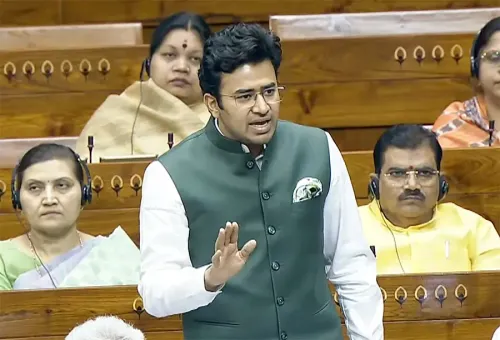
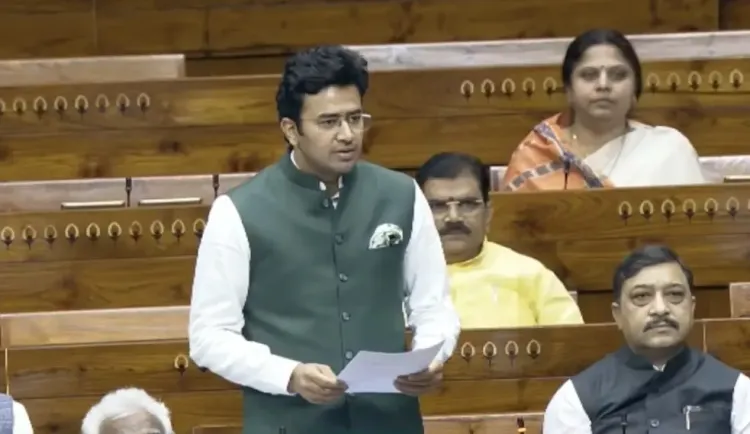
New Delhi, April 16 (NationPress) Tejasvi Surya, the BJP Member of Parliament representing Bengaluru South, praised Prime Minister Narendra Modi's ambition to expedite the women’s quota by 2029, describing it as a revolutionary chapter that offers Nari Shakti a real role in the politics of nation-building.
During a Lok Sabha debate on the Constitution (One Hundred and Thirty-First Amendment) Bill, 2026, which focuses on women's reservation and facilitates delimitation, Surya noted that women in India have awaited their rightful share in policy-making for three decades.
He expressed that the introduction of three significant bills by PM Modi's government will not only hasten the enactment of the women's reservation bill effective from 2029, but also initiate a new phase in India's development journey.
Surya emphasized that this initiative will grant the Nari Shakti of the nation a credible, vocal, visible, and substantial representation in political affairs. As the head of the Bharatiya Janata Yuva Morcha, he thanked the Prime Minister for these historic bills on behalf of all women in India, asserting that the legislation will “accelerate and catalyze” women’s political participation.
Reflecting on the women's reservation bill, which has a history dating back to 1996, Surya pointed out the numerous challenges it faced, including multiple blockages over the years. He remarked, “The bill was introduced at least six times previously, only to be thwarted by various parties, particularly those now in the opposition, who ensured it remained unpassed.”
He specifically criticized the Samajwadi Party and the Rashtriya Janata Dal, recalling that during previous administrations, a leader from these parties famously tore the bill in Parliament, claiming it would only pass over his dead body.
“The nation remembers their fierce opposition to the women's reservation bill, which has been stalled for 30 years,” Surya reiterated, attributing the passage of the Nari Shakti Vandan Adhiniyam solely to PM Modi and the BJP's efforts.
He also discussed the automatic delimitation triggered by the upcoming 2027 Census, which will allow for the redistribution of the 543 Lok Sabha seats among states and union territories, potentially increasing to 850.
Surya illustrated this with Kerala, stating that if the women's quota is enacted without delimitation, the number of Lok Sabha seats for the state would decrease from 20 to 14, affecting leaders like K.C. Venugopal. By supporting delimitation, PM Modi ensures that Kerala retains its six seats, and he projected that the state could gain 10 seats if delimitation occurs after the 2027 Census.
“Implementing the women’s reservation based on any earlier Census could result in Kerala losing 5-6 seats,” he concluded, labeling the introduction of these three bills as the most favorable proposal.
Point of View
It is evident that the proposed women's reservation initiative, championed by PM Modi and supported by Tejasvi Surya, represents a significant shift in political representation in India. This development, which aims to enhance women's participation in governance, showcases a commitment to inclusivity in national policy-making.
NationPress
15 Oct 2026
Frequently Asked Questions
What is the objective of the women's quota proposed by Tejasvi Surya?
The women's quota aims to ensure greater representation of women in Indian politics by implementing a reservation system effective from 2029.
Why has the women's reservation bill faced delays in the past?
The bill has faced multiple blockages due to political opposition and various parties preventing its passage over the past 30 years.
What are the anticipated benefits of delimitation after the 2027 Census?
Delimitation is expected to allow for a fair redistribution of Lok Sabha seats, potentially increasing representation while ensuring that states like Kerala do not lose their existing seats.
How does Tejasvi Surya view the role of PM Modi in this initiative?
Surya credits PM Modi with being instrumental in passing the women's reservation bill and believes it marks a significant step forward for women in governance.
What historical context surrounds the women's reservation bill?
The women's reservation bill was first introduced in 1996 and has faced numerous challenges, including being blocked multiple times by opposition parties.