Telangana CM Calls for Southern Unity Against Centre's Pro Rata Plan
Synopsis
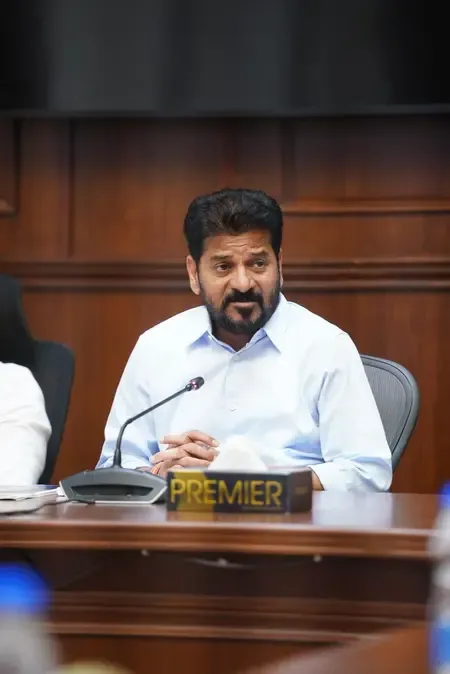
Telangana's Chief Minister, A. Revanth Reddy, appeals to southern states and Puducherry to unite against the Centre's proposed 'pro rata model' for Lok Sabha seat allocation, warning of severe repercussions for southern interests.
Key Takeaways
Revanth Reddy advocates for unity among southern states against the Centre's pro rata proposal.
The pro rata model could exacerbate political inequalities among states.
A hybrid model is suggested to balance representation based on economic contributions .
Financial injustices compound the issue, reflecting a broader South-North divide .
Collective action is deemed essential to preserve political equity .
Hyderabad, April 14 (NationPress) The Chief Minister of Telangana, A. Revanth Reddy, called on his fellow leaders from other southern states and the Union Territory of Puducherry to stand together against the Centre's initiative to implement a 'pro rata model' for increasing Lok Sabha seats. He warned that this move could be extremely detrimental and harmful to the interests of southern states.
In a series of letters addressed to the Chief Ministers of Andhra Pradesh, Tamil Nadu, Karnataka, Kerala, and Puducherry, Revanth Reddy expressed his grave concerns regarding the proposed increase in Lok Sabha seats through the pro rata method, highlighting that this has significant implications for southern states and disrupts the federal balance of the nation.
The Chief Minister pointed out the urgent need for collaborative efforts among southern states and other like-minded regions to ensure their voices are effectively represented at the national level.
He clarified that women's reservations, national delimitation, and the increment of Lok Sabha seats should be viewed as separate issues, which are being intentionally conflated to confuse the public.
Revanth Reddy asserted that those advocating for the Women's Reservation Bill (unrelated to the increase of seats) or delimitations are primarily interested in altering the boundaries of Assembly constituencies within their states.
"The real contentious issue lies in the proposal to raise the number of Lok Sabha seats to 850 using a pro rata approach. We must categorically oppose this increase based on such a model," Revanth Reddy stated.
He elaborated on how the pro-rata model's arithmetic changes the political power dynamics between states.
"While all states may experience an increase in the total number of seats, the relative gap between them will significantly widen. For example, Andhra Pradesh currently holds 25 Lok Sabha seats, while Uttar Pradesh has 80—a gap of 55 seats. Under the proposed model, Andhra Pradesh's seats will rise to approximately 38, while Uttar Pradesh will expand to 120 seats, widening the gap to 82 seats, thereby exacerbating the representation imbalance," the Telangana CM noted in his letter to Andhra Pradesh's Chief Minister, N. Chandrababu Naidu.
In his correspondence with Tamil Nadu's Chief Minister Stalin, he pointed out: "According to the proposed model, Lok Sabha seats for Tamil Nadu and Puducherry combined may grow from 40 to around 60, in contrast to Uttar Pradesh's increase to about 120 seats, which expands the gap from 40 to 60 seats."
In a letter to Karnataka's CM Siddaramaiah, he indicated: "Under the proposed framework, Karnataka's Lok Sabha seats will increase from 28 to about 42, while Uttar Pradesh's will rise to 120 seats, thus widening the gap from 52 to 78 seats."
He also explained how the proposed model would escalate the political divide between Kerala and Uttar Pradesh from 60 seats to 90 seats.
"Thus, the pro rata method effectively undermines the representation and influence of your state in Parliament, even as its contributions to the nation continue to grow," the letters stated.
The Telangana Chief Minister underscored the substantial investments southern states have made in population stabilization, public health, education, and economic development, significantly contributing to India's growth narrative.
"However, under a population or pro rata framework, these achievements become irrelevant in determining political representation. This approach risks systematically diluting the political voice of southern states. As representation increasingly favors regions with higher population growth, national policy priorities could be shaped without adequate input from states that have led the way in economic and social progress. A model that disregards such contributions could foster perceptions of inequity that may have long-term repercussions for national unity. Currently, our states face structural disadvantages and political disenfranchisement. The implications of a pro rata model extend beyond statistical adjustments; they signify a fundamental shift in political power," Revanth Reddy articulated.
He also pointed out ongoing financial injustices, highlighting disparities in financial devolutions, where states like Bihar receive significantly more per rupee contributed than Andhra Pradesh, which only receives 63 paisa for the same tax contribution. This serves as an example of the longstanding South-North divide. With the proposed changes in Lok Sabha seats, the southern states will face not only financial injustices but also political inequities. Consequently, states contributing significantly to the national economy will see their voices diminished in Parliament, while states in the northern-central belt with higher population growth will benefit disproportionately. This situation translates into a reality where progress is penalized, and demographic expansion is rewarded," he expressed in his letter to Chandrababu Naidu.
In his letters to other Chief Ministers, he emphasized their respective states' contributions and the disparity in support from the Centre, particularly when compared to Bihar.
Proposing a balanced alternative hybrid model to ensure fair representation based on contributions, Revanth Reddy remarked that it could serve as an optimal solution.
"Given that they plan to increase Lok Sabha seats from 543 to 850, we advocate that only half of the newly added seats should be allocated via the pro-rata model, while the remaining half must be distributed based on economic contributions and other performance metrics. This is merely one suggestion, a potential approach," he noted.
"Let us unite to initiate a coordinated effort to tackle this issue. India's strength is rooted in its diversity, and equitable representation across all regions is essential. It is our shared duty to maintain this balance," he concluded.
Frequently Asked Questions
What is the pro rata model?
The pro rata model is a method proposed by the Centre to increase Lok Sabha seats based on the population, which could disproportionately affect representation from different states.
Why is the Telangana CM opposing this model?
A. Revanth Reddy believes the pro rata model will harm southern states' political representation and widen the existing disparities among states.
What are the implications of this proposal?
The proposal could lead to a significant imbalance in political representation, favoring states with higher population growth and undermining the voice of economically progressive southern states.
What alternative model is being suggested?
Revanth Reddy suggests a hybrid model that allocates half of the new seats based on the pro rata method and half based on economic contributions and performance metrics.
How are financial injustices related to this issue?
The CM highlights disparities in financial devolutions, where certain states receive disproportionately more than southern states, exacerbating the concerns over political representation.