Anurag Thakur Questions Congress Stand on Vande Mataram
Synopsis
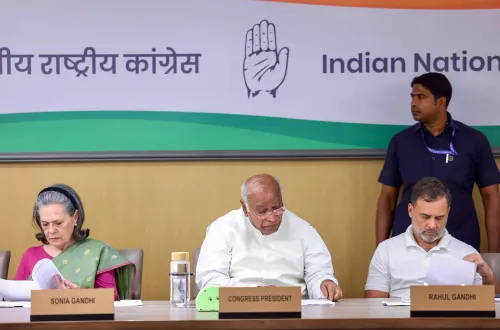
BJP MP Anurag Thakur has publicly challenged Congress and its allies over their stance on Vande Mataram, reviving a debate rooted in a 1937 Congress resolution that restricted the song's public singing — a fault line that has defined India's culture wars ever since.
Key Takeaways
Anurag Thakur , BJP Lok Sabha MP from Hamirpur, Himachal Pradesh , posted on 29 July 2026 questioning Congress's opposition to Vande Mataram.
Vande Mataram was written by Bankim Chandra Chatterjee in 1882 and became a central anthem of India's independence movement.
In 1937 , the Indian National Congress passed a resolution limiting public singing to the song's first two stanzas, citing concerns from Muslim members over later stanzas' religious imagery.
The Constituent Assembly adopted Vande Mataram as India's national song on 24 January 1950 , distinct from the national anthem Jana Gana Mana .
BJP leaders have routinely used Congress's historical stance on the song to frame the opposition as ambivalent toward national symbols and Hindu cultural heritage.
A song that helped fuel India's independence movement is once again at the centre of political fire. BJP MP Anurag Thakur on Wednesday, 29 July 2026, posted a sharp question on X directed at the opposition: why do Congress and its allies oppose Vande Mataram?
The post, in Hindi, reads: 'Kांग्रेस और उसके सहयोगी दल आख़िर वande मातरम् का विरोध क्यों करते हैं?' — 'Why do Congress and its allied parties ultimately oppose Vande Mataram?' The question is short. The history behind it is anything but.
A song, a split, and a 1937 resolution
Vande Mataram was composed by Bankim Chandra Chatterjee and first appeared in his 1882 novel Anandamath. It became a rallying cry of the independence movement — sung at protests, carried into prisons, chanted at the gallows. But even then, the song carried contested ground.
In 1937, the Indian National Congress passed a resolution restricting the singing of Vande Mataram to only its first two stanzas at public events. The move came after objections from some Muslim members who found the later stanzas — invoking the goddess Durga — religiously uncomfortable. Congress framed it as accommodation; critics framed it as capitulation. That fault line has never fully closed.
National song, national anthem — and the distinction that matters
On 24 January 1950, the Constituent Assembly of India gave Vande Mataram its formal standing: adopted as the national song, with Jana Gana Mana designated the national anthem. The distinction is constitutional, not casual. The national anthem carries legal obligation; the national song carries moral weight — and that ambiguity is precisely where the politics lives.
BJP leaders have repeatedly used that ambiguity as a cudgel, arguing that Congress's historical reluctance to sing the full song in the 1930s and 1940s reflects a deeper ambivalence toward Hindu cultural symbols. Congress has countered that the 1937 resolution was an act of inclusive statecraft, not disrespect. Neither side has moved much since.
Thakur's post and the recurring cultural battleground
Thakur, a former Union Minister of Information and Broadcasting and a reliably sharp voice in the BJP's culture-war repertoire, frames the question as self-evident — as if the answer indicts the opposition simply by being asked. The post carries a video, suggesting a fuller argument is packaged inside, though the specific trigger for the July 2026 timing is not independently established.
What is established is the pattern: questions about national symbols — the flag, the anthem, the song — are perennial instruments in India's political theatre, surfacing with particular intensity ahead of elections, during parliamentary sessions, or whenever the ruling party wants to shift the frame of debate toward identity and loyalty.
The song that once united a nation against colonial rule now divides it along lines of nationalism and secularism. Eighty-nine years after the Congress resolution and seventy-six years after constitutional adoption, Vande Mataram is still being argued over — and that, in itself, tells you everything about where Indian politics stands.
Point of View
Making it a durable weapon. For Congress, any response risks either alienating secular coalition partners or appearing to validate the BJP's framing — a no-win trap that the party has struggled to escape for decades. The exchange reflects a broader BJP strategy of contesting cultural legitimacy alongside electoral ground, treating national symbols as a second front in the permanent campaign.
NationPress
13 Sept 2026
Frequently Asked Questions
Why did Congress oppose Vande Mataram?
Congress did not oppose Vande Mataram outright but passed a 1937 resolution restricting its public singing to the first two stanzas, responding to objections from some Muslim members who found later stanzas — invoking the goddess Durga — religiously problematic.
Is Vande Mataram India's national anthem?
No. Jana Gana Mana is India's national anthem. Vande Mataram was adopted as India's national song by the Constituent Assembly on 24 January 1950 — a distinct and non-mandatory designation.
Who wrote Vande Mataram?
Bankim Chandra Chatterjee wrote Vande Mataram, which first appeared in his 1882 Bengali novel Anandamath . It became a rallying song during India's independence movement.
What did Anurag Thakur post about Vande Mataram?
On 29 July 2026 , BJP MP Anurag Thakur posted on X asking why Congress and its allied parties oppose Vande Mataram, reigniting a long-running debate about the national song and political attitudes toward national symbols.
Why is Vande Mataram controversial in Indian politics?
The controversy stems from a 1937 Congress resolution that limited the song's public singing, seen by BJP as evidence of Congress ambivalence toward Hindu cultural symbols. The debate reflects a deeper tension between nationalism and secularism in post-independence India.