Tamil Nadu to launch VB-G RAM G from July 1 despite ₹3,034 crore state burden

Synopsis
Tamil Nadu is pressing ahead with the Centre's revamped rural employment scheme from 1 July — even as it faces an annual fiscal hit of up to ₹5,000 crore under a new 60:40 cost-share and objects to a 60-day work restriction in select districts. The state's decision to proceed despite unresolved concerns tests how far federalism bends under fiscal pressure.
Key Takeaways
Tamil Nadu will launch the revamped VB-G RAM G scheme from 1 July across rural districts.
The 60:40 cost-sharing formula requires the state to contribute ₹3,034.19 crore in the remaining nine months of the current financial year.
Annual state commitment is projected at ₹4,500–₹5,000 crore , a significant increase over the earlier arrangement.
The Centre has allocated ₹7,585.49 crore for Tamil Nadu under the revised structure.
Tamil Nadu has raised concerns over a 60-day restriction on employment works in selected districts, citing misalignment with local agricultural cycles.
Administrative preparations are underway for a smooth district-level rollout from 1 July .
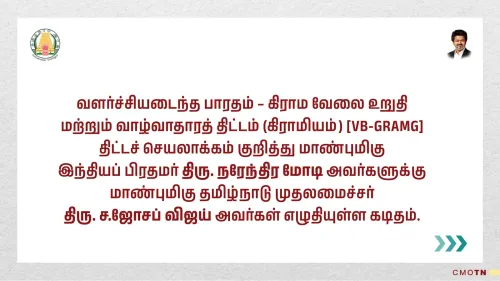
Tamil Nadu has resolved to roll out the Centre's revamped Viksit Bharat Guarantee for Rozgar and Ajeevika Mission (VB-G RAM G) from 1 July, even as the state faces a substantially higher fiscal outlay under the revised cost-sharing framework. The decision, confirmed by senior officials, comes despite formal reservations over both the financial structure and certain operational restrictions embedded in the new guidelines.
The Funding Structure
The revamped scheme operates on a 60:40 cost-sharing formula, with the Union government bearing 60 per cent of expenditure and the state absorbing the remaining 40 per cent. The Centre has allocated ₹7,585.49 crore for Tamil Nadu under this arrangement.
For the remaining nine months of the current financial year, Tamil Nadu will be required to contribute ₹3,034.19 crore. On an annualised basis, the state's financial commitment is expected to range between ₹4,500 crore and ₹5,000 crore — a marked increase over its obligations under the earlier funding pattern, according to officials.
What Has Changed From Earlier Arrangements
Officials acknowledged that the revised funding pattern represents a significant departure from the previous structure, under which the state's share was considerably lower. Tamil Nadu has, in the past, raised concerns with the Union government over changes to the financing of Centrally sponsored rural employment programmes, particularly regarding their impact on state finances.
This comes amid a broader national pattern of the Centre recalibrating cost-sharing ratios on flagship welfare schemes — a shift that has drawn pushback from several non-Bharatiya Janata Party (BJP)-governed states, who argue it disproportionately burdens states with larger rural populations.
Operational Reservations
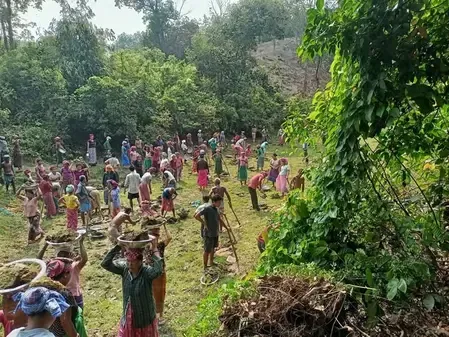
Beyond the fiscal implications, Tamil Nadu has also flagged concerns over specific operational provisions in the revised scheme guidelines. Officials pointed out that restrictions on undertaking employment-related works for up to 60 days in selected districts could adversely affect rural livelihoods and curtail employment opportunities during critical periods.
They argued that such restrictions may not adequately account for local agricultural cycles and seasonal employment patterns, especially in districts where farming calendars diverge from national averages. The state has not indicated whether it will seek a formal exemption or modification on this point.
Tamil Nadu's Track Record and Commitment
According to officials, Tamil Nadu has consistently ranked among the leading states in implementing rural employment and livelihood programmes over the past two decades. The government has stated it remains committed to sustaining rural employment and livelihood generation while adapting to the new framework introduced by the Centre.
Administrative preparations are currently underway, with departments coordinating implementation plans to ensure a smooth launch across rural Tamil Nadu from 1 July.
What Comes Next
With the rollout date confirmed, the immediate focus shifts to operational readiness at the district level. Whether Tamil Nadu formally escalates its reservations on the 60-day work restriction — or absorbs the fiscal burden without further negotiation — will be closely watched as implementation begins.
Point of View
Opposition-governed states: refuse a Central scheme and absorb the political cost of denying rural benefits, or accept terms that strain the state exchequer. The 60:40 ratio is not new in principle, but its application to a scheme of this scale — with an annualised burden of up to ₹5,000 crore — is a material shift. The 60-day work restriction concern is the more substantive governance issue: if it cuts off employment during sowing or harvest windows, the scheme's own livelihood mandate is undermined. That tension between Centre-designed operational rules and ground-level agricultural reality is a structural flaw the state has flagged but not yet resolved.
NationPress
21 Sept 2026
Frequently Asked Questions
What is the VB-G RAM G scheme being launched in Tamil Nadu?
The Viksit Bharat Guarantee for Rozgar and Ajeevika Mission (VB-G RAM G) is a revamped Central rural employment and livelihood scheme being rolled out from 1 July. Tamil Nadu will implement it under a 60:40 cost-sharing arrangement, with the Centre contributing 60 per cent and the state 40 per cent.
How much will Tamil Nadu have to spend on VB-G RAM G?
Tamil Nadu must contribute ₹3,034.19 crore during the remaining nine months of the current financial year. On an annual basis, the state's share is expected to range between ₹4,500 crore and ₹5,000 crore under the revised funding structure.
Why has Tamil Nadu raised concerns about the scheme despite agreeing to implement it?
The state has flagged two issues: a significantly higher financial burden compared to the earlier arrangement, and an operational restriction that bars employment-related works for up to 60 days in selected districts. Officials argue the restriction may not align with local farming cycles and could harm rural livelihoods during critical periods.
How much has the Centre allocated for Tamil Nadu under VB-G RAM G?
The Union government has allocated ₹7,585.49 crore for Tamil Nadu under the revamped scheme, with the state required to match this with its 40 per cent share.
When will VB-G RAM G begin in Tamil Nadu and what is the current status of preparations?
The scheme is set to launch on 1 July. Administrative preparations are underway, with state departments coordinating implementation plans and operational arrangements for a district-level rollout across rural Tamil Nadu.