Uttarakhand becomes India's sixth fully literate state under CM Dhami
Synopsis
Uttarakhand has been declared India's sixth fully literate state, with the Chief Minister's Office crediting CM Pushkar Singh Dhami's leadership on 11 July 2026. The milestone follows sustained school-enrolment and adult-literacy drives aligned with the National Education Policy 2020 and the ULLAS scheme.
Key Takeaways
Uttarakhand has been declared the sixth fully literate state in India as of 11 July 2026 .
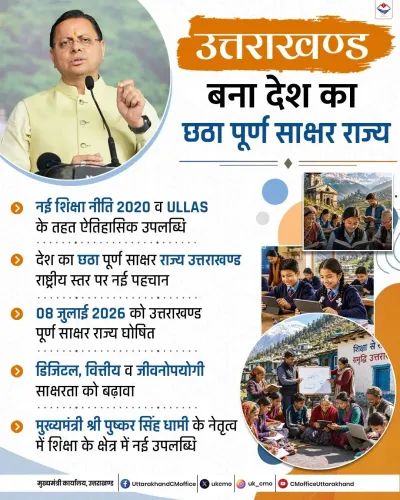
The announcement was made by the Chief Minister's Office of Uttarakhand via an official post on X.
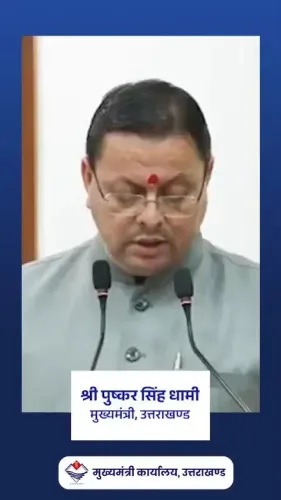
The achievement is attributed to the education initiatives pursued under Chief Minister Pushkar Singh Dhami , who has been in office since 2021 .
The milestone builds on India's National Literacy Mission (1988) and aligns with the National Education Policy 2020 and the ULLAS adult-education scheme .
Earlier states to achieve full-literacy status include Kerala and Mizoram , among others.
The declaration is expected to improve Uttarakhand's human-development index ranking and strengthen eligibility for additional central education funding.
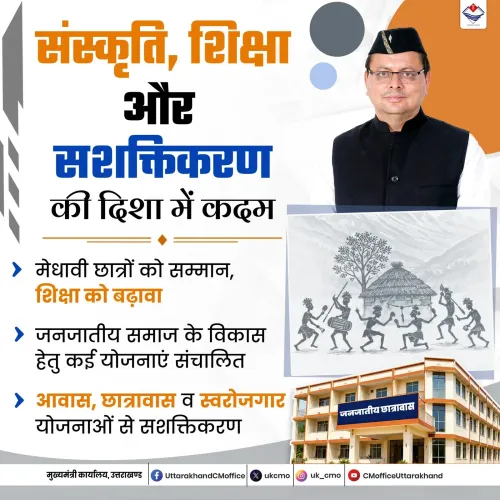
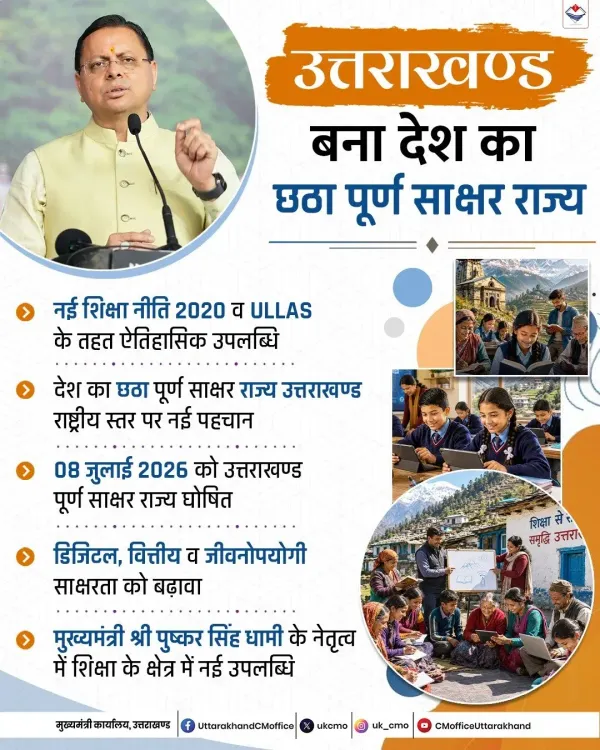
The Chief Minister's Office of Uttarakhand announced on Saturday, 11 July 2026 that the state has achieved full literacy status, becoming the sixth fully literate state in India — a milestone attributed to the leadership of Chief Minister Pushkar Singh Dhami.
Context
The official post from the Chief Minister's Office declared: 'Mukhyamantri Shri Pushkar Singh Dhami ke netritva mein shiksha ke kshetra mein nayi uplabdhi, desh ka chhatha poorn sakshar rajya bana Uttarakhand' — ('A new achievement in education under the leadership of Chief Minister Shri Pushkar Singh Dhami: Uttarakhand has become the sixth fully literate state in the country.')
The declaration places Uttarakhand in a select group of Indian states that have crossed the full-literacy threshold, a benchmark that combines near-universal school enrolment with measurable adult literacy rates across the population.
Policy Backdrop
India's literacy drive has a long institutional history, rooted in the National Literacy Mission launched in 1988, which established the framework for state-level total-literacy campaigns. Successive programmes built on that foundation, targeting out-of-school adults and marginalised communities.
The most recent national push is the ULLAS (Understanding Lifelong Learning for All in Society) adult-education scheme, which aligns with the literacy and foundational-learning goals embedded in the National Education Policy 2020. Uttarakhand's declaration fits squarely within this national arc, following the trail blazed by Kerala, Mizoram, and other states that achieved the milestone through sustained enrolment and community-education drives.
Uttarakhand, formed as a separate state in 2000, has historically emphasised access to schooling given its dispersed hill geography, where reaching remote villages requires dedicated outreach rather than standard urban-centric approaches.
Stakeholders and Impact
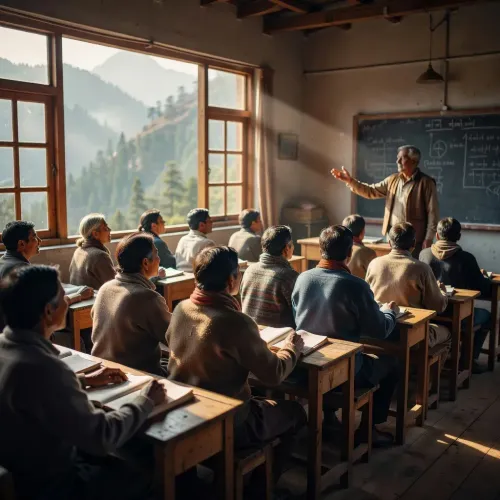
The beneficiaries of this achievement span two broad groups: school-age children, whose enrolment and retention rates have been central to the state's education strategy, and adult learners, particularly women and older residents in rural and hill districts who were targeted by literacy camps and community programmes.
Full-literacy status carries practical consequences beyond a symbolic declaration — it can unlock additional central funding, improve the state's human-development index ranking, and strengthen the case for higher-education investment in a state that already hosts several prominent universities and technical institutions.
For CM Dhami, who has been in office since 2021, the announcement reinforces his administration's positioning on governance delivery ahead of future electoral cycles in the state.
What's Next
Attention will now turn to whether the full-literacy declaration is backed by a formal central government certification and what benchmarks were used to define 'full literacy' in this context. Observers will also watch for ULLAS scheme rollout updates in Uttarakhand and announcements from other aspirant states working toward similar milestones.
The broader national goal of achieving universal foundational literacy by 2030 — in line with Sustainable Development Goal 4 — means Uttarakhand's achievement will likely be cited as a model for other hill and north-eastern states still working toward the threshold.
Point of View
Translating a long-running national policy agenda into a state-level headline achievement. The timing — mid-term in the electoral cycle — suggests a deliberate effort to consolidate the BJP government's development narrative in a state where hill-district welfare and education access have historically been vote-sensitive issues. Fitting within a broader pattern of hill and north-eastern states reaching literacy milestones, the announcement also serves as indirect pressure on larger, more populous states that have yet to cross the threshold. Whether the declaration is backed by a rigorous, centrally verified methodology will determine how durable the political dividend proves to be.
NationPress
11 Jul 2026
Frequently Asked Questions
Which are the fully literate states in India?
As of July 2026, Uttarakhand has been declared the sixth fully literate state in India. Earlier states to achieve this status include Kerala and Mizoram, among others, through sustained literacy campaigns and school-enrolment drives.
What does full literacy status mean for an Indian state?
Full literacy status means a state has achieved near-universal literacy across its population — covering both school-age children and adults — as measured by enrolment, retention, and adult-education benchmarks set under national schemes.
What is the ULLAS scheme in India?
ULLAS (Understanding Lifelong Learning for All in Society) is a central government adult-education scheme aligned with the National Education Policy 2020. It targets out-of-school adults and aims to achieve foundational literacy and life skills across all age groups.
What is Pushkar Singh Dhami's role in Uttarakhand's literacy achievement?
Pushkar Singh Dhami is the Chief Minister of Uttarakhand since 2021. The Chief Minister's Office credited his leadership with driving the education initiatives — including school enrolment and adult literacy programmes — that led to the state being declared fully literate.
When was Uttarakhand declared a fully literate state?
Uttarakhand was declared a fully literate state on 11 July 2026, according to an announcement by the official Chief Minister's Office of Uttarakhand on X.