Uttarakhand CMO: Trout Farming Is Now a Major Self-Employment Driver
Synopsis
The Chief Minister's Office of Uttarakhand on 25 May 2026 spotlighted trout farming as a growing self-employment avenue for hill communities, aligning with the central government's Pradhan Mantri Matsya Sampada Yojana and the state's push to curb rural out-migration through high-value cold-water aquaculture.
Key Takeaways
The Chief Minister's Office of Uttarakhand declared on 25 May 2026 that trout farming has become a major medium of self-employment in the state.
Uttarakhand's glacial rivers and streams provide near-ideal conditions for cold-water trout aquaculture, lowering infrastructure costs for small farmers.
The Pradhan Mantri Matsya Sampada Yojana , launched in 2020 , provides the national policy and funding backbone for the state's trout farming push.
Rural youth, hill farmers, and women-led self-help groups are the primary target beneficiaries of trout rearing schemes.
Trout commands premium prices in urban markets and the tourism hospitality sector, making it a high-value diversification crop for hill communities.
State fisheries production and employment data for 2025-26 will be a key indicator of the sector's actual scale and reach.
The Chief Minister's Office of Uttarakhand on Monday, 25 May 2026 highlighted trout farming as an emerging engine of self-employment across the hill state, underscoring the government's push to channel rural youth and farmers toward high-value cold-water aquaculture.
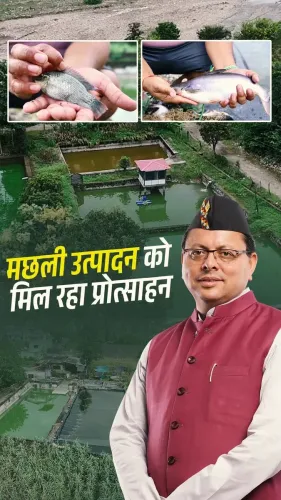
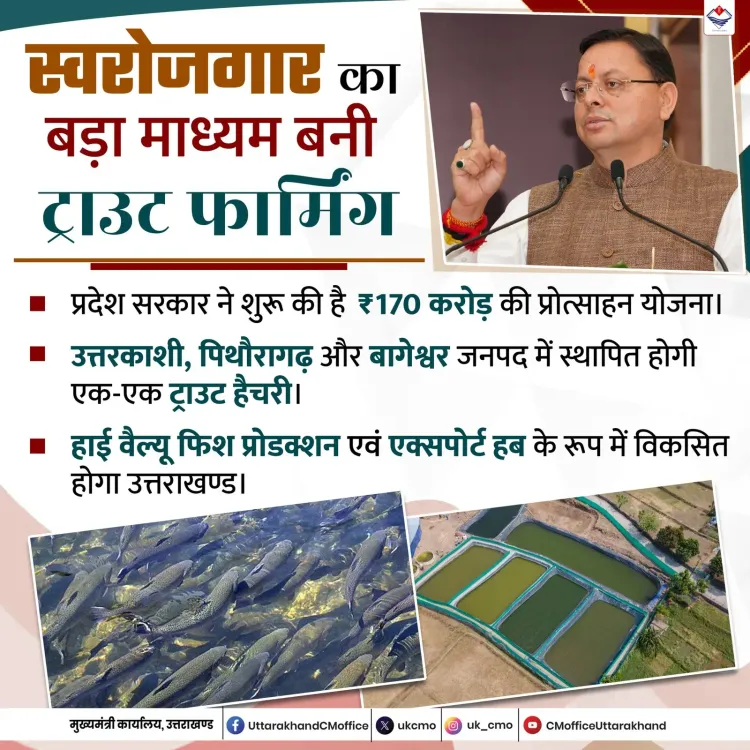
The post, shared from the official CMO account, stated in Hindi: 'Pradesh mein swarozgar ka bada madhyam bani Trout Farming' ('Trout farming has become a major medium of self-employment in the state'). The message was accompanied by an image, reinforcing the administration's effort to spotlight allied agricultural sectors as viable livelihoods in Uttarakhand's mountainous terrain.
Context
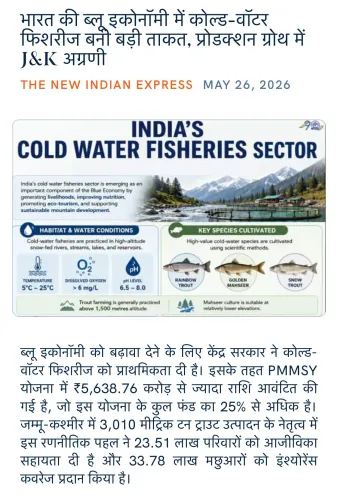
Uttarakhand is uniquely positioned for cold-water fisheries. Its extensive network of Himalayan rivers and streams — fed by glacial and snowmelt water — provides near-ideal conditions for rainbow trout and brown trout cultivation. Unlike plains-based aquaculture, trout farming in the hills requires lower capital infrastructure for water sourcing, making it accessible to small and marginal farmers who have historically depended on subsistence agriculture. The state's fisheries department has, over successive years, promoted trout rearing units in districts such as Uttarkashi, Chamoli, Tehri, and Pithoragarh — areas where alternative income streams are critical given the limited arable flatland and high rates of rural out-migration.Policy Backdrop
The broader national framework underpinning this push is the Pradhan Mantri Matsya Sampada Yojana (PMMSY), launched in 2020 by the central government to modernise fisheries and aquaculture across India. The scheme integrates cold-water fisheries — a category in which Himalayan states like Uttarakhand are natural leaders — into India's larger Blue Economy strategy. Under Chief Minister Pushkar Singh Dhami, the state administration has consistently aligned its self-employment messaging with central schemes, framing trout farming not merely as an agricultural activity but as an entrepreneurship opportunity for hill communities. Subsidies on hatchery units, feed, and rearing tanks have been part of the state's fisheries promotion toolkit, channelling PMMSY funds toward individual beneficiaries in remote valleys.Stakeholders and Impact
The primary beneficiaries of trout farming expansion are rural youth and hill farmers seeking income diversification. Trout commands a premium price in domestic urban markets and in the tourism economy that sustains hill towns — hotels, resorts, and restaurants in destinations like Mussoorie, Rishikesh, and Auli are natural consumers of locally farmed trout. For women-led self-help groups and small entrepreneurs, rearing units can be established on modest plots adjacent to natural water channels, lowering the barrier to entry compared with other forms of livestock or horticulture. The CMO's public communication signals that the government views this sector as a replicable model for reducing dependence on government employment and reversing migration from hill districts.What's Next
The state fisheries department's production and employment data for 2025-26 is expected to provide a clearer picture of how many beneficiaries have been enrolled under trout farming schemes and what contribution the sector is making to rural incomes. Any new hatchery subsidies or farm-support announcements in the upcoming budget cycle will be closely watched by stakeholders in the hill agriculture sector. If trout farming continues on its current policy trajectory, Uttarakhand could position itself as the benchmark Himalayan state for cold-water aquaculture — a model potentially replicable in Himachal Pradesh, Jammu and Kashmir, and the Northeast as national Blue Economy priorities deepen.Point of View
Which fits the Dhami administration's broader self-reliance narrative. By anchoring trout farming to self-employment, the government is also implicitly addressing Uttarakhand's chronic rural out-migration problem, a politically sensitive issue in hill constituencies. The timing, ahead of any potential fisheries budget announcement, suggests the post may be laying public groundwork for a new subsidy or scheme rollout. More broadly, it reflects a pan-Himalayan policy trend of treating cold-water fisheries as a climate-resilient, high-value alternative to fragile hill agriculture.
NationPress
10 Oct 2026
Frequently Asked Questions
What is trout farming and why is it important for Uttarakhand?
Trout farming is the controlled cultivation of trout fish in cold, fast-flowing water channels. Uttarakhand's Himalayan rivers and streams provide ideal natural conditions, making it a cost-effective and high-value livelihood option for hill farmers and rural youth.
How does the government support trout farming in Uttarakhand?
The central government's Pradhan Mantri Matsya Sampada Yojana , launched in 2020, funds hatchery units, feed, and rearing infrastructure. The Uttarakhand state fisheries department channels these subsidies to individual beneficiaries in remote hill districts.
Who benefits from trout farming schemes in Uttarakhand?
The primary beneficiaries are rural youth, small and marginal hill farmers, and women-led self-help groups who can set up rearing units adjacent to natural water channels with relatively modest investment.
Which districts in Uttarakhand are known for trout farming?
Districts such as Uttarkashi , Chamoli , Tehri , and Pithoragarh have been focal areas for trout farming promotion, given their cold-water river networks and limited alternative agricultural land.
What is the market for trout farmed in Uttarakhand?
Locally farmed trout is sold to urban markets and to the state's thriving tourism hospitality sector — hotels and restaurants in destinations like Mussoorie , Rishikesh , and Auli are key consumers, supporting premium pricing for farmers.