Giriraj Singh flags J&K as leader in cold-water fisheries growth
Synopsis
Union Textiles Minister Giriraj Singh has spotlighted cold-water fisheries as an emerging pillar of India's blue economy, with Jammu and Kashmir leading production growth. The post connects to a decade-long policy push through the Blue Revolution and PMMSY, which channelled over Rs 20,000 crore into modernising India's fisheries sector.
Key Takeaways
Union Textiles Minister Giriraj Singh shared coverage on 26 May 2026 highlighting cold-water fisheries as a major force in India's blue economy.
Jammu and Kashmir is identified as the leading Union Territory or state in cold-water fisheries production growth.
The Pradhan Mantri Matsya Sampada Yojana , approved in 2020 with an outlay of Rs 20,050 crore , is the primary central scheme backing this sector.
The Blue Revolution launched in 2015 laid the groundwork for hatchery and value-chain development that underpins current growth.
Post- 2019 reorganisation of J&K as a Union Territory enabled faster disbursement of central fisheries funds to the region.
Trout and other cold-water species are central to J&K's aquaculture expansion, offering livelihood and export potential.
Union Textiles Minister Giriraj Singh on Tuesday, 26 May 2026, shared a report highlighting the rise of cold-water fisheries as a key pillar of India's blue economy, specifically pointing to Jammu and Kashmir as the frontrunner in production growth in this segment.
Context
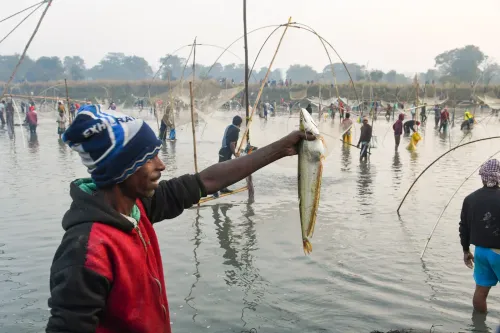
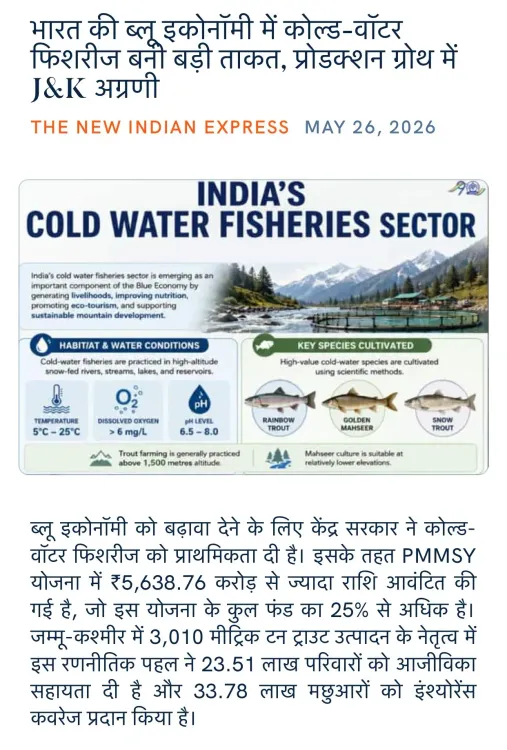
The post, shared via the NaMo App, amplifies coverage of how India's Himalayan and high-altitude water bodies — particularly in Jammu and Kashmir — are being leveraged for cold-water aquaculture. Species such as trout, suited to the region's fast-flowing rivers and high-altitude lakes, are central to this push. The minister's post carries a Hindi headline translating to: 'Bharat ki Blue Economy mein cold-water fisheries bani badi takat, production growth mein J&K agrani' ('Cold-water fisheries have become a major force in India's blue economy, with J&K leading production growth').
While Giriraj Singh holds the Textiles portfolio, senior BJP leaders routinely amplify government achievements across ministries, particularly those tied to rural livelihoods and the development of Jammu and Kashmir as a Union Territory.
Policy Backdrop
India's fisheries sector has been backed by two major policy interventions in recent years. The Blue Revolution, launched in 2015, aimed to modernise aquaculture and capture fisheries through new hatcheries and value-chain infrastructure. It was followed by the Pradhan Mantri Matsya Sampada Yojana (PMMSY), approved in 2020 with an outlay of Rs 20,050 crore, targeting a doubling of fish production by 2024-25 and significant employment generation across marine and inland sectors.
Cold-water fisheries in Himalayan states received targeted attention under both programmes, given their unique climatic advantages and the limited alternative livelihood options available to communities in high-altitude regions. Following the 2019 reorganisation of Jammu and Kashmir as a Union Territory, the Department of Fisheries gained access to enhanced central funding, enabling faster rollout of cold-water fisheries infrastructure across the territory.
Stakeholders and Impact
The primary beneficiaries of this growth are J&K's fishermen and cold-water aquaculture farmers, for whom trout and allied species represent a significant income source. Expansion in this sector also feeds into India's broader export earnings ambitions, as premium cold-water fish command higher prices in domestic and international markets.
India's blue-economy strategy integrates both inland and marine fisheries to generate rural employment and boost foreign exchange. Himalayan Union Territories and states are seen as strategic nodes in this plan, offering produce that coastal aquaculture cannot replicate.
What's Next
Attention will now turn to the release of the next All India Fisheries Census or state-level production data that could quantify J&K's claimed leadership in cold-water output. Any expansion of PMMSY or dedicated cold-water cluster designations in future policy iterations would further institutionalise the sector's role in India's blue-economy framework. For J&K, continued central support will be critical to sustaining the growth trajectory and converting production gains into lasting livelihood improvements for fishing communities across the Union Territory.
Point of View
Using the Union Territory's post-2019 transformation as a proof point for the government's administrative and economic agenda. Cold-water fisheries, though a niche segment, serve as a compelling symbol of how a region historically associated with conflict is being reframed around livelihood and blue-economy potential. The choice of a Textiles Minister to share fisheries content underlines how senior party leaders are deployed as broad amplifiers of government achievement, not just sectoral spokespeople. Sustained growth in this sector will ultimately depend on whether production gains translate into measurable income improvements for J&K's fishing communities — a metric the next fisheries census will be closely watched for.
NationPress
22 Sept 2026
Frequently Asked Questions
What are cold-water fisheries in India?
Cold-water fisheries refer to the cultivation and capture of fish species — primarily trout — in the fast-flowing rivers, streams, and high-altitude lakes of Himalayan regions such as Jammu and Kashmir, Himachal Pradesh, and the North-East. These ecosystems support species that cannot survive in warmer lowland waters.
Why is Jammu and Kashmir leading cold-water fisheries growth?
Jammu and Kashmir's extensive network of Himalayan rivers and high-altitude lakes provides ideal conditions for cold-water species like trout. Post-2019, its status as a Union Territory also gave it direct access to enhanced central funding under schemes such as PMMSY, accelerating infrastructure rollout.
What is the Pradhan Mantri Matsya Sampada Yojana?
PMMSY is a central sector scheme approved in 2020 with an outlay of Rs 20,050 crore. It aims to modernise fisheries infrastructure, double fish production by 2024-25, and generate employment across marine and inland fisheries sectors, including cold-water aquaculture.
What is India's blue economy strategy for fisheries?
India's blue-economy strategy integrates marine and inland fisheries to boost exports, rural employment, and sustainable resource use. Cold-water Himalayan fisheries are a targeted component because of their unique ecological niche and the limited alternative livelihoods available to mountain communities.
Why did Giriraj Singh, the Textiles Minister, post about fisheries?
Senior BJP leaders routinely share government achievement narratives across ministries, especially those linked to rural livelihoods and Jammu and Kashmir's development. Giriraj Singh's post reflects this broader party communication practice rather than a formal ministerial function.