Cold-water fisheries: 3% of India's inland fish output, trout up 1.8x in a decade
Synopsis
India's cold-water fisheries — long overshadowed by marine and freshwater aquaculture — are quietly becoming a significant economic force. Trout output has jumped 1.8 times in a decade, Jammu and Kashmir alone produces over 3,000 metric tonnes, and more than ₹5,600 crore has been committed under PMMSY to transform Himalayan and north-eastern fish farming from subsistence to scale.
Key Takeaways
India's total fish production stood at approximately 197.75 lakh tonnes in 2024–25 .
Cold-water fisheries contribute nearly 3 per cent of inland fish production, with national output at around 7,000 metric tonnes .
Trout production rose nearly 1.8 times over the past decade to approximately 6,000 metric tonnes in 2024–25 .
Jammu and Kashmir leads with approximately 3,010 metric tonnes of trout in 2025–26 , backed by over 2,000 private trout units .
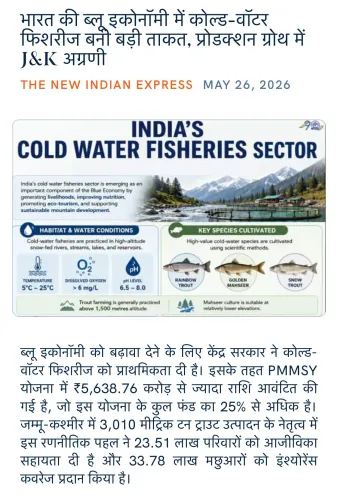
Under PMMSY (2020–26) , over ₹5,638.76 crore has been sanctioned for cold-water states out of a national approval of ₹21,963.48 crore .
23.51 lakh families have received livelihood support and 33.78 lakh fishers are covered under insurance schemes across cold-water states.
India's cold-water fisheries now account for nearly 3 per cent of the country's total inland fish production, with national cold-water fish output standing at approximately 7,000 metric tonnes, the Ministry of Fisheries, Animal Husbandry and Dairying said on Saturday, 23 May 2025. Overall fish production reached approximately 197.75 lakh tonnes in 2024–25, underlining the sector's growing role in India's blue economy ambitions.
Trout Production Surges
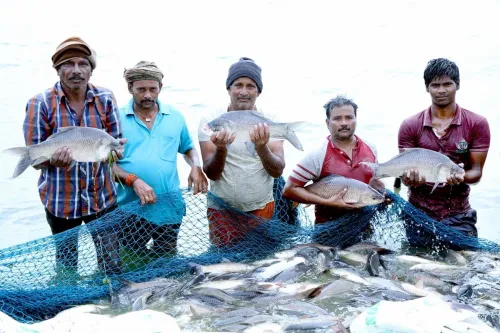
Trout output has risen nearly 1.8 times over the past decade, reaching approximately 6,000 metric tonnes in 2024–25. Species cultivated across India's cold-water belt include rainbow trout, golden mahseer, and snow trout, raised through specialised infrastructure such as hatcheries, raceways, recirculating aquaculture systems (RAS), biofloc units, and cold-chain facilities.
State-wise Performance
Jammu and Kashmir has emerged as India's leading trout-producing region, recording approximately 3,010 metric tonnes in 2025–26, backed by the Kokernag hatchery and more than 2,000 private trout units and over 31,000 registered fishers and fish farmers. Himachal Pradesh produced around 1,673 metric tonnes of trout in 2025–26, supported by 909 trout farmers and 1,739 farming units. Uttarakhand recorded approximately 710 metric tonnes of trout and total fish production of 10,486 metric tonnes in 2024–25, with close to 2,500 raceways spread across Pithoragarh, Bageshwar, and Chamoli districts.
Even Ladakh, despite its harsh climatic conditions, has crossed 50 metric tonnes of production with 120 raceways and four hatcheries. North-eastern states — Arunachal Pradesh, Sikkim, Meghalaya, and Nagaland — are steadily scaling up hatcheries and trout farming, while Kerala, Karnataka, and Tamil Nadu are piloting RAS and biofloc systems in hill regions including Wayanad, Nilgiris, and Uttara Kannada.
Livelihood and Insurance Coverage
Across cold-water states, 23.51 lakh families have received livelihood support and 33.78 lakh fishers have been brought under insurance coverage, according to the ministry. This is a significant social dividend from what was, until recently, a niche segment of Indian aquaculture.
PMMSY Investments and Infrastructure
Under the Pradhan Mantri Matsya Sampada Yojana (PMMSY) for the period 2020–26, projects worth ₹21,963.48 crore have been approved nationally, of which more than ₹5,638.76 crore has been specifically sanctioned for cold-water states. The infrastructure built or sanctioned includes 5,663 raceways, 54 trout hatcheries, 65 RAS units of varying scales, nearly 4,600 ponds in Himalayan and north-eastern regions, 293 cold storages, and 8,366 transport vehicles. Additionally, the PM-MKSSY scheme, with an outlay of ₹6,000 crore, is supporting fisheries insurance and performance grants across the sector.
With production benchmarks rising and infrastructure investment accelerating, India's cold-water fisheries are positioned to play a larger role in the country's overall aquaculture strategy in the years ahead.
Point of View
But the real question is whether the ₹5,638 crore sanctioned under PMMSY is translating into durable livelihoods or merely expanding infrastructure that communities struggle to maintain. Trout farming in Himalayan states is highly climate-sensitive — a warming trend in high-altitude water bodies poses a structural risk that no raceway or hatchery subsidy can fully offset. The 1.8x growth in trout output over a decade is creditable, but with 23.51 lakh families dependent on the sector, the policy conversation needs to move from production targets to income stability and climate resilience.
NationPress
7 Oct 2026
Frequently Asked Questions
What is India's total fish production in 2024–25?
India's total fish production reached approximately 197.75 lakh tonnes in 2024–25, according to the Ministry of Fisheries, Animal Husbandry and Dairying. Cold-water fisheries account for nearly 3 per cent of the country's inland fish output.
How much has India's trout production grown in the last decade?
Trout production has increased nearly 1.8 times over the past decade, reaching approximately 6,000 metric tonnes in 2024–25. Jammu and Kashmir is the leading producer, contributing around 3,010 metric tonnes in 2025–26 alone.
Which states are the top cold-water fish producers in India?
Jammu and Kashmir leads with approximately 3,010 metric tonnes of trout in 2025–26, followed by Himachal Pradesh at around 1,673 metric tonnes and Uttarakhand at approximately 710 metric tonnes. North-eastern states and southern hill districts are also expanding capacity.
How much has the government invested in cold-water fisheries under PMMSY?
Under the Pradhan Mantri Matsya Sampada Yojana (2020–26), more than ₹5,638.76 crore has been sanctioned specifically for cold-water states, out of a total national approval of ₹21,963.48 crore. This covers raceways, hatcheries, RAS units, cold storages, and transport vehicles.
How many people depend on cold-water fisheries for their livelihood?
Across cold-water states, 23.51 lakh families have received livelihood support and 33.78 lakh fishers are covered under insurance schemes, according to the Ministry of Fisheries, Animal Husbandry and Dairying. Jammu and Kashmir alone has over 31,000 registered fishers and fish farmers.