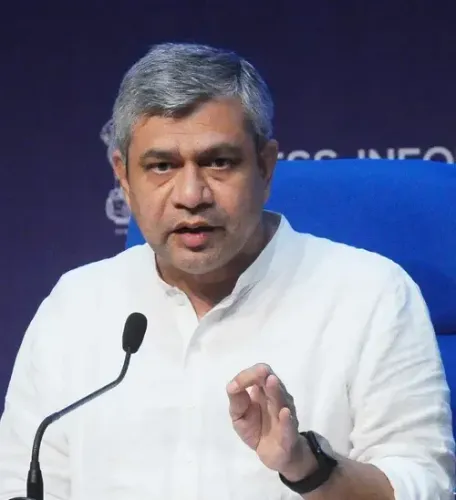
Vaishnaw: PM Modi lays foundation of Vizag semiconductor plant

Synopsis
PM Modi laid the foundation stone of the ASIP Semiconductor Project in Visakhapatnam on 1 August 2026. The facility will produce 96 million chips annually with an investment of over ₹460 crore, advancing India's domestic semiconductor goals under the India Semiconductor Mission.
Key Takeaways
PM Narendra Modi laid the foundation stone of the ASIP Semiconductor Project in Visakhapatnam, Andhra Pradesh on 1 August 2026 .
The project carries an investment of over ₹460 crore and targets an annual output of 96 million chips .
The facility is expected to generate high-skilled employment in the Visakhapatnam region.
The project falls under the India Semiconductor Mission , launched in 2021 with a central outlay of ₹76,000 crore .
The initiative is part of the broader Atmanirbhar Bharat push to reduce India's dependence on imported semiconductors.
A port city on the Bay of Bengal just entered India's chip-making map. Prime Minister Narendra Modi laid the foundation stone of the ASIP Semiconductor Project in Visakhapatnam, Andhra Pradesh, marking a concrete step in the country's years-long push to manufacture semiconductors at home. Union Minister Ashwini Vaishnaw announced the development on Saturday, 1 August 2026, flagging an investment of over ₹460 crore and a planned annual output of 96 million chips.
What the Visakhapatnam plant will produce — and for whom
The ASIP project's headline numbers are significant: 96 million chips per year from a single facility, backed by an outlay exceeding ₹460 crore. The plant is positioned to serve electronics manufacturers who currently depend heavily on imported semiconductors — a supply-chain vulnerability that the COVID-era chip shortage made painfully visible across the globe. Vaishnaw specifically highlighted high-skilled employment as a third pillar of the project, signalling that the government sees Visakhapatnam as a talent hub, not just a manufacturing site.
Five years of the India Semiconductor Mission — and what Vizag adds
The foundation stone did not arrive in a vacuum. In 2021, the Union Cabinet approved the India Semiconductor Mission with a headline outlay of ₹76,000 crore — one of the largest technology-sector bets in independent India's history. The mission was designed to attract both fabrication units and chip-design operations, reducing the country's near-total dependence on East Asian and Taiwanese supply chains. The ASIP project in Visakhapatnam is one of the units materialising under that broader framework, and its foundation stone represents the mission moving from policy architecture to physical construction.
Andhra Pradesh's role in this ecosystem is worth noting. Visakhapatnam already hosts port infrastructure, a growing aerospace corridor, and engineering talent pipelines — factors that make it a logical anchor for capital-intensive, precision-driven semiconductor work. The project also fits within the Atmanirbhar Bharat framework, the government's self-reliance doctrine that has consistently prioritised domestic electronics manufacturing as a strategic rather than purely commercial goal.
The bigger chip race India is running
India's semiconductor ambitions are unfolding against a fiercely competitive global backdrop. The United States, the European Union, Japan, and South Korea have each passed large-scale chip-subsidy legislation since 2021, and Taiwan remains the world's dominant fabrication hub. India's strategy has been to compete on cost, talent, and policy incentives rather than attempt to replicate advanced-node fabs overnight. Projects like ASIP — focused on volume output at competitive cost — fit that approach. Whether the 96 million chip annual capacity is absorbed by domestic demand or finds export markets will be a key indicator of the project's longer-term success.
The next milestones to watch: construction timelines for the Visakhapatnam facility, capacity ramp-up schedules for other India Semiconductor Mission-approved units, and whether Andhra Pradesh announces additional state-level incentives to attract ancillary chip-design or packaging firms to the region.
India's chip revolution now has a Visakhapatnam address. The question is how fast the construction crews can make it real.
Point of View
Five years after its announcement, is producing ground-level action in a state that the BJP has strategic electoral interest in. Placing a high-visibility chip project in Andhra Pradesh also reflects the Centre's effort to anchor southern industrial corridors within the Atmanirbhar Bharat narrative. The 96-million-chip annual capacity figure, while significant, will need to be contextualised against India's vast import volumes before the project can be called transformative. For Vaishnaw, whose portfolio spans both railways and electronics, amplifying this milestone reinforces the government's technology-first messaging ahead of what remains a competitive political cycle.
NationPress
1 Aug 2026
Frequently Asked Questions
What is the ASIP Semiconductor Project in Visakhapatnam?
The ASIP Semiconductor Project is a chip fabrication facility being set up in Visakhapatnam, Andhra Pradesh, with an investment of over ₹460 crore and a planned annual production capacity of 96 million chips.
Who laid the foundation stone of the Visakhapatnam semiconductor plant?
Prime Minister Narendra Modi laid the foundation stone of the ASIP Semiconductor Project in Visakhapatnam on 1 August 2026.
What is the India Semiconductor Mission?
The India Semiconductor Mission is a central government programme approved in 2021 with an outlay of ₹76,000 crore to build domestic semiconductor design and manufacturing capabilities and reduce dependence on chip imports.
How many chips will the Visakhapatnam plant produce each year?
The ASIP Semiconductor Project is designed to produce 96 million chips annually once operational.
Why is Visakhapatnam chosen for a semiconductor project?
Visakhapatnam offers port infrastructure, an emerging aerospace corridor, and engineering talent pipelines, making it a strategic location for capital-intensive semiconductor manufacturing under India's Atmanirbhar Bharat framework.