Yadav Hails India's Chip-to-Ship Manufacturing Dream
Synopsis
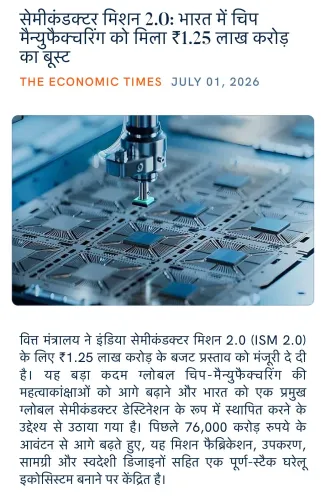
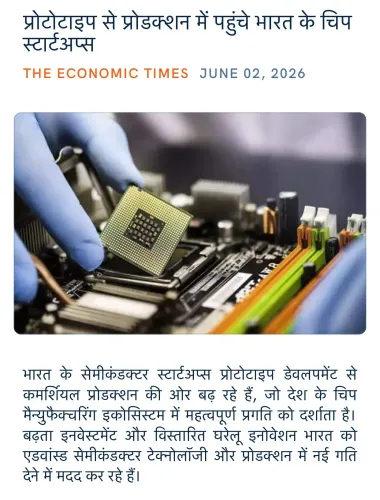
Union Minister Bhupender Yadav invoked a young engineer's pride at being the 'first in his bloodline' to make a chip in India, underlining the country's chip-to-ship manufacturing ambition backed by a Rs 76,000 crore semiconductor mission.
Key Takeaways
Bhupender Yadav shared a youth's declaration of being the 'first in his bloodline to make a chip in India' on 8 August 2026 .
The post echoed the government's 'chip to ship' manufacturing vision — covering semiconductors to shipbuilding.
India's Semiconductor Mission , approved in 2021 , carries a Rs 76,000 crore outlay to build domestic chip fabrication and design capabilities.
The Make in India campaign, launched in 2014 , provides the broader policy framework for domestic electronics and heavy industry manufacturing.
India has deployed production-linked incentives since 2020 to cut dependence on imported semiconductors and electronics components.
Key milestones to watch: commissioning timelines for approved semiconductor fabs and potential incentive expansion into advanced packaging and shipbuilding.
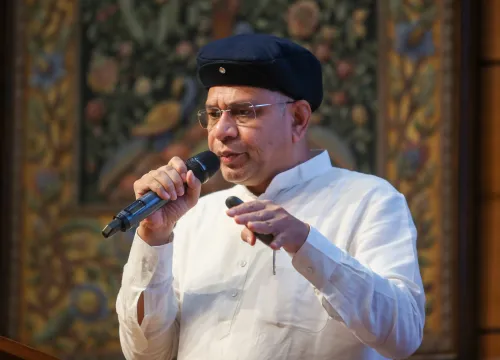
A young Indian engineer, the first in his family's history to build a semiconductor, looks at his work and says: 'First in my bloodline to make a chip in India.' That single line — quoted by Union Environment Minister Bhupender Yadav on Saturday, 8 August 2026 — captures the generational ambition now coursing through India's technology push.
Yadav shared the moment alongside a rallying promise from India's manufacturing drive: 'Chip se lekar ship tak sab kuch, yaheen par aap hi ke haathon se banega' — 'Everything from chip to ship will be made right here, by your own hands.' The line is more than rhetoric; it maps the full arc of what India's industrial ambition now covers, from the nanoscale world of semiconductors to the massive steel hulls of ocean-going vessels.
The Mission Behind the Moment
The confidence in that youth's voice did not appear from nowhere. India's Semiconductor Mission, approved in 2021 with a Rs 76,000 crore outlay, was designed precisely to make moments like this possible — attracting global chip investments, seeding domestic fabrication units, and building a workforce that had never before touched a wafer. Paired with the Make in India campaign launched in 2014, the policy architecture has steadily layered production-linked incentives across electronics, defence hardware, and heavy industry.
The 'chip to ship' framing is deliberate. It signals that India's ambitions now span the entire technology-and-manufacturing value chain — not just assembling imported components but designing, fabricating, and deploying them inside products built on Indian soil, by Indian hands.
A Generation Writing New History
What makes Yadav's post land is the human detail at its centre. The phrase 'first in my bloodline' is a social fact as much as a personal one — it marks the entry of first-generation engineers into industries that were, until recently, dominated by imports and foreign expertise. India has long produced world-class software talent; the bet now is that it can do the same in hardware.
The broader pattern is clear: since 2020, India has used mission-mode programmes and production-linked incentives to systematically reduce dependence on imported semiconductors and electronics. The commissioning timelines of approved semiconductor fabs — and whether incentives expand into advanced packaging and shipbuilding — will determine how quickly that bloodline of chip-makers grows.
One young engineer's pride today is the policy outcome India has been engineering for years. The question is how many more will follow.
Point of View
First-generation story to make the India Semiconductor Mission feel lived rather than bureaucratic. The 'chip to ship' formulation is also a strategic expansion of the manufacturing conversation beyond software services, signalling that the BJP's economic pitch for 2026 and beyond rests on hardware self-reliance. Amplifying a youth voice rather than a minister's speech is a studied communication choice: it shifts the frame from government promise to citizen achievement. Whether the semiconductor fabs deliver on commissioning timelines will be the real test of whether this pride is premature or earned.
NationPress
8 Aug 2026
Frequently Asked Questions
What is India's Semiconductor Mission?
India's Semiconductor Mission is a central government programme approved in 2021 with a Rs 76,000 crore outlay to build a domestic semiconductor ecosystem, including chip fabrication units, design centres, and assembly facilities, reducing India's dependence on imported chips.
What did Bhupender Yadav post about chips and ships?
On 8 August 2026 , Union Minister Bhupender Yadav shared a post quoting a young Indian engineer who called himself the 'first in his bloodline to make a chip in India,' alongside the government's vision that everything from chip to ship will be manufactured in India by Indian hands.
What does 'chip to ship' mean in India's manufacturing context?
'Chip to ship' refers to India's ambition to manufacture across the entire technology and industrial value chain — from nanoscale semiconductors (chips) to large ocean-going vessels (ships) — domestically, reducing reliance on imports at every level.
What is Make in India and how does it relate to semiconductors?
Make in India , launched in 2014 , is a government campaign to promote domestic manufacturing across sectors including electronics, defence, and heavy industry. The India Semiconductor Mission sits within this broader framework, adding chip fabrication as a strategic manufacturing priority.
Which semiconductor fabs are being set up in India?
Several semiconductor fabrication and assembly units have received government approval under the India Semiconductor Mission. Specific commissioning timelines and operational status of individual fabs are subject to ongoing updates beyond publicly confirmed records.