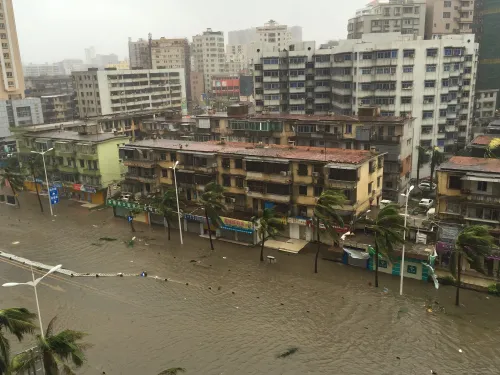
China warns bloggers AI weather forecasts for Typhoon Bavi may break law

Synopsis
As Typhoon Bavi bore down on eastern China, bloggers using open-source AI weather models — some charging fees for location-specific predictions — drew a public legal warning from state broadcaster China Media Group, highlighting a fast-emerging collision between accessible AI tools and centralised state control over emergency information.
Key Takeaways
China Media Group warned on Thursday, 10 July 2026 that bloggers posting AI-generated weather forecasts during Typhoon Bavi may be breaking the law.
A Shandong province blogger predicted a '90 per cent chance' the typhoon would move deep into the province, based on AI tracking models.
Some bloggers were reportedly charging fees for location-specific typhoon predictions derived from open-source AI weather tools.
Under the Meteorology Law of the People's Republic of China , only authorised meteorological stations may issue public forecasts and severe weather warnings.
Huang Xiang of Nanjing University of Information Science and Technology (NUIST) said the centralised system is vital to prevent public confusion during emergencies.
AI weather models from institutions including Google AI and Shenzhen Institutes of Advanced Technology (CAS) are increasingly accessible to non-specialist users, intensifying the regulatory challenge.
As Typhoon Bavi approached the eastern coast of China on Thursday, 10 July 2026, social media was flooded with amateur storm predictions generated using open-source AI weather models — prompting a sharp warning from state media that such posts could violate national meteorology law.
AI forecasts go viral amid typhoon anxiety
China Media Group, the state broadcaster also known as Voice of China, reported that bloggers describing themselves as 'weather enthusiasts' were publishing typhoon track predictions derived from various open-source artificial intelligence weather models. Some had gone further, reportedly offering location-specific forecasts for a fee. One blogger based in Shandong province posted on Thursday evening that there was a '90 per cent chance' the storm could move deep into Shandong, citing tracking model outputs.
What the law actually says
Under the Meteorology Law of the People's Republic of China, public weather alerts are subject to a centralised release system. Only officially designated meteorological stations — including the National Meteorological Centre — are authorised to issue forecasts and severe weather warnings. Bloggers publishing unsanctioned predictions, particularly for commercial gain, risk running afoul of these provisions.
Why it matters: the risk of public confusion
Huang Xiang, a researcher at Nanjing University of Information Science and Technology (NUIST), told the broadcaster that the centralised system exists specifically to prevent public confusion during high-stakes weather events. Conflicting amateur predictions circulating alongside official guidance can undermine evacuation decisions and emergency response coordination, analysts have noted. The concern is especially acute when AI-generated outputs carry the appearance of scientific precision.
The competitive backdrop: AI weather models gain traction
The episode reflects the rapid proliferation of AI-based meteorological tools globally. Models developed by institutions including Google AI and research bodies such as the Shenzhen Institutes of Advanced Technology under the Chinese Academy of Sciences (CAS) have demonstrated competitive forecast accuracy, making them increasingly accessible to non-specialist users. Provinces including Fujian and Zhejiang — both in Typhoon Bavi's projected path — faced the real-world consequences of this information environment.
What's next
Regulators have not yet announced specific enforcement actions against individual bloggers, but the state broadcaster's public warning signals that authorities are actively monitoring the space. As AI weather tools become more capable and widely available, China's meteorological regulators face growing pressure to clarify where the line sits between public science communication and illegal forecast dissemination. How the government codifies AI-generated weather content under existing meteorology law will be the key development to watch.
Point of View
But the underlying problem — state information monopolies colliding with democratised AI tools — is universal. What mainstream coverage misses is the commercial dimension: bloggers charging fees for AI-generated forecasts are effectively operating unlicensed meteorological services, a category regulators globally have not yet defined. The outcome in China will set an early precedent for how governments classify AI-generated scientific content under existing professional-licensing and public-safety law.
NationPress
11 Jul 2026
Frequently Asked Questions
What is the legal issue with AI weather forecasts in China?
Under the Meteorology Law of the People's Republic of China , only officially designated meteorological stations are authorised to issue public weather forecasts and severe weather warnings. Bloggers publishing AI-generated predictions — especially for commercial gain — risk violating this centralised release system, according to China Media Group .
What happened with Typhoon Bavi forecasts on social media?
During Typhoon Bavi 's approach on 10 July 2026 , bloggers in China used open-source AI weather models to post storm track predictions on social media. One blogger in Shandong province claimed a '90 per cent chance' the typhoon would move deep into the province, while others reportedly charged fees for location-specific forecasts.
Why does China restrict who can issue weather forecasts?
Huang Xiang of Nanjing University of Information Science and Technology (NUIST) explained that the centralised system prevents public confusion during dangerous weather events. Conflicting amateur predictions alongside official guidance can disrupt evacuation decisions and emergency response.
Which AI weather models are being used by Chinese bloggers?
The bloggers were reportedly drawing on various open-source AI weather models. Institutions including Google AI and the Shenzhen Institutes of Advanced Technology under the Chinese Academy of Sciences (CAS) have developed AI meteorological tools that are increasingly accessible to non-specialist users.
What could happen to bloggers who posted illegal weather forecasts?
As of 10 July 2026 , no specific enforcement actions against individual bloggers had been announced. However, China Media Group 's public warning signals active regulatory scrutiny, and those found to have issued forecasts for commercial gain face the greatest legal exposure under the Meteorology Law .