Rajnath Singh at Delhi Defence Dialogue 2026: Battlefield now spans space and cyberspace

Synopsis
At the Delhi Defence Dialogue 2026, Defence Minister Rajnath Singh warned that war has permanently left the conventional battlefield — it now extends into space, cyberspace, and the digital domain. His four-pillar formula of reforms, self-reliance, collaboration, and exports frames India's most explicit public articulation yet of what a 21st-century defence industrial state must look like.
Key Takeaways
Defence Minister Rajnath Singh addressed the Delhi Defence Dialogue 2026 in New Delhi on 3 November 2026 .
He declared modern warfare has undergone a 'fundamental transformation' — the battlefield now spans space, cyberspace, and the digital domain .
Singh outlined a four-pillar strategy: reforms, self-reliance (Atmanirbharta), collaboration, and exports — warning that each element is necessary; none is sufficient alone.
The erstwhile Ordnance Factory Board has been corporatised into seven DPSUs ; defence industrial corridors have been established to expand domestic manufacturing.
2025 was formally observed as a year of reforms in the Ministry of Defence, focused on jointness, emerging technologies, and the domestic defence ecosystem.
Private industry, MSMEs, start-ups, and academia are being invited into programmes such as the advanced medium combat aircraft and shipbuilding.
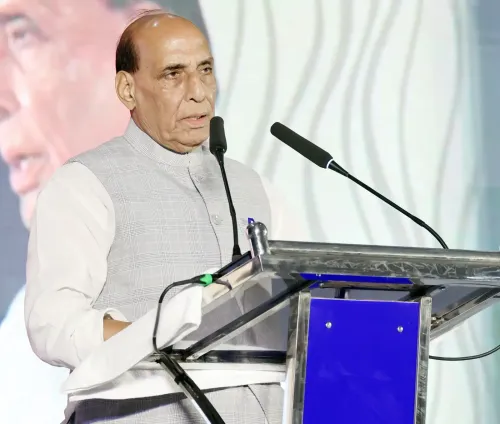
Defence Minister Rajnath Singh on Tuesday, 3 November 2026, declared that modern warfare has undergone a 'fundamental transformation', with the battlefield no longer confined to land, sea, or air but now extending into space, cyberspace, and the digital domain. Speaking at the Delhi Defence Dialogue 2026 in New Delhi, Singh outlined a four-pillar vision — reforms, self-reliance, collaboration, and exports — as the cornerstone of India's evolving defence ecosystem.
A New Character of War
Citing recent conflicts across the globe, Singh warned that the line between conventional and unconventional warfare is increasingly blurred. 'The battlefield is no longer confined to land, sea or air. It extends into space, cyberspace and the digital domain,' he said, adding that the economics of warfare are shifting just as dramatically.
He noted that 'relatively expensive drones and autonomous systems can challenge sophisticated and costly military platforms,' stressing that the capacity to innovate rapidly, manufacture at scale, and replenish capabilities has become as strategically vital as possessing advanced weapons.
The Four Pillars of Defence Transformation
Singh articulated a comprehensive framework for India's defence ambitions. 'Reforms represent our willingness to change. Atmanirbharta (self-reliance) represents our determination to create. Collaborations represent our confidence to partner with the world, and exports represent our readiness to compete with the world,' he said.
He cautioned, however, that any one element in isolation falls short: self-reliance without reform may not deliver its full potential; self-reliance without collaboration may limit technological horizons; and self-reliance without exports may deny the defence industry the scale and competitiveness a modern military-industrial complex requires.
Progress in Domestic Defence Manufacturing
The Defence Minister pointed to a decade of measurable progress in strengthening India's domestic defence industrial base. Key milestones include the establishment of defence industrial corridors to expand manufacturing capacity, and the corporatisation of the erstwhile Ordnance Factory Board into seven Defence Public Sector Undertakings (DPSUs) — a move intended to improve autonomy, efficiency, and competitiveness.
Singh also highlighted growing private-sector opportunities in programmes such as the advanced medium combat aircraft, propulsion systems, artillery ammunition, and shipbuilding, noting these initiatives open the door to wider participation from MSMEs, start-ups, and academia.
2025 as a Year of Defence Reforms
Notably, Singh confirmed that 2025 was formally observed as a year of reforms in the Ministry of Defence, with emphasis on jointness, integration, emerging technologies, innovation, and the domestic defence industrial ecosystem. The government has, according to him, initiated reforms spanning policies, institutional structures, technology development, acquisition procedures, and ease of doing business.
He underscored that military preparedness in the 21st century cannot be separated from technological and industrial preparedness: 'A nation's defence strength must increasingly rest on its ability to develop technology, manufacture critical equipment, and sustain its capabilities independently,' he said, adding that the right institutional environment and enabling policies are prerequisites — not optional additions.
What Comes Next
Singh's remarks at the Delhi Defence Dialogue 2026 signal that New Delhi views its defence modernisation push not merely as a procurement exercise but as a structural industrial transformation. With private industry being actively encouraged and export ambitions firming up, the coming months are likely to see continued policy action on acquisition timelines and technology-transfer frameworks.
Point of View
Where drone economics and electronic warfare reshaped outcomes faster than procurement cycles could respond. The four-pillar formula is elegant, but the harder question is sequencing: India's acquisition timelines and technology-transfer frameworks have historically lagged intent. Corporatising the Ordnance Factory Board was the right structural move, yet the DPSUs are still finding their competitive footing. The real measure of this 'fundamental transformation' will not be in speeches at dialogue forums but in how quickly private-sector partners move from MoUs to metal.
NationPress
3 Nov 2026
Frequently Asked Questions
What did Rajnath Singh say about modern warfare at Delhi Defence Dialogue 2026?
Defence Minister Rajnath Singh said modern warfare has undergone a 'fundamental transformation' — the battlefield now extends beyond land, sea, and air into space, cyberspace, and the digital domain. He added that the distinction between conventional and unconventional warfare is increasingly blurred.
What are the four pillars of India's defence transformation outlined by Rajnath Singh?
Singh articulated four pillars: reforms (willingness to change), Atmanirbharta or self-reliance (determination to create), collaboration (confidence to partner globally), and exports (readiness to compete internationally). He stressed that all four must work together for India's defence ecosystem to reach its potential.
What reforms has India carried out in its defence sector in recent years?
India has established defence industrial corridors, corporatised the Ordnance Factory Board into seven Defence Public Sector Undertakings, and opened advanced programmes — including the advanced medium combat aircraft, propulsion systems, and shipbuilding — to private industry, MSMEs, and start-ups. The Ministry of Defence formally observed 2025 as a year of defence reforms.
Why does Rajnath Singh say self-reliance alone is not enough for India's defence?
Singh cautioned that self-reliance without reform may not deliver its full potential, without collaboration it may limit technological horizons, and without exports it cannot achieve the scale and competitiveness a modern defence industry requires. He argued all four elements must work in concert.
How is the economics of warfare changing according to Rajnath Singh?
Singh noted that relatively cost-effective drones and autonomous systems can now challenge expensive, sophisticated military platforms. He said the ability to innovate rapidly, manufacture at scale, and replenish capabilities has become as important as possessing advanced weapon systems — reshaping how nations must approach defence preparedness.