China turns to bamboo to bolster Great Green Wall against deserts
Synopsis
China is pivoting from straw and plastic sand barriers to bamboo — the world's fastest-growing plant — to reinforce the Great Green Wall, backed by a new five-year conservation plan released on July 22, 2026, with a 2030 deadline.
Key Takeaways
Chinese researchers are testing bamboo as a replacement for straw, plastic, and conventional plant barriers used in sand-fixing along the Great Green Wall .
The Three-North Shelterbelt Programme , launched in the 1970s , spans thousands of kilometres across Inner Mongolia , Qinghai province , and other arid northern regions.
Beijing released a five-year forest and grassland conservation plan on July 22, 2026 , incorporating shelterbelt projects with a 2030 completion target.
Scientists at the Research Institute of Wood Industry under the Chinese Academy of Forestry , including researcher Yu Yanglun , are among those driving the bamboo initiative.
Current sand-fixing methods — including straw checkerboard grids and Artemisia plantings — are criticised for short lifespans, ecological risks, and health concerns.
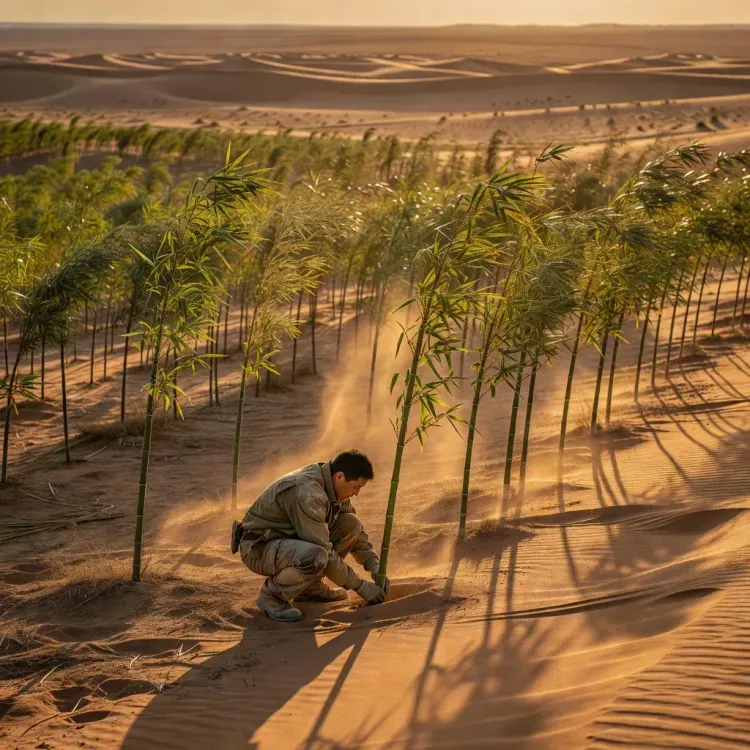
Chinese researchers have begun exploring bamboo as a next-generation sand-fixing material for the Three-North Shelterbelt Programme — commonly known as the Great Green Wall — marking a significant shift in how China battles desertification across its arid north, northwest, and northeast regions. The pivot comes after decades of relying on straw checkerboard grids, shrubs, and plastic barriers, methods that scientists say suffer from short lifespans, ecological risks, and human health concerns.
Why bamboo, and why now
Bamboo is the fastest-growing plant on Earth and is widely regarded as one of the most resilient and sustainable materials available. Researchers affiliated with institutions including the Research Institute of Wood Industry under the Chinese Academy of Forestry have identified bamboo's structural durability and rapid regeneration as key advantages over conventional sand-barrier materials. Scientist Yu Yanglun is among those involved in this line of research, according to reports.
Current sand-fixing techniques — including straw grids and plantings of drought-tolerant species such as Artemisia — face mounting challenges as climate pressures intensify. Bamboo, proponents argue, could address multiple shortcomings simultaneously, offering longer service life and reduced ecological disruption.
The Great Green Wall: scope and stakes
Launched in the 1970s, the Three-North Shelterbelt Programme is one of the largest ecological engineering projects in history, spanning thousands of kilometres across Inner Mongolia, Qinghai province, and other arid zones. Its goal is to halt the advance of deserts that threaten farmland, infrastructure, and communities.
Desertification — the degradation of fertile land driven by overgrazing, deforestation, and climate change — remains a critical challenge across Asia. China has invested heavily in countermeasures, planting networks of shrubs, flowering plants, and forests alongside physical barriers, but scientists acknowledge that no single solution has proven fully effective at scale.
Beijing's new five-year conservation blueprint
On July 22, 2026, Beijing released a five-year conservation plan covering the country's forests and grasslands, which explicitly incorporates projects to be implemented under the Three-North Shelterbelt Programme by 2030. The plan signals that bamboo-based interventions could be formally integrated into national reforestation and desertification-control targets within this window.
The timing underscores growing urgency: climate models suggest that without accelerated intervention, desertification in northern China could intensify significantly over the coming decades.
What's next
Researchers are expected to advance field trials of bamboo-based sand barriers in regions such as Inner Mongolia and Qinghai province, where conditions are among the most demanding. Success in these trials could position bamboo as a mainstream component of China's anti-desertification toolkit — and potentially inform similar programmes across Asia and other desertification-prone regions globally. The 2030 deadline set under the new conservation plan will serve as the first major benchmark for whether bamboo can deliver at scale.
Point of View
Fast solutions to a slow-moving ecological crisis. What mainstream coverage tends to underplay is the institutional weight behind this shift — a formal five-year plan from Beijing means bamboo research is now tied to state performance targets, not just academic papers. This also fits a broader pattern of China repositioning domestic natural resources (bamboo cultivation is a major rural industry) as geopolitical and environmental assets simultaneously. The 2030 deadline will be the real test of whether policy ambition translates into measurable desertification rollback.
NationPress
26 Oct 2026
Frequently Asked Questions
Why is China using bamboo for the Great Green Wall?
China is turning to bamboo because it is the fastest-growing plant on Earth and offers greater durability and sustainability than existing sand-fixing methods such as straw grids and plastic barriers, which suffer from short lifespans and ecological risks. Researchers believe bamboo can address multiple shortcomings of current techniques simultaneously.
What is the Three-North Shelterbelt Programme?
The Three-North Shelterbelt Programme, also called the Great Green Wall, is a large-scale ecological project launched by China in the 1970s to combat desertification in the country's arid north, northwest, and northeast. It involves planting forests, shrubs, and physical barriers across thousands of kilometres to halt desert expansion.
What did Beijing announce on July 22, 2026?
On July 22, 2026, Beijing released a five-year conservation plan for China's forests and grasslands that includes projects under the Three-North Shelterbelt Programme to be completed by 2030. The plan formally incorporates new approaches, including bamboo-based interventions, into national desertification-control targets.
Which Chinese institutions are researching bamboo for sand-fixing?
The Research Institute of Wood Industry under the Chinese Academy of Forestry is among the institutions involved, with researcher Yu Yanglun cited in connection with the bamboo sand-fixing work. The research is aimed at developing materials that outperform conventional straw and plastic barriers used along the Great Green Wall.
How does bamboo compare to current sand-fixing methods in China?
Current methods — including straw checkerboard grids and plantings of drought-tolerant species like Artemisia — are criticised for their short service life, potential ecological disruption, and health risks. Bamboo is considered superior due to its rapid growth, structural resilience, and lower ecological footprint, making it a strong candidate for long-term deployment at scale.