China-Brazil CBERS-5 satellite to watch South America 24/7 from 2030
Synopsis
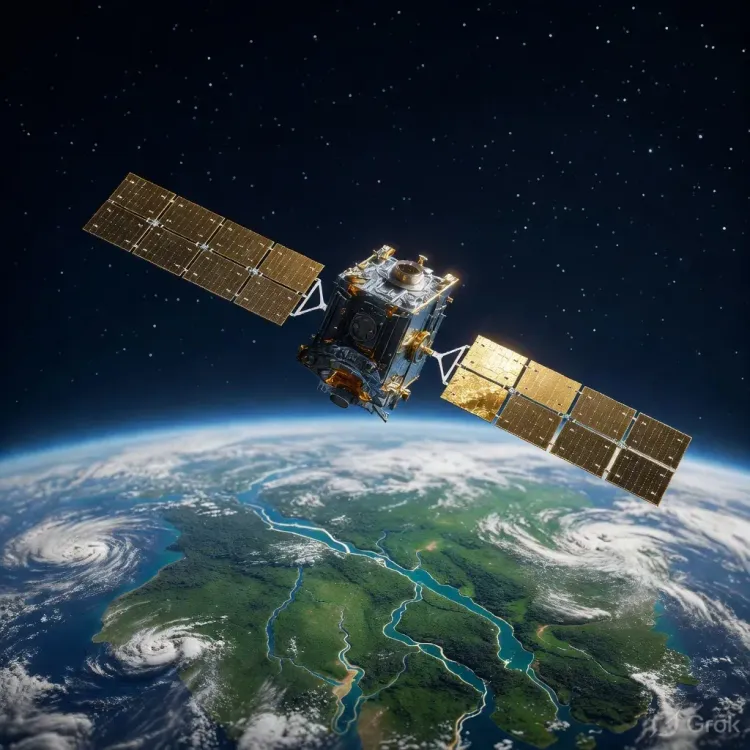
Brazil and China have revealed the CBERS-5 geostationary satellite, set for a 2030 launch, that will monitor all of South America around the clock for weather events and disasters — the most ambitious chapter yet in a four-decade bilateral space partnership.
Key Takeaways
Brazil and China announced the CBERS-5 satellite programme, targeting a 2030 launch from a Chinese launch site.
CBERS-5 will provide 24/7 meteorological and environmental monitoring of the entire South American continent.
Under the agreement, Brazil is responsible for the satellite platform and China for the meteorological and environmental payload.
Adenilson Roberto da Silva , General Coordinator of Engineering and Technology at INPE , said the satellite will enable 'improved weather forecasting, disaster monitoring and early-warning systems that can save lives.' Programme details were first presented after technical meetings between INPE and a Chinese delegation in May 2026 .
The project extends nearly four decades of China-Brazil space cooperation under the long-running CBERS series.
Brazil and China have unveiled plans for a next-generation geostationary satellite — CBERS-5 (Chinese-Brazilian Satellite of Earth Resources) — capable of round-the-clock monitoring of the entire South American continent, with launch targeted for 2030 from a Chinese launch site. The announcement builds on nearly four decades of bilateral space cooperation between the two nations.
What CBERS-5 will do
Adenilson Roberto da Silva, General Coordinator of Engineering and Technology at Brazil's National Institute for Space Research (INPE), said the satellite would deliver 'improved weather forecasting, disaster monitoring and early-warning systems that can save lives.' The platform is designed to operate continuously, providing real-time environmental and meteorological data across South America.How responsibilities are divided
Under the bilateral agreement, Brazil will be responsible for the satellite platform, while China will handle the meteorological and environmental payload, according to an INPE press release. Key institutional players include the Space Agency of Brazil, the China National Space Administration, the China Aerospace Science and Technology Corporation, the Chinese Academy of Space Technology, and the Shanghai Academy of Spaceflight Technology.How the project came together
Details of the CBERS-5 programme were first presented following technical meetings held in May 2026 between INPE and a Chinese delegation. The programme represents a continuation of the long-running CBERS series, which has produced multiple Earth-observation satellites since the late 1980s, making it one of the most enduring South-South space partnerships in history.Why it matters
South America is disproportionately exposed to climate-driven disasters — from Amazonian wildfires to catastrophic flooding in low-lying coastal regions. A dedicated geostationary satellite offering 24/7 coverage would significantly cut warning lead times, potentially protecting millions of people. Existing regional monitoring relies heavily on assets shared with other global coverage zones, leaving gaps in response capability.What's next
Both governments are expected to advance joint engineering work ahead of the 2030 launch window. The project's progress will be closely watched as a benchmark for emerging-economy space collaboration — and as a signal of how far China's space partnerships with Latin America can extend beyond the CBERS framework into broader strategic infrastructure.Point of View
China is deepening infrastructure partnerships across the Global South, with Latin America emerging as a key arena. The division of labour — Brazil builds the bus, China supplies the sensors — mirrors a model Beijing has used in telecoms and rail, embedding technical dependency while offering genuine capability transfer. Mainstream coverage focuses on the humanitarian upside; what it underplays is that whoever controls the payload data pipeline holds significant leverage over regional early-warning infrastructure for decades to come.
NationPress
28 Sept 2026
Frequently Asked Questions
What is the CBERS-5 satellite?
CBERS-5 , or the Chinese-Brazilian Satellite of Earth Resources 5 , is a planned geostationary satellite jointly developed by Brazil and China to provide round-the-clock meteorological and environmental monitoring of South America . It is scheduled for launch from a Chinese launch site in 2030 .
When will the CBERS-5 satellite be launched?
The CBERS-5 satellite is scheduled to launch in 2030 from a Chinese launch site. Technical meetings between INPE and a Chinese delegation in May 2026 produced the first formal presentation of the programme's details.
What are Brazil and China each responsible for in the CBERS-5 project?
Under the bilateral agreement, Brazil is responsible for building the satellite platform, while China is responsible for the meteorological and environmental payload. Key agencies involved include INPE , the Space Agency of Brazil , the China National Space Administration , and the Shanghai Academy of Spaceflight Technology .
Why does South America need a dedicated disaster early-warning satellite?
A dedicated 24/7 geostationary satellite over South America would significantly reduce response times for climate-driven disasters such as wildfires and floods. According to Adenilson Roberto da Silva of INPE , the satellite will provide 'improved weather forecasting, disaster monitoring and early-warning systems that can save lives.'
How long have China and Brazil been cooperating on space projects?
China and Brazil have maintained space cooperation for nearly four decades , making the CBERS programme one of the longest-running South-South space partnerships globally. CBERS-5 represents the latest and most ambitious phase of that collaboration.