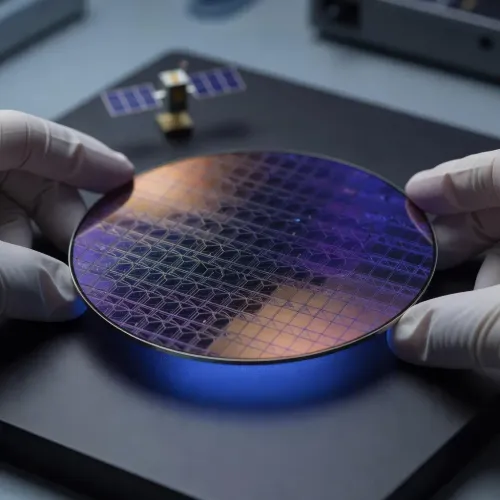
China mass-delivers 5 million GaN chips for space-ground 6G network
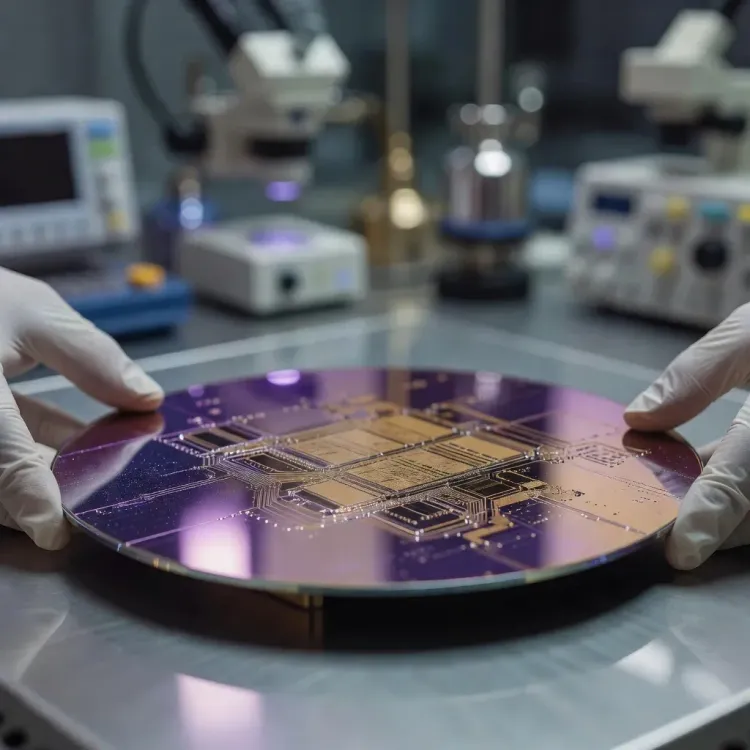
Synopsis
China has mass-delivered 5 million gallium nitride chips for a space-air-ground 6G network — the first commercial deployment of this technology — built by a US-sanctioned CETC subsidiary, underscoring Beijing's push to dominate next-generation wireless infrastructure despite American export controls.
Key Takeaways
China has delivered 5 million gallium nitride semiconductors for commercial smart terminals in a space-air-ground integrated 6G network , the first such mass-production deployment.
The chips were developed by the US-sanctioned No.
55 Research Institute of CETC and subsidiary Nanjing Guobo Electronics .
Science and Technology Daily reported on Thursday, 5 June 2026 that the chips will support 6G communications, commercial space, the low-altitude economy, and emergency response .
IDC analyst Cui Kai said the chips could be used in high-end smartphones or law enforcement devices for satellite signal supplementation.
China is the world's largest gallium holder and exporter and maintains strict end-use export controls on gallium and its oxides.
China has completed large-scale delivery of 5 million gallium nitride (GaN) semiconductors destined for smart terminals in a space-air-ground integrated 6G network — marking the first time these advanced chips have been mass-produced and deployed for commercial use, according to state media reports published on Thursday, 5 June 2026.
The breakthrough and who made it
The chips were developed by the US-sanctioned No. 55 Research Institute of China Electronics Technology Group Corporation (CETC) and its subsidiary, Nanjing Guobo Electronics. The development is significant because CETC sits on the US Department of Commerce entity list, meaning American firms are barred from supplying it with technology or components without a licence.
The milestone signals that China is advancing its domestic semiconductor capabilities even under sustained export controls — and doing so in a strategically sensitive domain: next-generation wireless infrastructure.
What the chips are designed to do
According to Science and Technology Daily, the chips are 'destined for commercial smart terminals, where they will build an integrated space-air-ground information network.' The report described the technology as 'the fundamental backbone supporting next-generation 6G communications, commercial space programmes, the low-altitude economy, and emergency response communications.'
The publication did not specify the exact terminal type, leaving the precise end-use open to interpretation.
Analyst view: satellites filling cellular gaps
Cui Kai, a communications industry analyst at IDC, a global market intelligence firm, said the chips could be deployed in high-end smartphones or mobile law enforcement devices for satellite signal filling — supplementing coverage in areas where cellular signals are weak or absent.
The use case points to a convergence of terrestrial and non-terrestrial networks that sits at the heart of global 6G standardisation debates, with China, the US, and Europe each pushing competing architectural visions.
The gallium leverage factor
China is the world's largest holder and exporter of gallium and currently enforces strict end-use-based export controls on the rare metal and its oxides. Gallium nitride is a wide-bandgap semiconductor prized for high-frequency, high-power applications — precisely the characteristics needed for 6G millimetre-wave and satellite link hardware.
Beijing's dual position — as both the dominant gallium supplier and now a mass-producer of GaN chips — gives it structural leverage in the global 6G supply chain at a moment when Western governments are scrambling to secure alternative sources of critical minerals.
What's next
The commercial rollout of these chips into smart terminals will be a key indicator of how quickly China can translate laboratory breakthroughs into deployable 6G infrastructure. Analysts and policymakers in Washington, Brussels, and Tokyo will be watching whether CETC's sanctioned status creates downstream compliance complications for any non-Chinese firms that eventually integrate hardware containing these components.
Point of View
Beijing demonstrates that export controls, while painful, have not halted China's advance in the semiconductor layers most critical to 6G infrastructure. Mainstream coverage tends to focus on logic chips and AI accelerators; the GaN layer — essential for high-frequency power amplifiers in satellite and millimetre-wave systems — receives far less attention despite being equally strategic. China's simultaneous control of raw gallium supply and now downstream chip production creates a pincer dynamic that Western supply-chain diversification efforts have yet to fully address. The commercial deployment timeline will be the real test: if these chips appear in consumer devices within 12 months, the gap between Chinese 6G ambition and Western readiness narrows considerably.
NationPress
24 Oct 2026
Frequently Asked Questions
What are the gallium nitride chips China delivered for 6G?
China delivered 5 million gallium nitride (GaN) semiconductors designed to power smart terminals in a space-air-ground integrated 6G network . These chips, developed by Nanjing Guobo Electronics , a subsidiary of the No. 55 Research Institute of CETC , represent the first mass-produced commercial deployment of this technology.
Why does it matter that a US-sanctioned company made these chips?
The No. 55 Research Institute of CETC is on the US Department of Commerce entity list, barring American firms from supplying it with technology without a licence. Its successful mass-production of advanced GaN chips signals that US export controls have not stopped China from developing cutting-edge semiconductor technology for strategic 6G infrastructure.
What will these chips be used for?
According to Science and Technology Daily , the chips will support 'next-generation 6G communications, commercial space programmes, the low-altitude economy, and emergency response communications.' IDC analyst Cui Kai added they could also appear in high-end smartphones or law enforcement devices to fill gaps in satellite signal coverage.
Why is China's control of gallium strategically important?
China is the world's largest holder and exporter of gallium, a critical input for gallium nitride chips, and enforces strict end-use export controls on the metal. Combined with its new mass-production capability, this gives Beijing significant structural leverage over the global 6G hardware supply chain.
How does this affect the global 6G race?
China's ability to mass-produce GaN chips through a sanctioned entity while also controlling global gallium supply strengthens its position in the 6G standardisation and infrastructure race against the US and Europe . The commercial rollout timeline will be closely watched as a benchmark for how quickly Beijing can translate this capability into deployed network hardware.