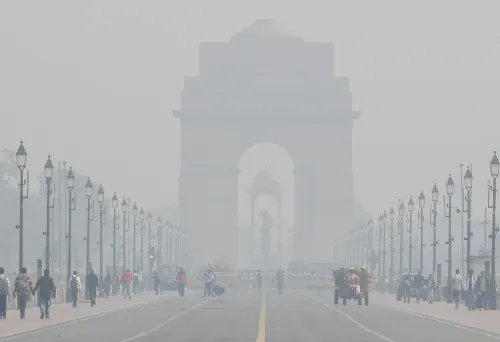
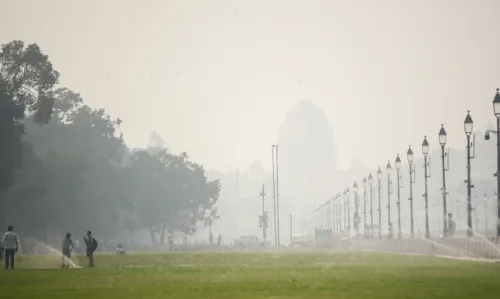
Is Delhi-NCR Experiencing Its Best AQI in 3 Years?
Synopsis
On December 4, 2023, the Delhi NCR region reported its best air quality in three years during the October-November period, as stated by the government. This article explores the significant improvements in the AQI levels and the ongoing efforts to combat air pollution in the region.
Key Takeaways
Significant AQI improvement in Delhi NCR reported.
Lowest PM10 and PM2.5 levels since 2023.
Increase of good air quality days to 200 in 2025.
CAQM established for better coordination.
Collaborative efforts are yielding positive results .
New Delhi, Dec 4 (NationPress) The Air Quality Index (AQI) in the Delhi NCR area has shown remarkable enhancement this year during the October-November timeframe, according to information presented to Parliament.
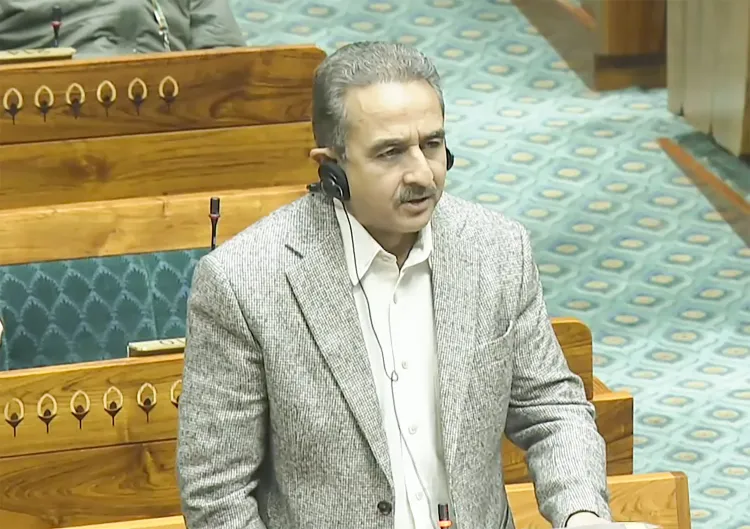
In a written statement in the Rajya Sabha, Union Minister of State for Environment, Forest, and Climate Change (MoEFCC) Kirti Vardhan Singh revealed that the region recorded the lowest average levels of PM10 and PM2.5 since 2023.
The Minister noted that the AQI for October 2023 was recorded at 219, which fell to 234 in 2024 and further improved to 223 in 2025. In the month of November, the AQI was noted at 373 in 2023, which decreased to 374 in 2024 and then to 354 in 2025.
The average concentration of PM2.5 in October 2023 was 105 μg/m3, rising to 114 μg/m3 in 2024 but improving to 108 μg/m3 in 2025.
Similarly, in November, the average concentration of PM2.5 was 240 μg/m3 in 2023, up to 246 μg/m3 in 2024, before improving to 223 μg/m3 in 2025.
For PM10, the average concentration in October 2023 was 231 μg/m3, dipping to 249 μg/m3 in 2024, and improving to 219 μg/m3 in 2025. November 2023 recorded PM10 at 384 μg/m3, which decreased to 393 μg/m3 in 2024, and then stood at 375 μg/m3 in 2025, Singh mentioned.
In acknowledging the success of these improvements, he emphasized that the “number of good days (AQI<200) in Delhi has risen to 200 days in 2025, up from 110 days in 2016.”
“While there has been an overall enhancement in the AQI this year, the instances of very poor days (AQI: 301-400) and severe days (AQI above 401) have been reduced from 71 days in 2024 to 50 days in 2025. Delhi has noted the lowest average AQI over the past 8 years, from 2018 to 2025 (excluding 2020 during the Covid lockdown),” the Minister added.
To combat air pollution in the Delhi-NCR region, the government has established the Commission for Air Quality Management (CAQM) under the Commission for Air Quality Management in NCR and Adjoining Areas Act, 2021, aiming for improved coordination, research, and resolution of air pollution issues.
The government has tackled the air pollution crisis in Delhi-NCR through a collective and participatory approach, engaging all key stakeholders.
Point of View
The ongoing improvements in air quality in the Delhi NCR region reflect a significant success story amidst ongoing environmental challenges. The government's proactive measures and stakeholder engagement are commendable, indicating that collective action can yield positive results in combating air pollution.
NationPress
17 Oct 2026
Frequently Asked Questions
What is the current AQI level in Delhi NCR?
As of December 2023, the AQI in October was recorded at 219 and in November at 373, indicating a notable improvement.
How have PM10 and PM2.5 levels changed?
The most recent data shows that PM2.5 levels have decreased to 108 μg/m³ in October 2025, and PM10 levels improved to 219 μg/m³ in October 2025.
What measures are being taken to improve air quality?
The government established the Commission for Air Quality Management (CAQM) to enhance coordination and address pollution issues in the Delhi NCR.
How many good air quality days has Delhi NCR achieved?
Delhi NCR has seen an increase in good air quality days (AQI < 200) from 110 days in 2016 to 200 days in 2025.
What are the future goals for air quality management?
The focus will remain on reducing pollution levels and increasing public awareness to sustain this improvement in air quality.