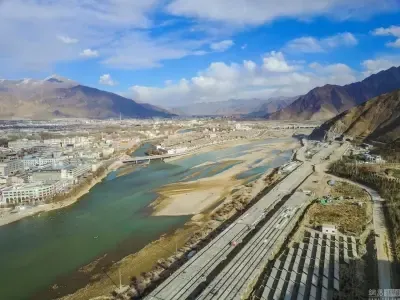
The Economist's 'eco-authoritarian' China tag sparks social media row

Synopsis
The Economist called China 'eco-authoritarian' for its Yangtze River fishing ban — even as a peer-reviewed study in Science confirmed a meaningful ecological recovery within five years. Critics say the framing is a textbook case of undermining a genuine environmental win with selective governance scrutiny.
Key Takeaways
The Economist published a piece on July 27 labelling China 's environmental governance 'eco-authoritarian,' sparking widespread social media criticism.
China imposed a 10-year fishing ban on the Yangtze River in 2021 alongside broader restoration measures.
A study in the peer-reviewed journal Science , published in February by an international team, found the river was already undergoing meaningful recovery within five years.
The Economist itself acknowledged the Yangtze 's 'remarkable comeback' while simultaneously questioning the governance methods used to achieve it.
Critics — including commentators Hasan Piker and Shen Shiwei , and academics from University of Washington , Carleton University , and University of Toulouse — accused the outlet of applying a 'but at what cost' double standard.
The Economist has drawn sharp criticism on social media after labelling China an 'eco-authoritarian' state in a July 27 article examining the country's Yangtze River fishing ban — with critics accusing the British publication of deploying a tired 'but at what cost' framing to undercut a genuine environmental success story.
What The Economist said
The article outlined China's multi-year effort to reverse decades of environmental degradation along Asia's longest river. In a social media post promoting the piece, The Economist wrote: 'The Chinese Communist Party, once famous for pillaging from the natural world, has set to protecting parts of it. But the country's eco-authoritarian approach deserves scrutiny.' The publication described Beijing's environmental governance as 'top-down and intolerant of resistance,' alleging that officials at times disregarded the views of environmentalists and communities affected by the policies.
The recovery behind the controversy
In 2021, China imposed a 10-year fishing ban on the Yangtze River, paired with a broader package of restoration measures. A study published in the peer-reviewed journal Science in February — authored by an international research team — found that within just half a decade the river was already undergoing a meaningful ecological recovery. The Economist itself acknowledged the turnaround, describing the waterway as making a 'remarkable comeback' and noting it could serve as a model for other degraded river systems across Asia.
Why it matters
The backlash centres on a well-worn media pattern critics call the 'but at what cost' trope — where a demonstrable policy achievement is immediately qualified by governance concerns, effectively neutralising the positive finding. Commentators on X (formerly Twitter), including prominent voices such as Hasan Piker and Shen Shiwei, pushed back against what they characterised as reflexive scepticism applied selectively to China's policy record. Academics affiliated with institutions including the University of Washington, Carleton University, and the University of Toulouse also weighed in, as did researchers connected to the Chinese Academy of Sciences.
The competitive backdrop
The episode arrives amid a broader debate about how Western media frames China's environmental record — a record that has become increasingly difficult to dismiss as the country accelerates renewable energy deployment and ecological restoration at scale. Outlets such as The China Briefing have separately documented the measurable gains from the Yangtze ban, lending weight to the argument that the governance critique, however legitimate, risks overshadowing the empirical outcome.
What's next
With the 10-year fishing moratorium still in its first half, scientists and policymakers will be watching whether the Yangtze's recovery trajectory holds — and whether the international debate around how to evaluate authoritarian-led conservation efforts sharpens or softens as the data accumulates.
Point of View
The instinct is often to reframe the story around process rather than outcome. That framing is not inherently wrong — governance methods matter — but applied asymmetrically it can function as a rhetorical escape hatch. What mainstream coverage largely missed is that the peer-reviewed evidence in Science was produced by an international team, not a Chinese state body, giving the recovery findings independent credibility that the 'eco-authoritarian' label does not easily absorb. As climate targets grow more urgent globally, the debate over whether democratic deliberation or centralised mandate can deliver faster ecological results will only intensify — and media framing will increasingly shape how that debate lands with the public.
NationPress
15 Sept 2026
Frequently Asked Questions
Why did The Economist face backlash over its China article?
The Economist faced backlash because it labelled China 'eco-authoritarian' in a July 27 article about the Yangtze River fishing ban, even while acknowledging the river's 'remarkable comeback.' Critics argued the framing used a 'but at what cost' trope to undercut a documented environmental success.
What is China's Yangtze River fishing ban?
China imposed a 10-year fishing ban on the Yangtze River in 2021 , paired with other restoration measures, to reverse decades of ecological degradation. A study published in the journal Science in February found the river was already showing meaningful recovery within five years.
What does 'eco-authoritarian' mean in this context?
In The Economist 's framing, 'eco-authoritarian' refers to an environmental governance style described as 'top-down and intolerant of resistance,' where officials allegedly did not always consult environmentalists or affected communities. Critics contend the label is applied selectively to China to qualify policy outcomes that would otherwise be viewed positively.
Who criticised The Economist over the China eco-authoritarian label?
Criticism came from a range of voices on X , including commentators Hasan Piker and Shen Shiwei , as well as academics linked to the University of Washington , Carleton University , University of Toulouse , and the Chinese Academy of Sciences .
Has the Yangtze River actually recovered under China's fishing ban?
According to a study published in the peer-reviewed journal Science in February by an international research team, the Yangtze River was already undergoing a meaningful ecological recovery within five years of the 2021 ban. The Economist itself described the river's progress as a 'remarkable comeback' that could serve as a model for other degraded waterways across Asia .