Piyush Goyal Meets Exporters April 27 Amid West Asia Crisis
Synopsis
India's merchandise exports crashed 7.44% in March 2025 — the steepest drop in five months — with West Asia shipments collapsing over 50% amid geopolitical turmoil. Commerce Minister Piyush Goyal now calls an emergency April 27 meeting with exporters, even as India signs a landmark FTA with New Zealand, signalling a twin-track crisis-response strategy.
Key Takeaways
Commerce Minister Piyush Goyal will meet export promotion councils and industry bodies on April 27, 2025 to address India's declining export performance.
India's merchandise exports fell 7.44% in March 2025 to $38.92 billion , the steepest decline in five months, driven by West Asia geopolitical tensions .
Exports to West Asia collapsed over 50% in March, while India's broader Middle East exports plunged nearly 58% during the period.
India is signing a free trade agreement with New Zealand at Bharat Mandapam on the same day, with New Zealand Trade Minister Todd McClay leading his country's delegation.
India's full-year FY 2025-26 merchandise exports hit a record $441.78 billion , but the trade deficit widened to $333.2 billion due to surging gold and silver imports.
Combined goods and services exports grew 4.22% to a record $860.09 billion in 2025-26 , offering a macro-level positive despite sectoral stress.
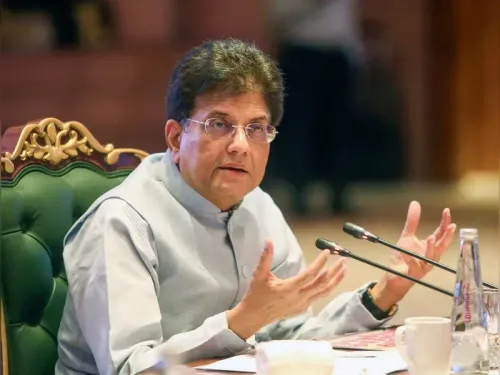
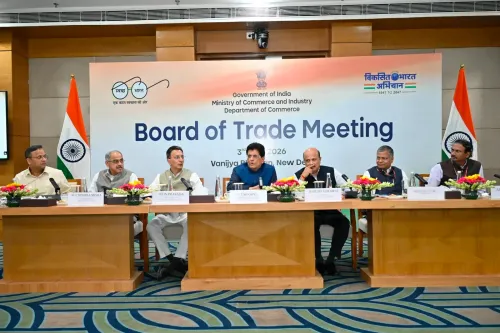
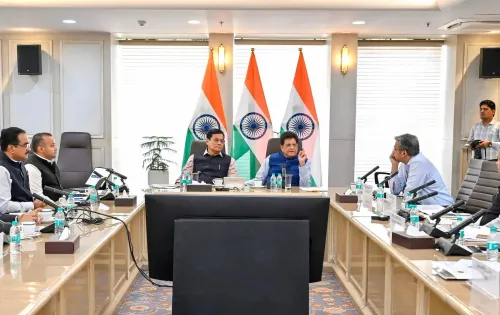
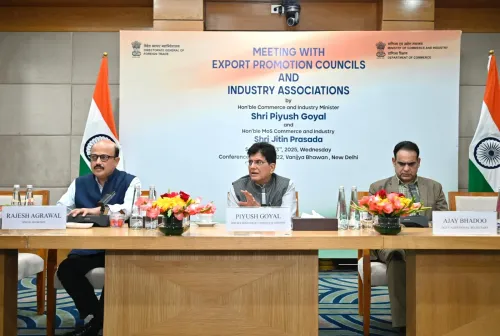
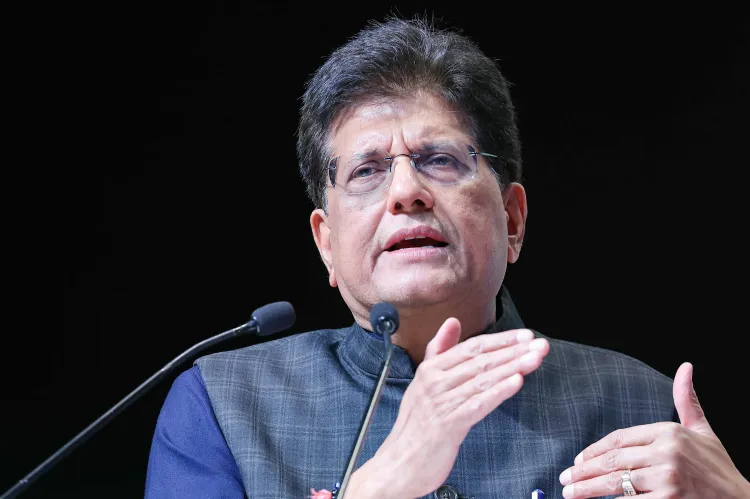
New Delhi, April 26: Commerce and Industry Minister Piyush Goyal is set to chair a high-stakes meeting with export promotion councils and leading industry bodies on April 27 to craft strategies for reviving India's outbound trade, as escalating West Asia geopolitical tensions and a sharp decline in merchandise exports demand urgent government intervention.
The meeting assumes critical importance as India's export engine sputters under the weight of a widening geopolitical crisis involving the United States, Israel, and Iran, which has severely disrupted key shipping corridors in the Middle East — one of India's most significant trade destinations.
Export Decline Triggers Emergency Consultation
India's merchandise exports fell 7.44 per cent in March 2025 to $38.92 billion, marking the steepest monthly decline in five months. The drop is primarily attributed to global trade uncertainty and the intensifying conflict in West Asia, which has made major shipping companies reluctant to operate across large stretches of the Middle East.
Exports to West Asia alone contracted by over 50 per cent during March, a staggering figure that underscores the vulnerability of India's trade architecture to regional conflicts. On a broader scale, India's exports to the Middle East plunged nearly 58 per cent, while imports from Gulf nations fell over 51 per cent in the same period.
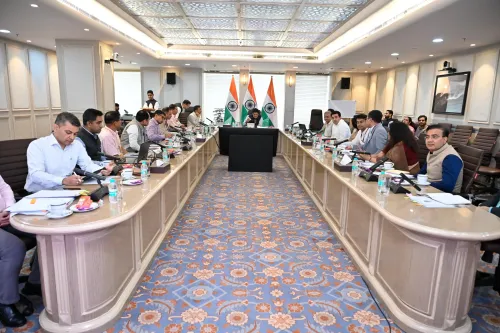
Representatives from key export sectors including leather, pharmaceuticals, automobiles, sports goods, and engineering goods are expected to participate in Monday's consultation, signalling the wide cross-sectoral impact of the current trade stress.
India-New Zealand FTA Signing Sets Positive Backdrop
The exporters' meeting is scheduled to follow India's landmark signing of a free trade agreement (FTA) with New Zealand at Bharat Mandapam — a deal that has been long-anticipated by trade circles on both sides. New Zealand Trade Minister Todd McClay is currently in India alongside a business delegation, actively engaging with Indian industry leaders.
Ahead of the formal FTA signing, Minister Goyal held preliminary discussions with Indian and New Zealand business leaders in Agra on Sunday, April 27, reflecting a concerted push to diversify India's export markets and reduce over-dependence on West Asian trade routes.
Full-Year Trade Data: Record Exports, But Rising Deficit
Despite the March setback, India's merchandise exports for the full financial year 2025-26 recorded a modest growth of 0.93 per cent to reach an all-time high of $441.78 billion. However, imports surged 7.45 per cent to $775 billion, driven largely by a spike in gold and silver imports, pushing the annual trade deficit to $333.2 billion.
On a combined goods and services basis, India's total exports grew 4.22 per cent to touch a record $860.09 billion in 2025-26 — a figure the government will lean on to project macro-level resilience even as sector-specific pain points deepen.
Meanwhile, imports in March declined 6.51 per cent to $59.59 billion, helped by lower inbound shipments of crude oil and gold. As a result, the trade deficit narrowed to a nine-month low of $20.67 billion in March — a silver lining in an otherwise concerning month.
Geopolitical Risk and the Structural Vulnerability Exposed
The West Asia crisis has exposed a structural vulnerability in India's export strategy: an over-concentration of trade flows through the Red Sea and Gulf of Aden corridors. With Houthi attacks on commercial vessels and broader regional instability, freight costs have surged and delivery timelines have stretched, eroding the competitiveness of Indian exporters in global markets.
Notably, this is not the first time India's trade has been buffeted by Middle East disruptions. The 2019-2020 US-Iran tensions similarly caused short-term volatility in India's oil imports and export logistics. However, the current crisis is being described by industry insiders as more prolonged and structurally damaging, given the simultaneous involvement of multiple state actors and the uncertainty around conflict resolution timelines.
Critics argue that India's export diversification strategy — long discussed in policy corridors — has not moved fast enough to reduce dependence on geopolitically volatile corridors. The India-New Zealand FTA and ongoing negotiations with the UK, EU, and GCC are steps in the right direction, but analysts warn that tangible trade redirection takes years, not months.
What to Expect Next
Monday's meeting is expected to produce a set of short-term relief measures for exporters, potentially including enhanced export credit guarantees, logistics subsidies, and market diversification incentives. The government may also fast-track pending FTA negotiations to open alternative market channels.
With India's annual export target for 2026-27 likely to be set ambitiously, the outcome of Goyal's April 27 consultation will be closely watched by industry bodies, foreign investors, and trade analysts as a signal of New Delhi's resolve to protect its export momentum in an increasingly fractured global trade environment.
Point of View
Yet a single regional conflict can erase months of export gains overnight. The India-New Zealand FTA is a welcome move, but signing agreements with smaller economies while the Middle East bleeds Indian trade is akin to building a lifeboat after the ship has already taken on water. Minister Goyal's April 27 meeting must go beyond optics — concrete logistics subsidies, emergency credit lines, and accelerated EU and UK FTA timelines are the only credible responses to a crisis that is both geopolitical and self-inflicted.
NationPress
19 Sept 2026
Frequently Asked Questions
Why is Piyush Goyal meeting exporters on April 27, 2025?
Commerce Minister Piyush Goyal is meeting export promotion councils and industry bodies on April 27 to devise strategies to counter a sharp decline in India's outbound shipments. The meeting is driven by a 7.44% fall in merchandise exports in March 2025 and a collapse of over 50% in exports to West Asia due to ongoing geopolitical tensions.
How much did India's exports fall in March 2025?
India's merchandise exports declined 7.44% in March 2025 to $38.92 billion, the steepest drop in five months. Exports to West Asia were the hardest hit, contracting by over 50% during the month due to shipping disruptions caused by the regional conflict.
What is the India-New Zealand free trade agreement about?
India and New Zealand are signing a long-anticipated free trade agreement at Bharat Mandapam, aimed at boosting bilateral trade and opening new market opportunities for Indian exporters. New Zealand Trade Minister Todd McClay is in India with a business delegation to finalise the deal.
What is India's total merchandise export figure for FY 2025-26?
India's merchandise exports for the full financial year 2025-26 reached an all-time high of $441.78 billion, a modest growth of 0.93%. However, imports rose 7.45% to $775 billion, pushing the annual trade deficit to $333.2 billion.
Which sectors will participate in the April 27 exporters' meeting?
Representatives from leather, pharmaceuticals, automobiles, sports goods, and engineering goods sectors are expected to attend the April 27 meeting with Commerce Minister Piyush Goyal. These sectors have been among those most affected by the disruption of West Asia trade routes.