How Can Tech Enhance Diagnosis While Preserving Human Compassion? - JP Nadda
Synopsis
In a powerful address at AIIMS, Union Health Minister JP Nadda highlights the critical role of technology in healthcare while emphasizing the need for compassion in patient care. As India expands its medical education system, he encourages new graduates to blend empathy with innovation for a brighter healthcare future.
Key Takeaways
Technology and human compassion must coexist in healthcare.
AIIMS has expanded from 1 to 23 institutions in India.
Medical colleges grew from 387 to 819 within 11 years.
Undergraduate medical seats increased from 51,000 to 129,000.
75,000 additional medical seats are expected in 5 years.
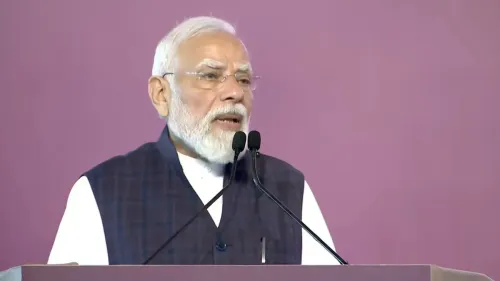
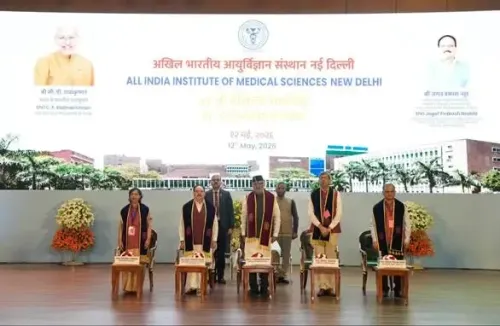
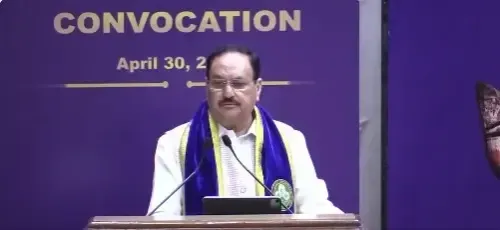
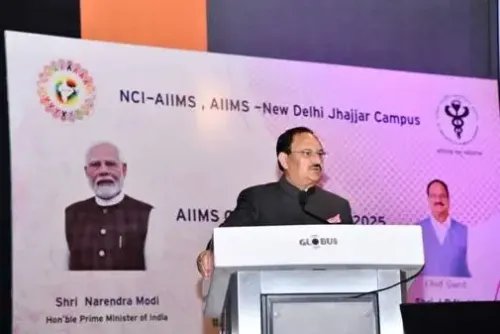
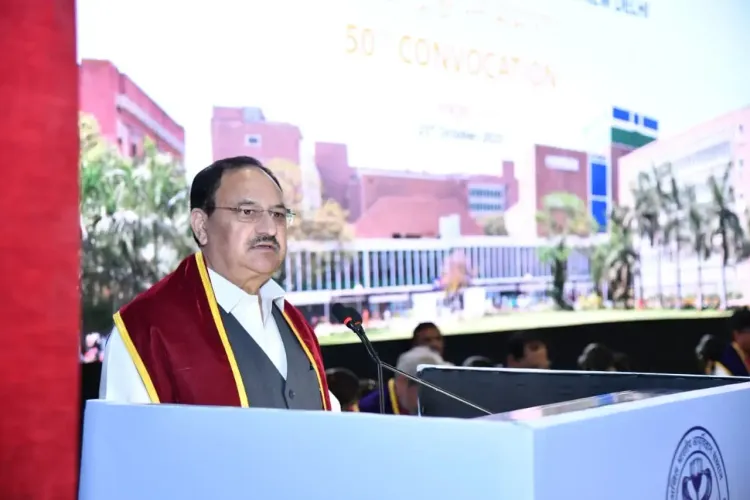
New Delhi, Oct 25 (NationPress) Union Minister of Health and Family Welfare JP Nadda emphasized the importance of integrating technology to enhance diagnosis and detection while ensuring that the human touch remains integral to healthcare. Speaking at the 50th Annual Convocation Ceremony of the All India Institute of Medical Sciences (AIIMS) in New Delhi, Nadda conveyed his heartfelt congratulations to the graduating class and praised AIIMS for its remarkable contributions to medical science, education, and patient care in India.
Nadda encouraged the new doctors to practice with empathy, maintain the highest ethical standards, and utilize innovation to address the changing healthcare landscape of the nation. He remarked, “AIIMS has pioneered advancements in artificial intelligence (AI), genomics, precision medicine, and telehealth—fields that are transforming healthcare. Although technology can aid in diagnosis and improve patient satisfaction, the essential human touch and compassion must endure.”
He commended AIIMS for its steadfast dedication to excellence in medical education, innovative research, and patient care. “In medical sciences, training, and healthcare delivery, AIIMS has carved out a significant reputation, both nationally and internationally,” the Minister stated.
Nadda highlighted the impressive advancements made in India’s healthcare and medical education sectors over the last decade, noting that while there was only one AIIMS at the turn of the century, there are now 23 across the country. This expansion reflects the government’s commitment to providing quality healthcare and medical training to every region.
Moreover, he mentioned that in the past 11 years, the number of medical colleges in India has surged from 387 to 819. Similarly, undergraduate medical seats have increased from 51,000 to 129,000, and postgraduate seats have grown from 31,000 to 78,000. He indicated that an additional 75,000 seats are expected to be created in the next five years for both undergraduate and postgraduate programs.
The Union Health Minister also brought attention to India's progress in maternal and child health, the reduction in under-five mortality rates, neonatal mortality rates, and the decline in tuberculosis cases and deaths.
Prof. V.K. Paul, Member of Niti Aayog, urged the graduates to consider academic careers to teach, mentor, and inspire future healthcare professionals, thereby contributing to the vision of a ‘Viksit Bharat’. “We have a profound societal responsibility to give back to the community that has nurtured us. As you advance in your careers, let excellence be your daily practice and innovation your guiding principle,” Paul remarked.
Point of View
The emphasis on balancing technology with compassionate care is vital for the continued evolution of India's healthcare system. As medical advancements progress, the integration of human empathy is essential for holistic healthcare delivery.
NationPress
5 Oct 2026
Frequently Asked Questions
What did JP Nadda emphasize regarding technology in healthcare?
JP Nadda highlighted the importance of utilizing technology for diagnosis while maintaining the essential human touch and compassion in healthcare.
How many AIIMS institutions are there in India now?
As of now, there are 23 AIIMS institutions across India, reflecting significant growth from just one at the end of the last century.
What progress has been made in India's medical colleges?
In the last 11 years, the number of medical colleges in India increased from 387 to 819, showcasing substantial growth in medical education.
What are the future projections for medical seats in India?
An additional 75,000 undergraduate and postgraduate medical seats are expected to be created in the next five years.
How did the under-five mortality rate change in India?
There has been a positive trend in reducing the under-five mortality rate and neonatal mortality rate in India.