New conger eel species from Arabian Sea named after CMFRI
Synopsis
Indian marine scientists have named a newly discovered deep-sea conger eel after their own institution — CMFRI — marking a rare taxonomic honour and a concrete win for the government's Deep Ocean Mission. Found at 300 metres off Kollam, Ariosoma cmfriense is unlike any of the 12 known Ariosoma species in Indian waters, with a unique speckle pattern that sets it apart. The find lands in CMFRI's 80th anniversary year.
Key Takeaways
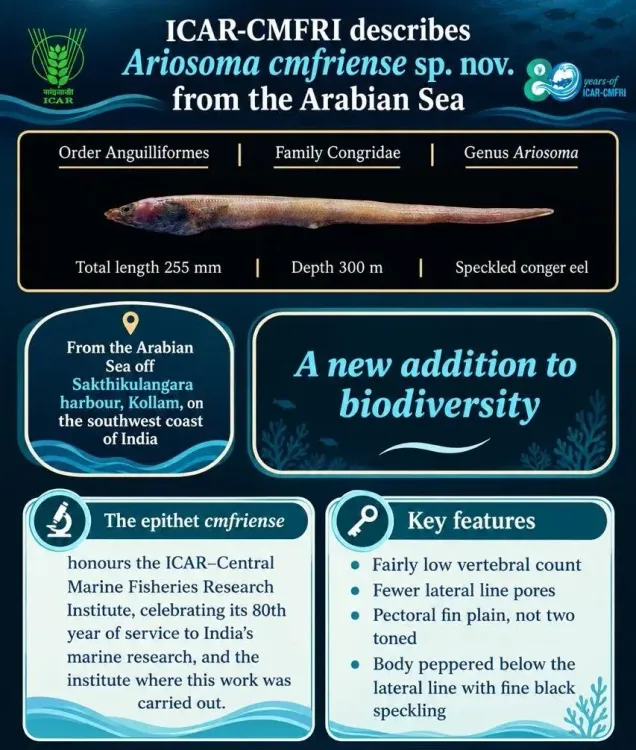
CMFRI scientists discovered a new conger eel species, Ariosoma cmfriense , from the Arabian Sea , named after the institute.
The specimen was collected off Kollam, Kerala at a depth of approximately 300 metres in January 2025 .
The species is distinct from all 12 recognised Ariosoma species in Indian and neighbouring waters, with a unique fine black speckling below the lateral line.
The discovery was made under the Deep Ocean Mission (DOM) of the Ministry of Earth Sciences .
The findings have been published in Zootaxa , and the holotype is deposited at the CMFRI Marine Biodiversity Museum .
The find coincides with CMFRI's 80th anniversary year .
Scientists at the ICAR-Central Marine Fisheries Research Institute (CMFRI) in Kochi have discovered a new species of conger eel from the deep waters of the Arabian Sea and named it Ariosoma cmfriense in honour of the institute. The specimen was collected off the coast of Kollam, Kerala, at a depth of approximately 300 metres in January 2025, and the finding has been formally published in Zootaxa, a peer-reviewed international journal of animal taxonomy.
How the Species Was Identified
Researchers confirmed the new species through a combination of detailed morphological studies and molecular analysis. The specimen was found to be distinctly different from all 12 recognised Ariosoma species previously documented from Indian and neighbouring waters.
The eel carries several anatomically distinctive traits. It has a relatively low total vertebral count of 135 and 127–130 lateral-line pores. Its preanal length is nearly half its total body length. The species also features two supraorbital pores and a dorsal fin that originates just ahead of the pectoral fin base. Notably, fine black speckling below the lateral line — a characteristic not observed in any related species — further sets Ariosoma cmfriense apart, according to the researchers.
Significance for Deep-Sea Research
Dr Grinson George, Director of CMFRI, said the discovery is expected to open new avenues for India's deep-sea research. 'The discovery is expected to offer new dimensions to India's deep-sea research by strengthening scientific understanding of biodiversity and generating baseline information for resource conservation,' he said.
The find is particularly significant as it coincides with CMFRI's 80th anniversary year, adding a symbolic milestone to the institute's scientific legacy. The holotype — the reference specimen used to formally describe the new species — has been deposited at the CMFRI Marine Biodiversity Museum in Kochi for future scientific reference.
Deep Ocean Mission Connection
The discovery was made as part of research conducted under the Deep Ocean Mission (DOM), a flagship national programme of the Ministry of Earth Sciences. The mission aims to explore and document the largely uncharted biodiversity of India's deep-sea zones, and this find represents a tangible output of that initiative.
Dr Rekha J. Nair, Principal Scientist at CMFRI and leader of the research project, noted that while the species has been formally described, its commercial potential can only be assessed after further detailed studies.
What This Adds to Marine Biodiversity Records
The identification of Ariosoma cmfriense adds a new entry to the documented marine biodiversity of the Arabian Sea and provides fresh baseline data for understanding the region's deep-sea ecosystems. This comes amid growing scientific and policy interest in India's oceanic resources, as the country scales up its deep-sea exploration capabilities under the DOM framework. The find underscores that even well-studied ocean basins like the Arabian Sea continue to harbour undescribed species at depth.
Point of View
Which needs exactly these kinds of documented results to justify its budget and sustain political backing. India's deep-sea zones remain vastly under-surveyed, and if a single targeted expedition at 300 metres off Kollam can yield an entirely new species, the case for sustained investment is self-evident. The commercial potential question raised by Dr Nair is also worth watching — deep-sea species have historically opened pharmaceutical and biotechnology applications that surface fisheries cannot.
NationPress
16 Sept 2026
Frequently Asked Questions
What is Ariosoma cmfriense?
Ariosoma cmfriense is a newly identified species of conger eel discovered in the deep waters of the Arabian Sea by scientists at CMFRI. It was formally described after morphological and molecular analysis confirmed it is distinct from all 12 known Ariosoma species in Indian and neighbouring waters.
Where and when was the new eel species found?
The specimen was collected from waters off Kollam, Kerala, at a depth of approximately 300 metres in January 2025. The discovery was made as part of research under the Deep Ocean Mission of the Ministry of Earth Sciences.
Why is this discovery scientifically significant?
The find adds a new species to the documented marine biodiversity of the Arabian Sea and provides baseline data for understanding deep-sea ecosystems. CMFRI Director Dr Grinson George said it is expected to strengthen scientific understanding of biodiversity and support resource conservation efforts.
Where has the research been published?
The scientific paper describing Ariosoma cmfriense has been published in Zootaxa, an international peer-reviewed journal specialising in animal taxonomy. The holotype specimen is deposited at the CMFRI Marine Biodiversity Museum in Kochi.
Does the new species have commercial value?
According to Dr Rekha J. Nair, Principal Scientist and leader of the research project, the commercial potential of Ariosoma cmfriense can only be assessed after further detailed studies. No commercial applications have been identified at this stage.