Nvidia GB300 NVL72 Beats Hopper by 25x Per Watt on DeepSeek
Synopsis
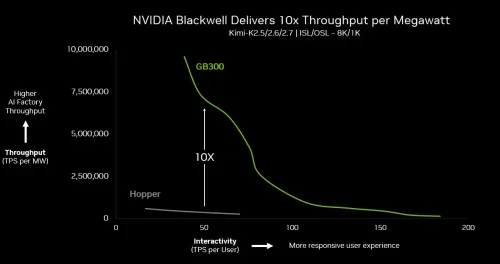
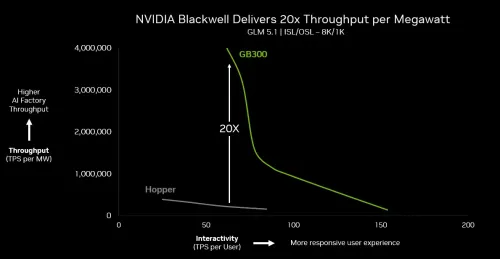
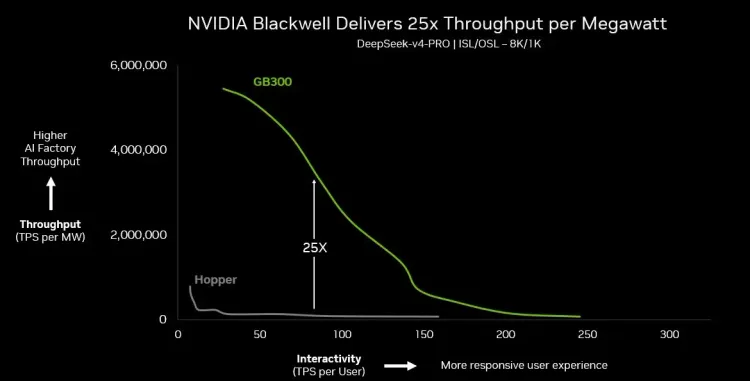
Nvidia claims its GB300 NVL72 rack-scale system delivers up to 25 times higher performance per watt than its Hopper generation on the DeepSeek V4 Pro workload, marking a potential step-change in AI infrastructure economics for data-centre operators worldwide.
Key Takeaways
Nvidia's official account stated on 14 July 2026 that the GB300 NVL72 delivers up to 25× higher performance per watt than the Hopper architecture.
The benchmark workload cited is DeepSeek V4 Pro , a large language model inference task.
The Hopper architecture, launched in 2022 around the H100 GPU, remains the dominant AI accelerator in most hyperscale data centres today.
Nvidia has followed a roughly two-to-three-year architecture cadence: Ampere (2020) , Hopper (2022) , and now the Blackwell Ultra-based GB300 generation.
A 25× efficiency gain, if independently validated, would significantly alter GPU procurement economics for AI operators, including those in India pursuing sovereign compute capacity.
Independent third-party benchmarks are awaited to confirm the performance-per-watt figure across varied workloads and configurations.
Chip giant Nvidia on Tuesday, 14 July 2026 claimed its GB300 NVL72 rack-scale system delivers up to 25 times higher performance per watt than its own previous-generation Hopper architecture when running the DeepSeek V4 Pro inference workload.
Context
The post, shared from Nvidia's official corporate account, states: 'On DeepSeek V4 Pro, NVIDIA GB300 NVL72 systems deliver up to 25× higher performance per watt than NVIDIA Hopper.' The claim positions the GB300 NVL72 — a liquid-cooled, rack-scale platform built around the Blackwell Ultra generation — as a decisive leap over the H100-based Hopper systems that currently power the majority of the world's large AI deployments.
The Hopper architecture was unveiled in 2022 and introduced the H100 GPU alongside NVLink-based rack-scale configurations. It became the de-facto standard for AI training and inference at hyperscale data centres globally, including those operated by major cloud providers serving Indian enterprises.
Policy Backdrop
Nvidia has followed a cadence of releasing new GPU architectures roughly every two to three years — from Ampere (2020) to Hopper (2022) — with each generation targeting large uplifts in performance per watt to keep pace with the exponential growth in AI model sizes. Data-centre power consumption has become a binding constraint for governments and operators worldwide, making efficiency gains as commercially significant as raw throughput.
In India, the government's push to build sovereign AI compute capacity under initiatives such as the IndiaAI Mission has placed GPU procurement and power efficiency at the centre of policy discussions. A 25-fold improvement in performance per watt, if independently validated, would materially change the economics of building and operating AI infrastructure in power-constrained markets.
Stakeholders and Impact
AI hyperscalers and data-centre operators are the primary audience for this benchmark claim. For them, performance per watt directly translates into total cost of ownership: fewer racks, lower cooling bills, and reduced power-purchase agreements for an equivalent amount of AI compute.
Indian cloud providers and public-sector AI projects evaluating next-generation hardware will likely scrutinise this figure closely. The DeepSeek V4 Pro model — a large language model that has attracted significant attention for its efficiency profile — serves as the benchmark workload here, lending the comparison particular relevance to inference-heavy deployments that dominate commercial AI usage today.
What's Next
Independent benchmark results from third-party research groups and hyperscaler customers will be critical to validating Nvidia's claim. The company's own successive architecture comparisons have historically been borne out by external testing, though the precise multiplier can vary by workload and configuration.
Analysts and data-centre planners will watch for detailed technical disclosures on GB300 NVL72 power envelopes, rack density, and availability timelines. For the broader AI industry, a confirmed 25× efficiency gain over Hopper would accelerate the retirement of existing H100 clusters and reshape capital expenditure plans for 2026 and beyond.
Point of View
Nvidia is also signalling that its newest hardware is optimised for the inference workloads that now dominate commercial AI spending, not just training. For India, where the IndiaAI Mission is actively evaluating GPU infrastructure, such efficiency claims carry direct policy weight: fewer megawatts needed per unit of AI output means sovereign compute goals become more financially and logistically attainable. The broader pattern — each Nvidia generation delivering outsized efficiency gains — has consistently reset competitive expectations and extended the company's dominance in AI infrastructure.
NationPress
14 Jul 2026
Frequently Asked Questions
What is the Nvidia GB300 NVL72?
The GB300 NVL72 is Nvidia's latest rack-scale AI compute system, built on the Blackwell Ultra GPU generation and designed for liquid-cooled data-centre deployments targeting large AI inference and training workloads.
How much faster is GB300 NVL72 compared to Hopper?
Nvidia claims the GB300 NVL72 delivers up to 25 times higher performance per watt than its Hopper-generation systems when running the DeepSeek V4 Pro workload, though independent validation is still awaited.
What is DeepSeek V4 Pro?
DeepSeek V4 Pro is a large language model used here as the benchmark inference workload on which Nvidia compared its GB300 NVL72 and Hopper systems.
What was Nvidia's Hopper architecture?
Hopper is an Nvidia GPU architecture unveiled in 2022 that introduced the H100 chip and NVLink-based rack-scale systems; it became the dominant platform for AI training and inference at hyperscale data centres worldwide.
Why does performance per watt matter for AI data centres?
Performance per watt determines how much AI compute a data centre can deliver within its power budget; higher efficiency means lower electricity costs, fewer cooling requirements, and reduced infrastructure investment for the same AI output.