Nvidia, Microsoft Partner on OpenShell AI Runtime for Windows
Synopsis
Chip giant Nvidia announced a partnership with Microsoft to bring secure, user-controlled AI to Windows through a new OpenShell runtime for agents, featuring governance tools, policy enforcement and smart local-to-cloud query routing. The move deepens a long-running hardware-software alliance and targets enterprise concerns about data control in the agentic AI era.
Key Takeaways
Nvidia announced a Microsoft partnership on 3 June 2026 for 'secure, user-controlled AI on Windows'.
The new NVIDIA OpenShell runtime is pitched for AI agents running on Windows endpoints.
Features highlighted: governance tools, policy enforcement and smart local-to-cloud query routing.
Extends a Nvidia-Microsoft collaboration on GPU-accelerated AI dating back to the early 2010s.
Targets enterprise governance and data-sovereignty concerns shaping AI adoption globally.
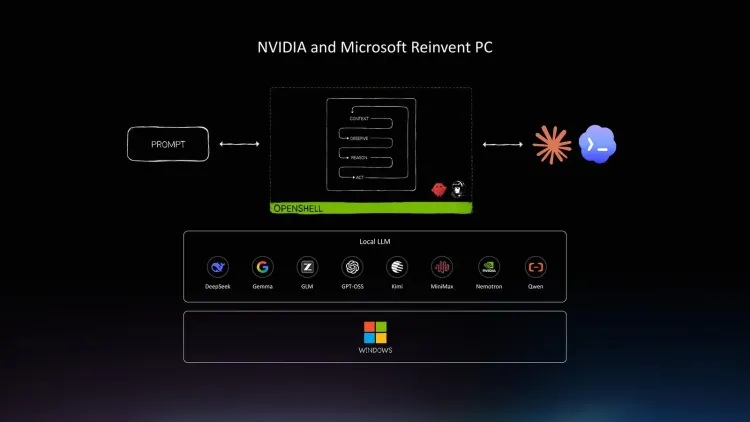
Chip giant Nvidia announced on 3 June 2026 a partnership with Microsoft to enable what it described as 'secure, user-controlled AI on Windows', built around a new NVIDIA OpenShell runtime for AI agents. The corporate post said the runtime would provide governance tools, policy enforcement and smart local-to-cloud query routing for agentic workloads on the world's most widely used desktop operating system.
Context
In the post, Nvidia said it is 'partnering with Microsoft to enable secure, user-controlled AI on Windows', and that the OpenShell runtime for agents will offer 'governance tools, policy enforcement, and smart local-to-cloud query routing'. The message was accompanied by a single image and a link to Nvidia's website for further technical detail.
The framing emphasises three pillars increasingly central to enterprise AI deployment: control over what an autonomous agent can do, enforceable rules on data flow, and the ability to decide which queries are processed on the device versus a remote data centre. These are precisely the levers that chief information officers have flagged as gatekeepers to broader rollout of agentic AI in regulated industries.
Policy backdrop
Nvidia, led by chief executive Jensen Huang, has dominated accelerated computing through its CUDA platform and GPU stack. Microsoft, the maker of Windows and the Azure cloud, has been among Nvidia's largest hardware customers and has aggressively folded AI features into Windows since launching Copilot in 2023.
The two firms have collaborated on GPU-accelerated AI for Azure since the early 2010s, including DGX deployments and deep CUDA optimisation. The latest tie-up extends that relationship from the data centre down to the endpoint, where governance and privacy concerns are most acute.
Globally, regulators in the United States and European Union have intensified scrutiny of how AI systems handle personal and corporate data, pushing vendors toward hybrid architectures that keep sensitive inference on-device while routing heavier workloads to the cloud. The OpenShell runtime, as described, slots squarely into that pattern.
Stakeholders and impact
The most direct beneficiaries, if the runtime ships as positioned, would be enterprise IT teams seeking to deploy AI agents without surrendering control over data egress. Policy enforcement at the runtime layer would let administrators define what agents can access, which models they can call, and under what conditions a query may leave the device.
For AI developers, the promise of 'smart local-to-cloud query routing' suggests a single programming surface that abstracts whether a workload runs on a local GPU or on a remote cluster. That could lower the engineering cost of building agents that respect data-residency rules — a sensitive issue for Indian enterprises in banking, healthcare and government covered by frameworks such as the Digital Personal Data Protection Act, 2023.
For India's rapidly expanding base of Windows PC users and the country's IT services industry, a governance-first agent runtime could shape how managed-services firms package AI offerings for global clients with strict compliance requirements.
What's next
Nvidia did not in the post specify a public release date, supported hardware list, or pricing for the OpenShell runtime. Developers will be watching upcoming editions of Microsoft Build and Nvidia's GTC conference for SDK availability, sample policies and integration guidance with existing Windows enterprise management tools.
The broader signal is that the agentic-AI era will be fought as much on governance plumbing as on raw model capability. If OpenShell delivers credible policy controls at the operating-system layer, it could accelerate enterprise adoption of agents that have so far been held back by compliance anxieties — and tighten the strategic alignment between the world's most valuable chip designer and the world's most widely deployed desktop OS.
Point of View
Not just the model layer. By pushing a runtime that enforces policy and routes queries between device and cloud, Nvidia is positioning itself beyond silicon into the control plane of enterprise AI. For Microsoft, embedding such controls into Windows answers a persistent CIO objection to broader Copilot and agent rollouts. The deeper subtext is regulatory: hybrid architectures with on-device enforcement are becoming the default response to tightening data-protection regimes worldwide.
NationPress
18 Oct 2026
Frequently Asked Questions
What is NVIDIA OpenShell?
NVIDIA OpenShell is a runtime for AI agents announced by Nvidia for use on Windows, designed to provide governance tools, policy enforcement and smart local-to-cloud query routing. Nvidia disclosed it in a 3 June 2026 post outlining a partnership with Microsoft, but did not publish full technical specifications in the post itself.
What did Nvidia and Microsoft announce?
Nvidia and Microsoft announced a partnership to enable 'secure, user-controlled AI on Windows'. The centrepiece is the NVIDIA OpenShell runtime for agents, which will offer governance, policy enforcement and routing of queries between the local device and the cloud.
How does local-to-cloud query routing work?
Local-to-cloud query routing decides whether an AI request is handled by hardware on the user's PC or sent to a remote cloud service. Nvidia describes OpenShell's routing as 'smart', implying the runtime evaluates each query and directs it based on factors such as policy, sensitivity and capability, though precise criteria were not detailed in the post.
Why does this partnership matter for enterprises?
It matters because enterprises have been cautious about deploying AI agents over data-control and compliance concerns. A runtime that enforces policy at the operating-system level could let IT teams allow agentic workflows while still meeting internal and regulatory rules on data egress and model access.
When will NVIDIA OpenShell be available?
Nvidia did not specify a release date in its 3 June 2026 announcement. Developers are likely to look to upcoming Microsoft Build and Nvidia GTC editions for SDK availability and integration timelines.