Nvidia Shifts AI Focus to Cost Per Token in Production
Synopsis
Nvidia declared on 13 July 2026 that the AI industry has moved from chasing peak chip specs to optimising cost per token — how many useful outputs organisations can deliver per dollar, per watt, and within latency limits — pointing to its full-stack inference software as the solution for production-scale deployments.
Key Takeaways
Nvidia publicly shifted the AI infrastructure evaluation metric from peak chip specs to cost per token — covering dollars, watts, and latency.
The company promoted its full-stack inference software as its answer to production-scale AI economics.
Nvidia introduced the CUDA platform in 2006 and the H100 Hopper GPU in 2022 , building its inference stack over nearly two decades.
Enterprise AI teams and data centre operators are the primary stakeholders as AI moves from pilots to continuous production workloads.
Indian data centres in Mumbai , Hyderabad , and Pune are among those most directly affected by this shift in procurement logic.
Future efficiency benchmarks from Nvidia and rival responses will determine whether cost-per-token becomes the industry standard metric.
Chip giant Nvidia on Monday, 13 July 2026, signalled a fundamental shift in how the AI industry evaluates infrastructure — moving away from peak chip specifications toward a new benchmark: cost per token, measured in dollars, watts, and latency.
Context
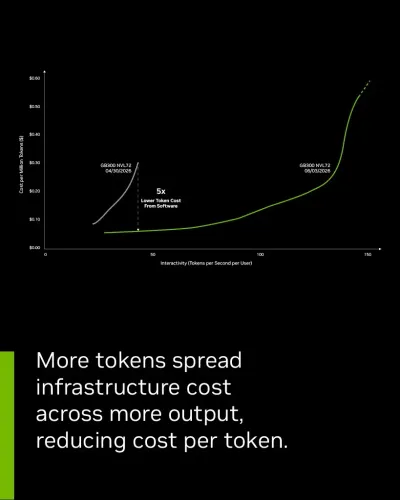
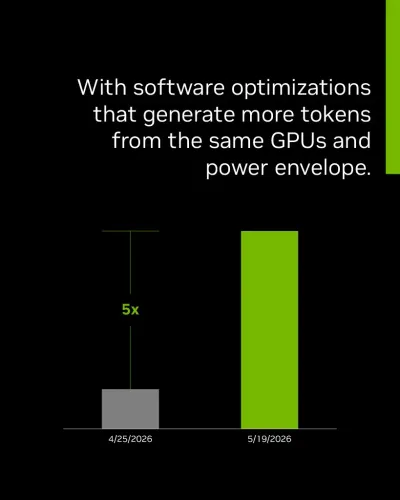
In a post on X, Nvidia stated that as organisations move from AI pilots to production, 'infrastructure decisions have shifted from peak chip specs to cost per token: how many useful tokens they can deliver per dollar, per watt, and within required latency targets.' The company pointed to its full-stack inference software as its answer to this new evaluation framework.
The framing marks a deliberate pivot in the industry's self-understanding. For years, AI procurement conversations centred on raw compute power — the number of floating-point operations a chip could perform per second. Nvidia is now publicly anchoring the conversation around sustained, economical throughput at scale.
Policy Backdrop
Nvidia has been building toward this moment for nearly two decades. The company introduced its CUDA parallel computing platform in 2006, which established graphics processing units as the backbone of AI workloads long before large language models became mainstream. The Hopper GPU architecture, launched with the H100 chip in 2022, was explicitly designed to optimise large-scale AI inference alongside model training.
The broader industry context is one of rising pressure. Hyperscale data centres running large language models face surging electricity bills and mounting capital expenditure. Operators are no longer asking 'how fast can this chip go?' but rather 'how cheaply and efficiently can it serve real users at scale?' Nvidia's full-stack approach — bundling hardware with inference software — is designed to capture value precisely at this layer.
Stakeholders and Impact
The primary audience for this message is enterprise AI teams and data centre operators who are past the pilot stage and now running inference workloads continuously. For these operators, energy costs and per-query economics are board-level concerns, not just engineering footnotes.
Indian enterprises and cloud providers are directly implicated. As domestic AI adoption accelerates — driven by government digital-infrastructure pushes and private sector deployments — procurement decisions for GPU clusters will increasingly be made on the cost-per-token metric Nvidia is now championing. Data centre operators in Mumbai, Hyderabad, and Pune, where major cloud availability zones are concentrated, will feel this shift most acutely.
For smaller AI startups and research institutions, the shift in framing could widen access: if inference efficiency improves, the cost of running production AI applications falls, potentially democratising deployment beyond well-capitalised hyperscalers.
What's Next
Nvidia's next set of inference software updates and any efficiency benchmarks released alongside upcoming earnings calls or developer conferences will be closely watched. The company's ability to demonstrate measurable improvements in tokens-per-dollar and tokens-per-watt will determine whether this framing translates into competitive advantage or remains marketing positioning.
The industry will also watch whether rival chipmakers and cloud providers adopt the cost-per-token metric as a standard benchmark, or contest it with alternative frameworks that may favour their own architectures.
Point of View
Nvidia shapes how enterprises evaluate competing chips, giving its own hardware-plus-software bundle a structural advantage. For India, where government-backed AI missions and private cloud expansion are driving GPU procurement at scale, this metric shift will directly influence billions of rupees in data centre investment decisions. The broader pattern mirrors how dominant platform companies set evaluation standards that happen to favour their own integrated offerings.
NationPress
14 Jul 2026
Frequently Asked Questions
What does cost per token mean in AI infrastructure?
Cost per token refers to how much it costs — in money, energy, or time — to generate one unit of AI output (a 'token', roughly a word or word-fragment). Nvidia is arguing this is now the most important metric for organisations running AI in production, replacing older benchmarks focused on raw chip speed.
What is Nvidia's full-stack inference software?
Nvidia's full-stack inference software is a suite of tools that works alongside its GPUs to optimise how AI models serve responses at scale. It is designed to maximise throughput and efficiency, reducing the cost and energy consumed per token generated.
Why is Nvidia shifting focus from peak chip specs to cost per token?
As AI moves from experimental pilots to always-on production systems, operators face real electricity bills and per-query economics. Peak speed matters less than sustained, affordable throughput. Nvidia is aligning its messaging with this operational reality to stay relevant to enterprise buyers.
How does this Nvidia announcement affect Indian companies?
Indian enterprises and cloud providers building AI products will increasingly use cost-per-token as a procurement benchmark when choosing GPU infrastructure. Data centres in Mumbai, Hyderabad, and Pune are directly in scope as domestic AI deployment scales up.
What should we watch next from Nvidia on AI inference?
Watch for Nvidia's next inference software updates and any efficiency benchmarks it releases at earnings calls or developer conferences. Rival chipmakers' responses to the cost-per-token framing will also signal whether this becomes an industry-wide standard.