Nvidia Welcomes RTX Spark, Signals New Era for AI PCs
Synopsis
Nvidia on June 1, 2026, welcomed RTX Spark and declared 'a new beginning for PCs,' extending its RTX brand into AI-accelerated personal computing. The move signals a fresh platform push targeting PC OEMs, AI developers, and consumers as the AI-PC race intensifies globally.
Key Takeaways
Nvidia officially welcomed @NVIDIARTXSpark on June 1, 2026 , describing it as 'a new beginning for PCs.' The announcement extends the RTX platform — first launched in 2018 with Turing GPUs — into a dedicated AI-PC identity.
Nvidia's RTX architecture combines real-time ray tracing, DLSS , and Tensor Core-based AI acceleration for consumer hardware.
PC OEMs and AI developers are the primary stakeholders likely to respond with co-branded products and optimised software.
The move positions Nvidia more directly against competing AI-PC platforms from Intel and AMD in a fast-growing global market.
Indian AI engineers, game developers, and creative professionals represent a key growth segment that could benefit from expanded RTX Spark-certified hardware.
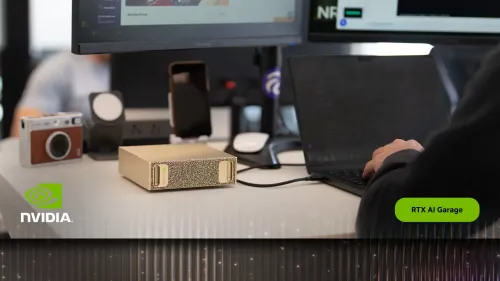
Chip giant Nvidia on Monday, June 1, 2026, officially welcomed @NVIDIARTXSpark to its ecosystem, signalling what the company described as 'a new beginning for PCs' — a move that underscores the GPU leader's deepening push into AI-accelerated personal computing.
Context
Nvidia's post — brief but pointed — reads: 'Welcome @NVIDIARTXSpark & a new beginning for PCs.' The phrasing suggests the formal introduction of a new platform, initiative, or partner account under the RTX Spark banner, extending Nvidia's well-established RTX brand into what appears to be a focused AI-PC segment. The RTX platform, first launched with the Turing GPU architecture in 2018, pioneered real-time ray tracing and DLSS (Deep Learning Super Sampling) for consumer graphics and has since expanded into AI inference workloads on local hardware.
The 'new beginning for PCs' framing carries deliberate weight. Nvidia has spent the better part of the last three years repositioning the personal computer not merely as a gaming or productivity device, but as a local AI inference node — capable of running large language models and generative AI applications without relying on cloud infrastructure.
Policy Backdrop
Nvidia's journey from discrete graphics cards to full-stack AI platforms traces back to the commercial success of CUDA, the company's parallel-computing framework, and later TensorRT, its inference optimisation toolkit. These tools gave PC hardware a software foundation that rivals could not easily replicate. The RTX line extended that moat into the consumer segment by baking AI acceleration — via dedicated Tensor Cores — directly into mainstream GPUs.
The broader industry context is significant: Microsoft's Copilot+ PC initiative, Intel's Core Ultra series, and AMD's competing Ryzen AI chips have all staked claims on the AI-PC narrative. Nvidia's RTX Spark positioning appears designed to consolidate its own identity within that race, leveraging the RTX brand's recognition among PC OEMs, developers, and gamers globally — including a fast-growing base in India, where PC gaming and AI developer communities have expanded sharply.
Stakeholders and Impact
PC original equipment manufacturers (OEMs) such as Asus, Dell, HP, Lenovo, and MSI are the most immediate stakeholders, as any new Nvidia platform designation typically triggers a wave of co-branded product announcements and marketing campaigns. For AI developers and independent software vendors, a dedicated RTX Spark identity could mean a cleaner certification or optimisation target for local AI applications.
Indian consumers and enterprises stand to benefit indirectly: the country's growing base of AI engineers, game developers, and creative professionals relies heavily on RTX-class hardware for local inference, content creation, and real-time rendering. A renewed platform push by Nvidia could accelerate OEM launches of AI-capable laptops and desktops at competitive price points in the Indian market.
What's Next
Industry observers will watch for formal product or partnership announcements tied to the RTX Spark identity, particularly at upcoming technology events and OEM launch cycles. Nvidia has historically used platform introductions of this kind as precursors to broader ecosystem reveals — including software toolkits, developer programmes, and co-marketing arrangements with hardware partners.
The 'new beginning for PCs' signal from one of the world's most influential semiconductor companies suggests that the AI-PC transition, often discussed in abstract terms, may be entering a more concrete, branded, and consumer-facing phase — with Nvidia intent on owning that narrative.
Point of View
The company is planting a brand flag at the intersection of AI and personal computing before rivals can consolidate that space. This follows a clear pattern — Nvidia used similar low-key platform introductions before major ecosystem rollouts around CUDA and RTX — suggesting the post is a soft launch signal rather than a standalone gesture. For India, where the AI developer and gaming PC markets are growing in tandem, a renewed Nvidia platform push could shape OEM product roadmaps and software investment cycles in the near term. The broader arc is one of Nvidia methodically converting its data-centre AI dominance into a consumer-PC narrative it can own end-to-end.
NationPress
15 Oct 2026
Frequently Asked Questions
What is Nvidia RTX Spark?
RTX Spark appears to be a new Nvidia platform or initiative under the established RTX brand, focused on AI-accelerated personal computing. Nvidia officially welcomed it on June 1, 2026, describing it as 'a new beginning for PCs,' though full details of its scope have not yet been disclosed.
What does 'a new beginning for PCs' mean for Nvidia?
The phrase signals Nvidia's intent to reposition the personal computer as an AI-capable device, building on its RTX architecture's Tensor Cores and DLSS technology to support local AI inference alongside traditional gaming and productivity workloads.
How does Nvidia RTX Spark affect Indian PC buyers?
Indian consumers, AI developers, and creative professionals who use RTX-class hardware could see new OEM laptops and desktops certified or optimised under the RTX Spark banner, potentially bringing AI acceleration features to a wider range of price points.
What is the Nvidia RTX platform?
The Nvidia RTX platform was introduced in 2018 with the Turing GPU architecture, adding real-time ray tracing and Deep Learning Super Sampling (DLSS) to consumer graphics cards. It has since expanded to cover professional workstations and AI PC workloads.
Which PC brands could launch RTX Spark products?
Major PC OEMs including Asus, Dell, HP, Lenovo, and MSI are the most likely partners for any RTX Spark-branded product line, as these manufacturers have historically co-launched hardware tied to new Nvidia platform designations.