Has NASA’s Perseverance Rover Completed Its 1st AI-planned Drive on Mars?
Synopsis
NASA's Perseverance rover has made history by completing its first drives on Mars, entirely planned by artificial intelligence. This groundbreaking achievement not only showcases advanced technologies but also paves the way for future explorations of distant worlds. Discover how AI is revolutionizing space missions and enhancing our understanding of the cosmos.
Key Takeaways
Perseverance rover successfully completed first AI-planned drives.
AI enhances mission efficiency and navigation.
Collaboration with Anthropic for AI technology.
Vision-language models aid in decision-making.
Rover has been exploring Mars since 2021.
New Delhi, Feb 1 (NationPress) NASA has announced that its six-wheeled Perseverance rover has successfully completed its inaugural drives on Mars, which were orchestrated by artificial intelligence (AI). The drives took place on December 8 and 10, 2025, showcasing the use of generative AI to establish waypoints for the rover. This intricate decision-making process is usually handled manually by human rover planners at the Jet Propulsion Laboratory (JPL) in Southern California.
NASA Administrator Jared Isaacman remarked, "This demonstration illustrates how far our capabilities have advanced and expands our prospects for exploring other worlds." He further emphasized, "Autonomous technologies like this can enhance mission efficiency, adapt to challenging landscapes, and boost scientific returns as the distance from Earth increases. This is a compelling example of teams applying new technology judiciously and responsibly in real operational contexts."
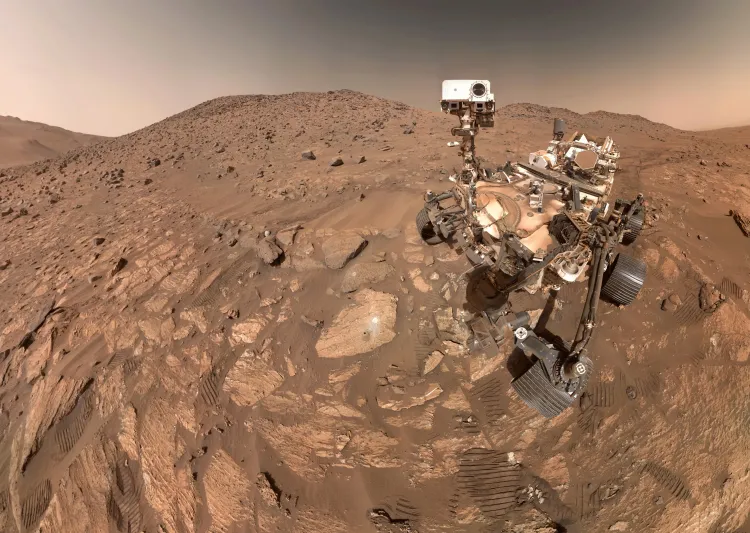
The rover, which is comparable in size to a car and equipped with seven scientific instruments, has been on a mission to explore Mars since 2021, investigating its geology and atmosphere while collecting samples.
During this demonstration, the team utilized a type of generative AI known as vision-language models to interpret data from the surface mission dataset. The AI processed the same images and data that human planners typically use to determine waypoints—specific locations where the rover receives a new set of instructions—allowing Perseverance to navigate the challenging Martian landscape safely.
This initiative originated from JPL's Rover Operations Center (ROC) in partnership with Anthropic, employing the company's Claude AI models. The team employed a vision-capable AI to chart a secure course across the Red Planet's surface without reliance on human route planners.
NASA highlighted that on December 8, with the AI-generated waypoints stored in its memory, Perseverance drove a distance of 689 feet (210 meters). Two days later, it successfully traveled 807 feet (246 meters).
Point of View
The evolution of technology in space exploration is a testament to human ingenuity. NASA's successful deployment of AI in the Perseverance rover's navigation not only enhances mission efficiency but also represents a significant leap toward future interplanetary exploration. This advancement is crucial as we seek to understand more about Mars and beyond.
NationPress
19 Oct 2026
Frequently Asked Questions
What is the significance of AI in NASA's Perseverance rover?
The use of AI allows the rover to navigate autonomously, making real-time decisions without human intervention, which enhances mission efficiency and adaptability to challenging terrains.
When did the Perseverance rover complete its AI-planned drives?
The rover completed its first AI-planned drives on Mars on December 8 and 10, 2025.
Who collaborated with NASA in this AI initiative?
NASA collaborated with Anthropic and utilized their Claude AI models for this initiative.
What are vision-language models?
Vision-language models are a type of generative AI that can interpret and analyze visual data, aiding in decision-making processes.
What instruments does the Perseverance rover carry?
The Perseverance rover carries seven scientific instruments designed for studying Mars' geology and atmosphere, as well as for sample collection.