Tianwen-2 images asteroid 2016 HO3 at 20km, finds it smaller than expected
Synopsis
China's Tianwen-2 has photographed asteroid 2016 HO3 from just 20 km away, only to discover the target may be as small as 20–30 metres across — a surprise that scientists warn makes the planned sample return far harder than any previous asteroid mission.
Key Takeaways
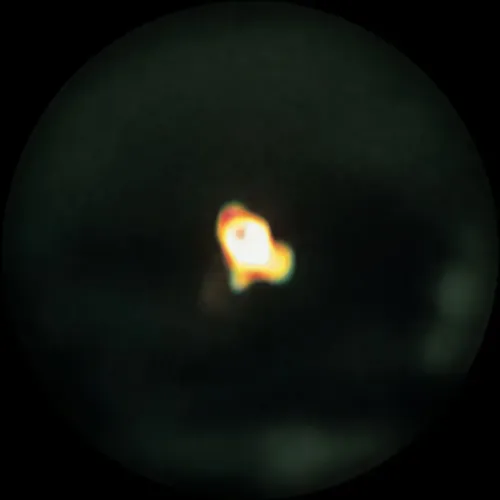
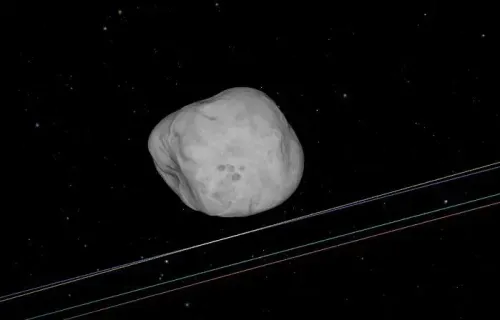
Tianwen-2 captured its first close-up image of asteroid 2016 HO3 from roughly 20 kilometres away, the China National Space Administration announced on 6 July 2026 .
New imagery suggests the asteroid is less than 40 metres in diameter, below the pre-mission estimate of 40–100 metres .
Zhang Pengfei of the Institute of Geochemistry, Chinese Academy of Sciences , now estimates the body is only 20–30 metres across, versus an earlier published figure of 57 metres .
The revised size makes 2016 HO3 far smaller than Japan's Ryugu (~ 900 m ) and NASA's Bennu (~ 500 m ), complicating the sample-return manoeuvre.
A successful sample collection would deliver China's first asteroid material and advance the broader Tianwen programme, which also targets Mars and Jupiter .
China's Tianwen-2 spacecraft has captured its first close-up image of near-Earth asteroid 2016 HO3 (also designated 469219 Kamo'oalewa) from a distance of approximately 20 kilometres, revealing the target is significantly smaller than pre-mission estimates — a finding scientists say will make the sample-return task "far more difficult" than comparable Japanese and American missions.
What the images reveal
The China National Space Administration (CNSA) announced on Monday, 6 July 2026 that Tianwen-2 had entered its approach phase and was close enough to begin scientific exploration of the asteroid. The image released by CNSA, along with its accompanying scale bar, suggests the asteroid is likely less than 40 metres in diameter — well below the previously estimated range of 40 to 100 metres.
Zhang Pengfei, a researcher from the Institute of Geochemistry at the Chinese Academy of Sciences, put the revised figure even lower. "Based on the image released so far, this asteroid appears to be somewhat smaller than previously predicted — it seems to be only about 20 to 30 metres across, whereas the earlier estimate from our paper was around 57 metres," he said.
Why it matters: size complicates sample return
The diminutive scale of 2016 HO3 sets it apart sharply from the two asteroids previously targeted by peer space agencies. Japan's Ryugu and NASA's Bennu measure roughly 900 metres and 500 metres across, respectively — making 2016 HO3 potentially 10 to 45 times smaller than those bodies. A smaller asteroid means weaker surface gravity, less predictable terrain, and a narrower margin for the touch-and-go sampling manoeuvre that is central to the mission's scientific objectives.
The asteroid is classified as an Apollo-type near-Earth asteroid, a family of objects whose orbits cross Earth's path around the Sun. Its quasi-satellite behaviour — it appears to orbit Earth while actually circling the Sun — has made it a subject of scientific interest for years.
The competitive backdrop
Tianwen-2 arrives at 2016 HO3 after a roughly 400-day cruise from Earth, building on the engineering heritage of Tianwen-1, China's first Mars mission. The broader Tianwen programme also includes Tianwen-3, a planned Mars sample-return mission, and Tianwen-4, targeting the outer solar system including Jupiter. A successful sample return from 2016 HO3 would give China its first asteroid material and position CNSA alongside JAXA and NASA as a full-spectrum planetary-science power.
What's next
The spacecraft will continue its close-approach scientific survey before attempting the sample-collection phase. The revised size estimate means mission planners may need to adapt proximity-operations procedures developed for larger bodies. All eyes will be on whether CNSA can execute a precision landing on a target that is, by some measures, barely larger than a city block.
Point of View
But a 20–30 metre target operates in a gravitational and navigational regime those missions never encountered. If Tianwen-2 succeeds, China will have leapfrogged its peers on technical difficulty, not merely replicated them. Failure, conversely, would expose the gap between CNSA's rapid programme expansion and the operational maturity needed for precision small-body rendezvous.
NationPress
5 Oct 2026
Frequently Asked Questions
What has Tianwen-2 discovered about asteroid 2016 HO3?
Tianwen-2 has found that asteroid 2016 HO3 is likely only 20–30 metres in diameter, significantly smaller than the pre-mission estimate of 40–100 metres. The China National Space Administration released the close-up image on 6 July 2026, taken from about 20 kilometres away.
Why is the small size of 2016 HO3 a problem for the mission?
A smaller asteroid has weaker gravity and less predictable surface conditions, making the touch-and-go sample collection far more challenging. Scientists have described the task as 'far more difficult' than the Japanese Hayabusa2 mission to Ryugu or NASA's OSIRIS-REx mission to Bennu, both of which targeted much larger bodies.
How does 2016 HO3 compare to Ryugu and Bennu?
Ryugu is approximately 900 metres across and Bennu roughly 500 metres, making them 10 to 45 times larger than the revised estimate for 2016 HO3. This size difference fundamentally changes the orbital dynamics and landing procedures a spacecraft must use.
What is China's broader Tianwen programme?
The Tianwen programme is China's series of deep-space exploration missions. It includes Tianwen-1 (Mars orbiter and rover), Tianwen-2 (current asteroid mission), Tianwen-3 (planned Mars sample return), and Tianwen-4 (targeting Jupiter and the outer solar system).
What happens next for Tianwen-2?
Tianwen-2 will continue its close-approach scientific survey of 2016 HO3 before attempting the sample-collection phase. Mission planners may need to revise proximity-operations procedures in light of the asteroid's smaller-than-expected size.