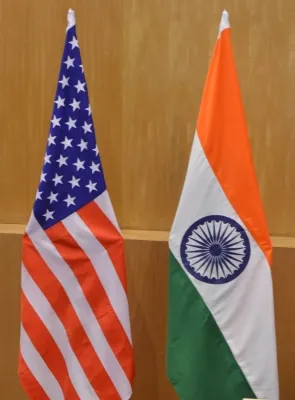
US-China AI safety cooperation urged at Singapore forum
Synopsis
At a Singapore forum, top scholars and executives — including Macro Advisory Partners’ Jude Blanchette — warned that the US and China must jointly govern AI risks despite geopolitical rivalry, invoking the concept of a ‘technocene’ era of exponential technological disruption.
Key Takeaways
Jude Blanchette , managing director of Macro Advisory Partners , called on the US and China to collaborate on AI safety at the FutureChina Business Forum in Singapore on 25 September 2026 .
Blanchette coined the term ‘technocene’ to describe an era of exponential technological change that will reshape global power dynamics.
Concerns extend beyond AI to robotics , underscoring how multiple emerging technologies are converging to create shared civilisational risks.
Participants included representatives from Tsinghua University , Hugging Face , OpenAI , and Uisee Technology .
Singapore is emerging as the preferred neutral venue for bridging US-China AI governance discussions.
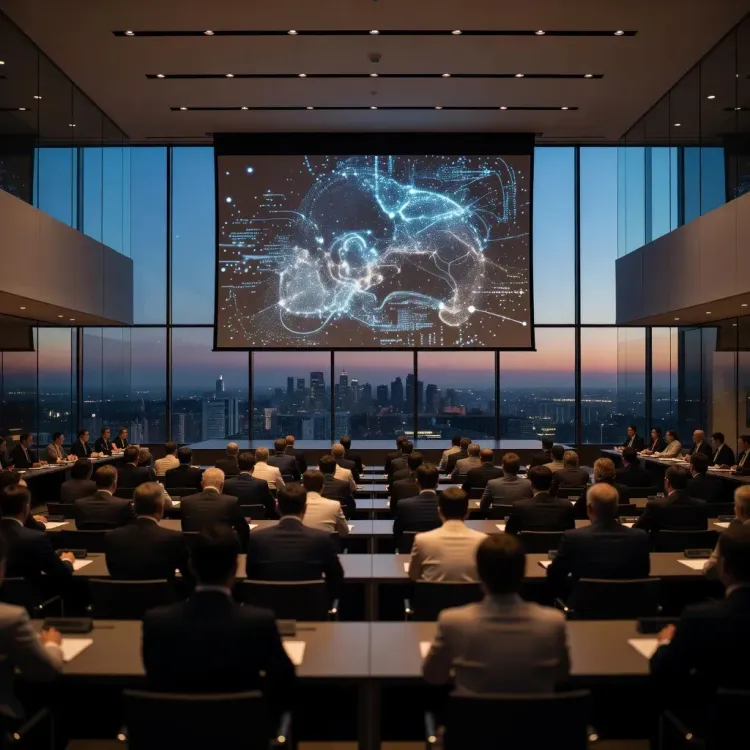
Leading scholars and industry executives called on the United States and China to jointly establish safety guardrails for artificial intelligence at the FutureChina Business Forum in Singapore on Friday, 25 September 2026, warning that the pace of AI advancement is outstripping existing risk-control frameworks.
The core call to action
Jude Blanchette, managing director of consultancy Macro Advisory Partners, urged both superpowers to find common ground despite deepening geopolitical tensions. “If ever there was a moment for [the US and China] to feel a strong impetus to come together, it would be now … given the shared concerns about the impact of emerging technologies, not only AI but also robotics,” Blanchette said.
His remarks carried particular weight given the sustained deterioration in US-China relations across trade, semiconductors, and defence technology over recent years.
Why it matters
Blanchette argued that the world is transitioning from an era shaped by traditional human behaviour into what he termed a ‘technocene’ — a period defined by exponential technological leaps that will fundamentally reshape global power dynamics. The framing positions AI not merely as an economic tool but as a civilisational-scale force requiring multilateral governance.
The warning comes as both Washington and Beijing accelerate national AI investment programmes, with frontier model development, autonomous robotics, and AI-enabled defence systems all advancing rapidly on both sides.
The competitive backdrop
The forum brought together voices from Tsinghua University, Hugging Face, OpenAI, and Uisee Technology, reflecting a rare convergence of Chinese and Western AI stakeholders on neutral ground. Singapore has increasingly positioned itself as a diplomatic midpoint for exactly these conversations, given its strong ties with both Washington and Beijing.
Historically, US-China coordination on risk-laden technologies has proven difficult — analysts have drawn comparisons to Cold War-era nuclear arms-control diplomacy, noting that even adversaries eventually recognised the necessity of shared safety protocols.
What’s next
The forum signals growing pressure on both governments to move beyond competitive framing and engage in structured AI safety dialogue, whether through bilateral channels or multilateral bodies. Singapore’s role as a convener is likely to deepen as frontier AI capabilities continue to expand.
Observers will be watching whether the calls from FutureChina Business Forum translate into concrete policy engagement, particularly ahead of anticipated regulatory milestones in both Washington and Beijing in early 2027.
Point of View
Not ideological. Singapore’s emergence as the convening venue is itself telling; it reflects a vacuum in multilateral AI governance that neither Geneva nor New York has filled. If Blanchette’s ‘technocene’ framing gains traction in policy circles, it could shift the debate from competitive dominance to shared-risk management — but only if governments move faster than their domestic political incentives currently allow.
NationPress
25 Sept 2026
Frequently Asked Questions
What was agreed at the FutureChina Business Forum on AI safety?
No formal agreement was reached, but leading scholars and industry executives at the FutureChina Business Forum in Singapore on 25 September 2026 issued a strong collective call for the US and China to establish joint AI safety guardrails. The forum served as a platform for consensus-building rather than binding commitments.
Who is Jude Blanchette and why does his view matter?
Jude Blanchette is the managing director of consultancy Macro Advisory Partners , a firm that advises on geopolitical risk. His call for US-China AI cooperation is significant because he works at the intersection of policy and business advisory, giving his warnings practical weight beyond academic commentary.
Why is Singapore hosting US-China AI discussions?
Singapore has positioned itself as a diplomatic neutral ground with strong ties to both Washington and Beijing , making it an ideal venue for conversations that would be politically fraught on either superpower’s home turf. The city-state’s role as a convener of sensitive tech-governance dialogue is expected to grow as AI capabilities expand.
What is the ‘technocene’ concept mentioned at the forum?
The ‘technocene’ is a term used by Jude Blanchette to describe a coming era in which exponential technological leaps — driven by AI, robotics, and related fields — will dramatically reshape global power dynamics. It frames current AI development not as a commercial race but as a structural shift in how human societies operate.
Which organisations were represented at the FutureChina Business Forum?
The FutureChina Business Forum drew participants from Tsinghua University , Hugging Face , OpenAI , and Uisee Technology , among others. The mix of Chinese and Western AI stakeholders made the event a rare convergence of voices from both sides of the technology rivalry.