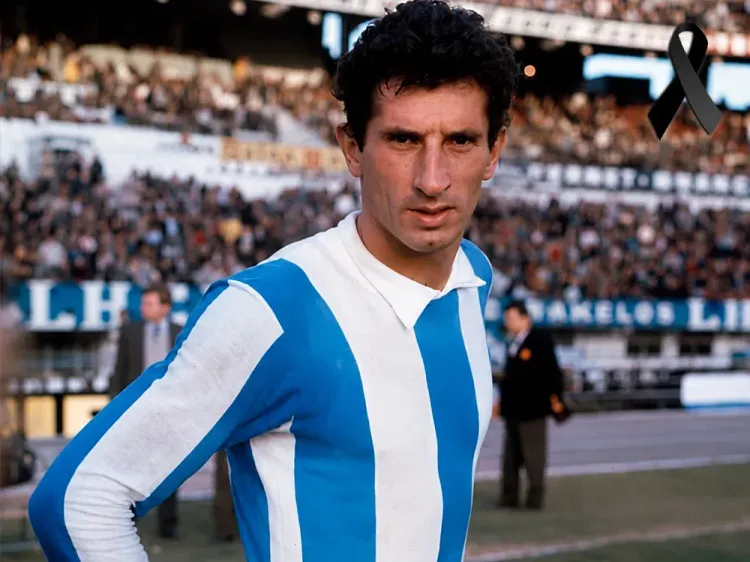
Antonio Rattin, who inspired football's card system, dies at 89
Synopsis
Antonio Rattin did not just play football — he changed it. His defiant refusal to leave the pitch at the 1966 World Cup, sitting on the Queen's carpet and crumpling a British flag, so rattled the global game that FIFA introduced the red and yellow card system four years later. He was 89.
Key Takeaways
Antonio Ubaldo Rattin , Argentine football captain and midfielder, died on 12 July at the age of 89 .
His sending-off in the 1966 World Cup quarter-final against England — before cards existed — directly inspired FIFA to introduce the card system at the 1970 World Cup .
Rattin made 382 appearances for Boca Juniors between 1956 and 1970 , winning four league titles and reaching the 1963 Copa Libertadores final.
He represented Argentina internationally from 1959 to 1969 , playing at the 1962 and 1966 World Cups.
After retiring, Rattin served briefly as Boca Juniors coach before entering politics.
Argentine football legend Antonio Ubaldo Rattin, one of the most commanding captains and midfielders in the history of the sport, died on 12 July at the age of 89. A towering figure across two World Cups — 1962 and 1966 — Rattin represented Argentina from 1959 to 1969 and left an imprint on the game that outlasted his playing days by decades.
The Argentine Football Association Pays Tribute
The Argentine Football Association (AFA), through its President Claudio Tapia, issued a formal statement mourning the loss. 'The Argentine Football Association, through its President Claudio Tapia, deeply mourns the passing of Antonio Ubaldo Rattín, one of the greatest symbols in the history of the Argentine National Team and an undisputed icon of Argentine football, who died today at the age of 89,' the statement read.
The AFA described Rattin as 'the emblem of a generation of footballers who understood the national team jersey as an absolute commitment, where leadership was exercised through example, sacrifice, and the pride of representing the country.'
The 1966 Incident That Changed Football Forever
Rattin's most consequential moment came not from a goal or a trophy, but from a dismissal. Captaining Argentina in the 1966 World Cup quarter-final against hosts England at Wembley, he was sent off by German referee Rudolf Kreitlein — at a time when yellow and red cards did not yet exist in the game.
Convinced he had been wronged and unable to comprehend the referee's decision, Rattin requested a translator before departing the field. What followed became one of football's most iconic scenes: he sat down on the red carpet reserved for Queen Elizabeth II and, before finally leaving the stadium, crumpled a British flag. The episode reverberated internationally and, notably, directly influenced FIFA's decision to introduce the formal card system — officially implemented at the 1970 World Cup — to bring clarity to refereeing sanctions.
A Career Built at Boca Juniors
Rattin spent his entire club career at Buenos Aires giants Boca Juniors, making 382 appearances between 1956 and 1970. He scored 28 goals, won four league titles, and led the club to the 1963 Copa Libertadores final. His loyalty to a single club across 14 seasons underscored the same sense of commitment the AFA attributed to his international career.
Life After Football
After hanging up his boots, Rattin briefly took charge as Boca Juniors coach before transitioning into politics. The AFA said his legacy 'will forever remain in the history of the Argentine Football Association and in the memory of all those who understand that wearing the Argentine jersey means much more than playing a match.' With his passing, world football loses one of the rare figures whose influence extended beyond the pitch and into the rulebook itself.
Point of View
Yet it risks overshadowing a decorated club career at Boca Juniors spanning 382 matches and 14 years. Mainstream obituaries will lead with the carpet and the flag; the fuller story is of a captain whose temperament, for better and worse, defined an era of Argentine football that prized national pride above diplomatic restraint.
NationPress
12 Jul 2026
Frequently Asked Questions
Who was Antonio Rattin?
Antonio Ubaldo Rattin was an Argentine footballer who captained the national team and played for Boca Juniors from 1956 to 1970, making 382 appearances and winning four league titles. He represented Argentina at the 1962 and 1966 World Cups and is widely regarded as one of the greatest captains in Argentine football history.
How did Antonio Rattin inspire football's card system?
At the 1966 World Cup quarter-final against England, Rattin was sent off by referee Rudolf Kreitlein at a time when no formal card system existed, creating confusion and a prolonged incident. The international controversy that followed prompted FIFA to officially introduce yellow and red cards at the 1970 World Cup to bring clarity to on-field sanctions.
What happened during Rattin's famous 1966 World Cup sending-off?
After being dismissed by referee Rudolf Kreitlein, Rattin refused to leave immediately and requested a translator. He then sat on the red carpet reserved for Queen Elizabeth II and crumpled a British flag before exiting — scenes that were broadcast globally and remain among the most iconic in World Cup history.
What was Antonio Rattin's club career record?
Rattin spent his entire playing career at Boca Juniors in Buenos Aires, making 382 appearances between 1956 and 1970, scoring 28 goals, winning four league titles, and reaching the 1963 Copa Libertadores final. He later had a brief stint as the club's coach.
When did Antonio Rattin die and how old was he?
Antonio Rattin died on 12 July at the age of 89. His passing was confirmed by the Argentine Football Association, which issued a formal statement mourning him as 'one of the greatest symbols in the history of the Argentine National Team.'