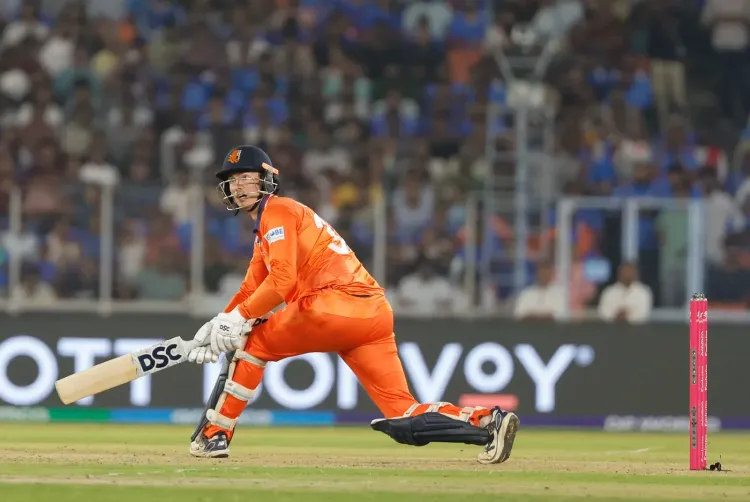
ODI World Cup 2027 format change hurts Associate nations, says Edwards
Synopsis
Six players from Netherlands, Namibia, Ireland, Scotland, USA, and New Zealand have collectively condemned the ICC's decision to insert a preliminary qualifying round for the three lowest-ranked sides at the 2027 ODI World Cup — a move critics say turns a historic qualification into a near-meaningless appearance and contradicts cricket's stated ambition to go global.
Key Takeaways
Netherlands captain Scott Edwards criticised the ICC on 17 July over the revised 2027 Men's ODI World Cup format.
The new format introduces a preliminary qualifying stage for the three lowest-ranked sides in the 14-team tournament, reducing their guaranteed matches against top nations.
The World Cricketers Association (WCA) issued a joint statement backed by players from Netherlands, Namibia, Ireland, Scotland, USA, and New Zealand .
Scotland captain Richie Berrington demanded that players be meaningfully consulted before major ICC decisions are announced.
New Zealand 's Daryl Mitchell expressed full support for Associate nations having consistent and fair access to global platforms.
The ICC has not yet issued a formal response to the WCA statement.
Netherlands captain Scott Edwards has publicly criticised the International Cricket Council (ICC) over its decision to alter the format of the 2027 Men's ODI World Cup, warning that the sudden shift directly undermines cricket's global growth and strips Associate nations of guaranteed opportunities to face elite opposition. The statement, issued by the World Cricketers Association (WCA) on Friday, 17 July, drew support from players across six nations.
What Changed in the 2027 Format
The ICC's revised structure introduces a preliminary qualifying stage within the main 14-team tournament, placing the three lowest-ranked sides in a pre-group round rather than guaranteeing them a full slate of matches against top-ranked teams. Critics argue this effectively creates a two-tier system inside the World Cup itself, eroding the competitive access that qualifying was meant to provide.
Edwards and Erasmus Voice Concern
'Qualifying for an ODI World Cup is a huge achievement for any country, so when the reality of that opportunity changes after years of planning, it's incredibly disappointing. The ICC talks a lot about growing the game globally but decisions like this make it harder for associate nations to play against the best teams in the world,' Edwards said. He added that such match opportunities are what drives player development and inspires the next generation in emerging cricket nations.
Namibia captain Gerhard Erasmus underscored the emotional weight these tournaments carry. 'For players in many countries, an ODI World Cup isn't just another tournament — it's our long form and something careers are built around and generations of players aspire to,' he said, adding that qualification must translate into a genuine chance to compete, not a ceremonial appearance.
Stirling Invokes Football World Cup as a Model
Ireland opener Paul Stirling drew a direct parallel with the 2026 FIFA World Cup, arguing that smaller nations have consistently added value and excitement to global sporting events. 'The football World Cup we've just witnessed is testament to that in other sports and it would be great to see cricket take a similar approach to maximise opportunities for the game,' Stirling said. His remarks reflect a broader sentiment among Associate players that cricket administrators are moving in the opposite direction to global sporting trends.
Lack of Consultation Draws Sharp Criticism
Scotland captain Richie Berrington identified the absence of prior communication from the ICC as a separate and serious grievance. 'Players don't expect to make every decision, but we should be meaningfully consulted on decisions that have significant impacts on the game and on players' careers. Better decisions are made when different perspectives are brought to the table,' he said, calling for structural reform in how the ICC engages with players before announcing major changes.
USA left-arm spin bowling all-rounder Harmeet Singh stressed that the consequences extend beyond the playing field. 'Countries and players invest years preparing for opportunities like an ODI World Cup. Those opportunities mean a lot, not just for the players involved but for growing the game in emerging countries and for the fans who invest in the game,' he said.
New Zealand Backs Associate Players
The chorus of dissent also found backing from established Test nations. New Zealand senior batting all-rounder Daryl Mitchell expressed solidarity with Associate cricketers, stating: 'We are fully supportive of players and countries around the world being provided with consistent and fair opportunities to reach and compete on the game's biggest platforms.' His support signals that concern over the ICC's decision is not limited to Associate member nations alone. The ICC is yet to formally respond to the WCA statement.
Point of View
That distinction is not procedural, it is existential. What makes this harder to defend is the process: a unilateral announcement, no player consultation, no transition period. The WCA statement is notable precisely because it includes a New Zealand voice — this is no longer just Associate grievance, it is a credibility question for the ICC's global growth narrative.
NationPress
16 Oct 2026
Frequently Asked Questions
What is the 2027 ODI World Cup format change that players are criticising?
The ICC has introduced a preliminary qualifying stage within the main 14-team tournament, where the three lowest-ranked sides must play an additional round before entering the main group stage. Critics say this denies Associate nations guaranteed matches against top-ranked cricket teams, undermining the value of qualification itself.
Who are the players who have spoken out against the ICC decision?
Players from six nations issued statements through the World Cricketers Association (WCA) on 17 July: Netherlands captain Scott Edwards, Namibia captain Gerhard Erasmus, Ireland opener Paul Stirling, Scotland captain Richie Berrington, USA all-rounder Harmeet Singh, and New Zealand's Daryl Mitchell.
Why does this format change matter for Associate cricket nations?
For Associate nations, an ODI World Cup is often the pinnacle of a player's career and a once-in-a-generation opportunity to compete against elite teams. Matches against top sides are crucial for development, visibility, and inspiring future players. Reducing those guaranteed fixtures, players argue, stunts the sport's growth in emerging cricket markets.
What did Scotland captain Richie Berrington demand from the ICC?
Berrington called for structural reform in how the ICC makes decisions, specifically demanding that players be meaningfully consulted before announcements that significantly affect the game and players' careers. He argued that better decisions emerge when diverse perspectives are included in the process.
Has the ICC responded to the World Cricketers Association statement?
As of the WCA's statement on 17 July, the ICC had not issued a formal response to the criticism raised by players from the six nations. The governing body has not publicly addressed the concerns around player consultation or the impact on Associate cricket.