Why Did Bareilly City Magistrate Resign Over the Swami Avimukteshwaranand Controversy?
Synopsis
In a bold move on Republic Day, Bareilly City Magistrate Alankar Agnihotri resigned, citing significant concerns about the treatment of revered saints and alleged upper caste discrimination under the UGC regulations. His resignation has sparked intense political debate and protests, raising questions about representation and equity in Uttar Pradesh.
Key Takeaways
Agnihotri's resignation reflects ongoing caste tensions.
UGC regulations are under scrutiny for perceived discrimination.
Political parties are seizing the opportunity to criticize the government.
Community support for Agnihotri is growing amid protests.
The incident could spark new political movements.
Bareilly, Jan 26 (NationPress) In a surprising turn of events on Republic Day, Bareilly City Magistrate Alankar Agnihotri, who is a 2019-batch officer from the Uttar Pradesh PCS, has stepped down from his position. His resignation was prompted by concerns regarding the treatment of respected saints and the perceived discrimination against upper castes due to the recent regulations set by the University Grants Commission (UGC).
Agnihotri submitted his resignation to the Governor of Uttar Pradesh, expressing that his choice was rooted in matters of self-respect, personal conscience, and social accountability, rather than any professional aspirations.
In his resignation letter, he vehemently condemned the incident at the Prayagraj Magh Mela, where followers of Shankaracharya Swami Avimukteshwaranand Saraswati were reportedly assaulted and mistreated during a protest concerning access to the Sangam for a sacred dip on Mauni Amavasya.
He characterized this act as a serious affront to Brahmins and saints, as their hair is traditionally not to be touched. Agnihotri questioned if the administration was covertly permitting such persecution.
His resignation letter was also a platform for strong language regarding what he claimed to be targeted harassment and discrimination, labeling the incident as a stain on humanity.
Connecting this controversy to broader issues, Agnihotri criticized the UGC’s Promotion of Equity in Higher Education Institutions Regulations, 2026, alleging that certain clauses, especially paragraphs 2, 5, 6, and 7, are exploitative and biased against students from the general category, particularly those belonging to the Brahmin, Kshatriya, Vaishya, Kayastha, and Bhumihar communities.
He likened the guidelines to the colonial-era Rowlatt Act of 1919, suggesting they could be misused to target upper-caste youth through conspiracies and false accusations.
His resignation letter also hinted at future political ambitions, as Agnihotri indicated that it is time to create an alternative political platform to advocate for Brahmins and other general category communities, due to the lack of a strong voice for them.
This decision has intensified the ongoing discourse in Uttar Pradesh regarding Brahmin sentiments, amidst almost two months of unrest associated with the Swami Avimukteshwaranand controversy.
Opposition parties, including the Samajwadi Party and the Congress, have taken this moment to criticize the BJP government, framing these issues as anti-upper caste and against Sanatan Dharma.
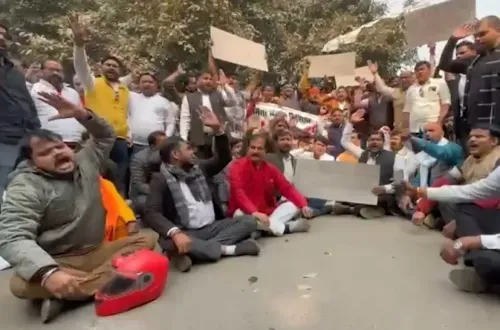
In the wake of Agnihotri’s resignation, supporters have begun to gather at his residence, with some protests reportedly escalating, including one individual who allegedly stripped in symbolic defiance of the UGC regulations.
Point of View
It is important to acknowledge the complexities surrounding this resignation. Alankar Agnihotri's departure highlights ongoing tensions regarding caste dynamics and representation in Uttar Pradesh. While we stand firm in our commitment to accurate reporting, we must also recognize the broader societal implications of such actions, especially in a politically charged environment.
NationPress
28 Sept 2026
Frequently Asked Questions
What prompted Alankar Agnihotri to resign?
Alankar Agnihotri resigned due to concerns over the treatment of revered saints and alleged discrimination against upper castes under the new UGC regulations.
How has the political landscape reacted to this resignation?
Opposition parties have criticized the BJP government, framing the issues as anti-upper caste and against Sanatan Dharma.
What incidents led to the criticism of UGC regulations?
The incident at the Prayagraj Magh Mela, where followers of Swami Avimukteshwaranand were allegedly assaulted, raised significant concerns regarding caste discrimination.
What are the broader implications of Agnihotri's resignation?
His resignation has intensified discussions on caste representation and equity in higher education, potentially leading to new political movements.
What can we expect in the aftermath of this incident?
We may see increased protests and political mobilization among Brahmin and other general category communities demanding better representation.