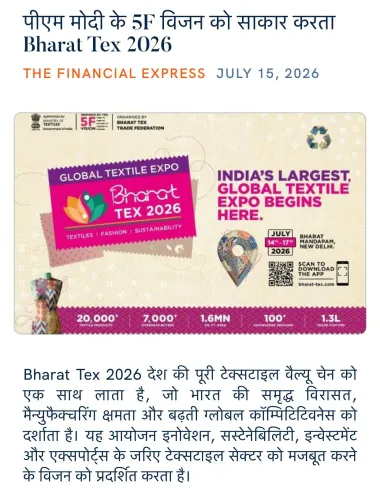
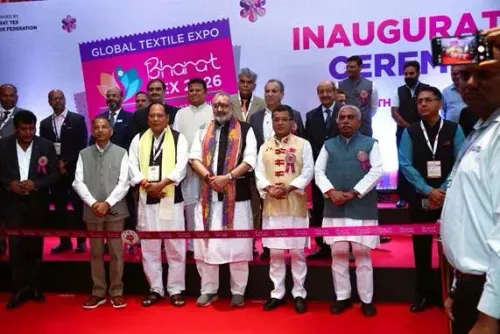
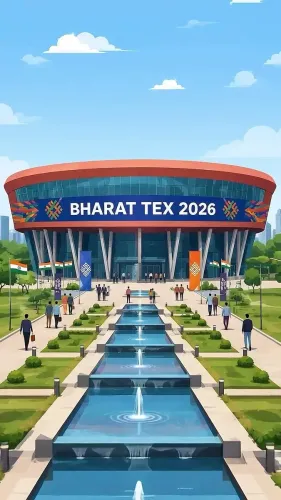
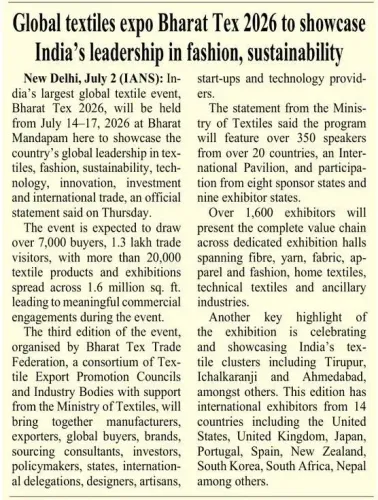
Bharat Tex 2026 opens at Bharat Mandapam, maps India's Vision 2030 textile roadmap
Synopsis
Bharat Tex 2026 is more than a trade fair — it is the government's most visible annual pitch for India's textile ambitions. With the sector employing over 100 million people and contributing 8.6% of exports, the stakes at Bharat Mandapam this week go well beyond showcasing silk and bandhani. The Vision 2030 roadmap now has a deadline, and this third edition is being framed as the inflection point.
Key Takeaways
Bharat Tex 2026 runs from 14 to 17 July at Bharat Mandapam, New Delhi — the third consecutive edition of the flagship textile trade fair.
PM Narendra Modi shared an article by MoS Textiles Pabitra Margherita linking the event to India's Vision 2030 textile roadmap.
The sector contributes 2.3% to GDP, 13% to industrial production, and 8.6% to exports.
Textiles is India's second-largest employer after agriculture , sustaining over 100 million people.
The event covers the full value chain: fibre, yarn, fabric, apparel, home textiles, technical textiles, and ancillary industries.
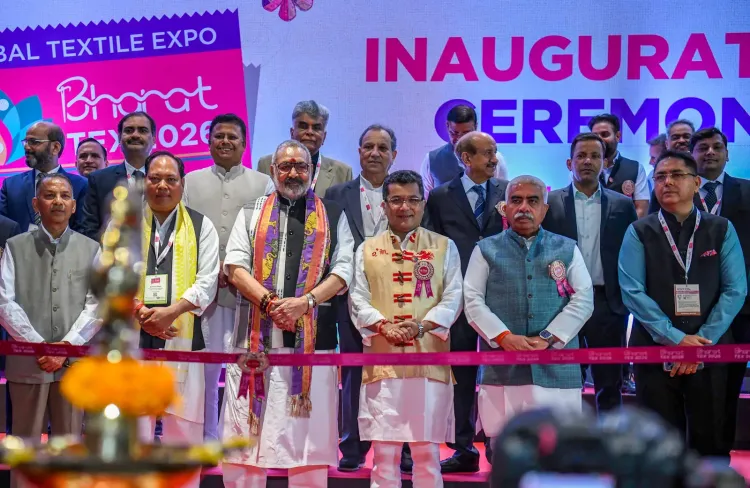
Prime Minister Narendra Modi on Wednesday, 15 July 2026, spotlighted Bharat Tex 2026 as a reflection of India's Vision 2030 roadmap for the textile sector, sharing an article by Union Minister of State for Textiles Pabitra Margherita that outlined how the event assembles the country's complete textile value chain under a single roof at Bharat Mandapam, New Delhi. The third edition of the flagship trade fair runs from 14 to 17 July.
What Bharat Tex 2026 Brings Together
The event spans dedicated exhibition halls at Bharat Mandapam and presents India's full textile value chain — from fibre and yarn to fabric, apparel, home textiles, technical textiles, and ancillary industries. It functions as a comprehensive marketplace hosting domestic manufacturers, state pavilions, international exhibitors, and global buyers, enabling high-value sourcing, corporate engagement, and brand showcasing at scale.
In the article shared by Modi, Margherita wrote: 'From the ethereal warmth of a Kashmiri Pashmina to the majestic lustre of Assam's Muga silk, from the vibrant geometric patterns of a Rajasthani Bandhani to the timeless, structured elegance of Kanjeevaram silk, India's geographic and cultural diversity is a living, breathing map drawn in thread. Today, this unparalleled civilizational canvas is assembled under a single, unified roof.'
Building on Two Editions of Momentum
Margherita noted that the first two editions attracted unprecedented international buyers and generated significant collaborative momentum. Recalling his experience at Bharat Tex 2025, he said government-to-government and business-to-government dialogues translated into tangible outcomes, confirming 'a highly positive outlook for the future and demonstrated growing global trust in India's execution capabilities.'
Modi had previously remarked at an earlier edition that 'the seed we planted is now rapidly growing into a banyan tree' — a phrase Margherita invoked to frame this third edition as a shift from early potential to 'absolute industrial dominance.'
The Macroeconomic Weight of India's Textile Sector
Textiles are not peripheral to India's economy. The sector contributes 2.3% to GDP, accounts for 13% of industrial production, and makes up 8.6% of total exports. As India's second-largest employer after agriculture, it sustains over 100 million people, with a particular role in strengthening rural communities and driving financial autonomy for women across the country.
Notably, this is the third consecutive edition of Bharat Tex, each building on the last — a signal that the government views the event not as a standalone showcase but as an annual institutional lever for textile diplomacy and industrial positioning.
What Comes Next
With the fair running through 17 July, industry observers will watch whether the government-to-business dialogues this edition produce the kind of verifiable sourcing commitments that Margherita cited from previous years. The Vision 2030 framework, which the event is designed to advance, sets the longer-term benchmark against which outcomes will ultimately be measured.
Point of View
And the government's framing has shifted from 'showcase' to 'industrial dominance' — a notable escalation in ambition. The sector's macroeconomic numbers are real: 100 million jobs and 8.6% of exports are not trivial stakes. But Vision 2030 targets require more than annual fairs; they require sustained policy continuity on PLI disbursements, logistics infrastructure, and compliance costs that small weavers and exporters still flag as barriers. The real measure of Bharat Tex's value will be whether the government-to-government dialogues Margherita cites produce verifiable sourcing contracts and investment commitments — not just footfall records.
NationPress
14 Oct 2026
Frequently Asked Questions
What is Bharat Tex 2026?
Bharat Tex 2026 is India's flagship global textile trade fair, held at Bharat Mandapam in New Delhi from 14 to 17 July. It brings together domestic manufacturers, state pavilions, international exhibitors, and global buyers to showcase India's complete textile value chain, from fibre and yarn to apparel and technical textiles.
How does Bharat Tex 2026 connect to India's Vision 2030?
The government has positioned Bharat Tex 2026 as a practical expression of India's Vision 2030 roadmap for the textile sector, which targets expanded global market share and industrial dominance. PM Modi highlighted this link by sharing an article by MoS Textiles Pabitra Margherita outlining the fair's strategic role.
Why is the textile sector important to India's economy?
India's textile sector contributes 2.3% to GDP, 13% to industrial production, and 8.6% to exports. It is the country's second-largest employer after agriculture, sustaining over 100 million people and playing a key role in rural livelihoods and women's financial independence.
What happened at previous editions of Bharat Tex?
The first two editions attracted unprecedented international buyers and generated significant government-to-government and business-to-government dialogue, according to Minister Margherita. PM Modi had described the initiative's growth as a 'seed rapidly growing into a banyan tree' at a prior edition.
Who is Pabitra Margherita?
Pabitra Margherita is the Union Minister of State for Textiles. He authored the article shared by PM Modi on 15 July, detailing Bharat Tex 2026's significance for India's manufacturing strength, textile heritage, and global trade ambitions.