CSIR, DAKSHIN sign pact to advance tech collaboration for Global South
Synopsis
India's premier science body CSIR and DAKSHIN-RIS have formalised a partnership to channel affordable, deployable Indian technologies toward the Global South — covering healthcare, agriculture, digital and blue economies. The move deepens India's strategic push to lead South-South cooperation through institutional science diplomacy, not just foreign aid.
Key Takeaways
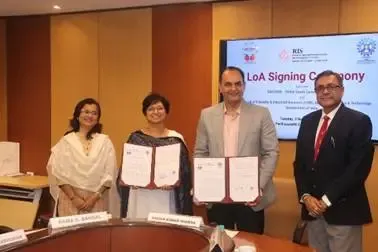
CSIR and DAKSHIN (Global South Centre of Excellence, RIS ) signed a Letter of Association (LoA) on 4 November 2026 .
The pact targets capacity building , technology transfer and research collaboration for Global South nations.
Focus sectors include healthcare , infrastructure , agriculture , the blue economy and the digital economy .
The partnership aims to accelerate progress toward the Sustainable Development Goals (SDGs) .
Joint policy studies, skills development programmes and documentation of best practices are core pillars of the agreement.
The Council of Scientific and Industrial Research (CSIR) and DAKSHIN, the Global South Centre of Excellence at the Research and Information System for Developing Countries (RIS), have formalised a partnership to strengthen capacity building, research collaboration and technology transfer for nations of the Global South, according to an official statement released on Wednesday, 4 November 2026. The agreement was announced by the Ministry of Science and Technology.
What the Agreement Covers
The two institutions signed a Letter of Association (LoA) aimed at promoting knowledge sharing, technology transfer and joint strategies to address shared development challenges. The pact is also designed to accelerate progress towards the Sustainable Development Goals (SDGs), areas where developing nations continue to face significant resource and capability gaps.
CSIR brings to this arrangement a broad portfolio of ready-to-deploy, affordable and adaptable technologies that are directly relevant to the developmental needs of Global South countries. These include solutions with strong potential for industry-led implementation and the facilitation of entrepreneurship across partner nations.
Key Voices Behind the Partnership
Dr Rama Swami Bansal, Head of the International Science and Technology Affairs Directorate at CSIR, emphasised the importance of international engagement among Global South countries. He highlighted the potential for developing innovative models of collaborative partnerships to address shared developmental priorities.
Professor Sachin Kumar Sharma, Director General of RIS, pointed to cooperation opportunities in critical areas including healthcare, infrastructure, agriculture, the blue economy and the digital economy.
Focus Areas of Collaboration
The partnership will direct its efforts toward fostering joint policy studies to identify context-specific solutions to development challenges. It will also engage institutions to scale up development interventions and promote capacity building and skills development across member nations.
An equally important focus will be the documentation of development experiences, best practices and success stories — a knowledge repository intended to strengthen collective self-reliance among Global South countries.
Broader Significance
The association is expected to serve as a meaningful platform for enhancing South-South cooperation, catalysing international partnerships and facilitating the transfer, adaptation and deployment of appropriate science and technology solutions. This comes amid growing momentum globally for frameworks that centre developing-country needs outside the traditional North-South aid architecture. India has increasingly positioned itself as a bridge nation capable of offering scalable, low-cost technological models to peers in Africa, Southeast Asia and Latin America.
The LoA signals a further institutionalisation of that strategy, with CSIR's proven technology base and RIS's policy research capacity forming a complementary pairing. How the partnership translates commitments into deployable solutions on the ground will be the measure of its long-term impact.
Point of View
Or remain demonstration-stage assets. With the Global South increasingly asserting autonomy in multilateral forums, India's ability to offer tangible science and technology value — not just rhetorical solidarity — will define its credibility as a development partner.
NationPress
4 Nov 2026
Frequently Asked Questions
What is the CSIR-DAKSHIN partnership about?
CSIR and DAKSHIN, the Global South Centre of Excellence at RIS, have signed a Letter of Association to collaborate on technology transfer, capacity building and joint research for developing countries. The pact targets sectors such as healthcare, agriculture, infrastructure, and the digital and blue economies.
What is DAKSHIN and what role does it play?
DAKSHIN is the Global South Centre of Excellence housed within the Research and Information System for Developing Countries (RIS), a New Delhi-based policy research institution. It focuses on identifying and scaling development solutions relevant to nations in Africa, Asia, Latin America and the Pacific.
How will the partnership advance the Sustainable Development Goals?
The LoA commits both institutions to joint policy studies, skills development and the documentation of best practices — all aimed at addressing shared development challenges that underpin SDG targets. The partnership is designed to give Global South countries context-specific, affordable solutions rather than generic frameworks.
What technologies is CSIR bringing to this collaboration?
CSIR brings a portfolio of ready-to-deploy, affordable and adaptable technologies covering multiple sectors relevant to the developmental needs of Global South nations. These are intended for industry-led implementation and to support entrepreneurship in partner countries.
Why does India's involvement in South-South cooperation matter?
India is increasingly positioning itself as a bridge nation that can offer scalable, low-cost technological solutions to developing peers across Africa, Southeast Asia and Latin America. Institutionalising this through bodies like CSIR and RIS adds policy depth to what has historically been a more rhetorical commitment to Global South solidarity.