Delhi CM Rekha Gupta cuts water, sewer infra charges for homes and businesses
Synopsis
Delhi CM Rekha Gupta has overhauled how water and sewer infrastructure charges are calculated — shifting from total area to actual water demand — and handed concessions of up to 70 per cent to residents in lower-category colonies. The reform also exempts redevelopment projects and rewards businesses that go zero-liquid-discharge, signalling a rare convergence of fiscal relief and environmental incentive in the capital's civic policy.
Key Takeaways
Delhi CM Rekha Gupta on 22 May rationalised water and sewer Infrastructure Charges (IFC) for residents, institutions, and industries.
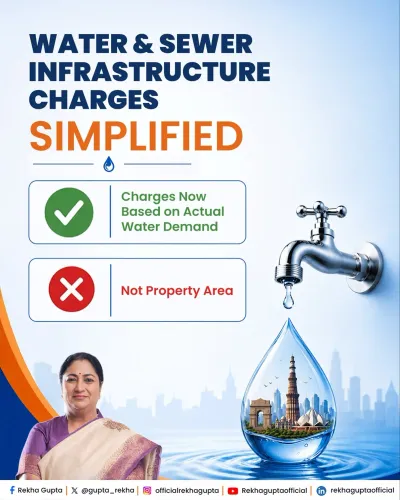
IFC will now be based on actual water demand , not total building area; applies only to new or additional construction .
Properties in E and F category colonies get a 50% concession ; those in G and H category colonies get up to 70% concession .
Residential units of 50 sq m or less on plots over 200 sq m receive an additional 50% concession .
Institutions and businesses adopting Zero Liquid Discharge (ZLD) systems qualify for up to 50% off sewer IFC ; non-compliance triggers a 0.05% per day penalty .
Religious bodies and charities registered under Section 12AB also entitled to an additional 50% concession .
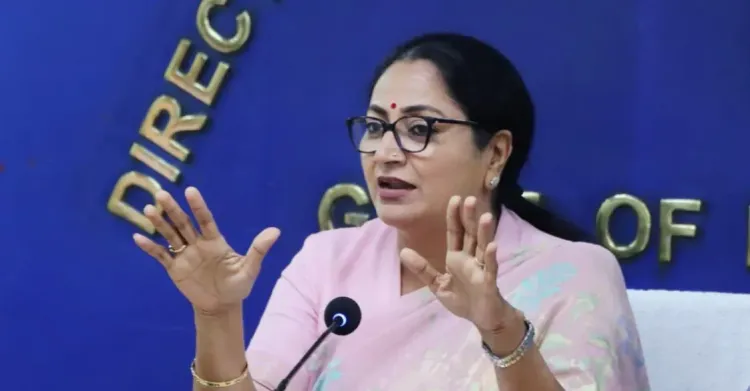
Delhi Chief Minister Rekha Gupta on Friday, 22 May announced a sweeping rationalisation of water and sewer Infrastructure Charges (IFC) for residents, housing units, institutions, and industries across the capital. The move is designed to reduce the financial burden on citizens, boost transparency, and accelerate development in New Delhi.
Key Changes to IFC Calculation
Under the revised framework, water and sewer infrastructure charges will be calculated on the basis of actual water demand rather than the total built-up area of a property — a structural shift that is expected to lower charges for most applicants. Crucially, the IFC will now apply only to new construction or additional construction on an existing property.
Redevelopment projects where water demand does not increase will be exempt from IFC entirely. Non-Floor Area Ratio (non-FAR) spaces and open or uncovered areas will also be excluded from both water demand calculations and IFC assessments, Chief Minister Gupta confirmed at a press conference at the Delhi Secretariat.
Concessions for Colonies and Small Homes
The Delhi government has announced targeted relief for economically weaker localities. Properties in E and F category colonies will receive a 50 per cent concession on IFC, while those in G and H category colonies will be eligible for concessions of up to 70 per cent.
Residential units measuring 50 square metres or less, built on plots larger than 200 square metres, will receive an additional 50 per cent concession — a provision the Chief Minister described as direct relief for small families and the middle class.
Relief for Religious Bodies and Green Adopters
Religious institutions and charitable organisations registered under Section 12AB will also be entitled to an additional 50 per cent concession on water and sewer IFC charges.
To incentivise environmental compliance, institutions and commercial establishments that adopt a Zero Liquid Discharge (ZLD) system will receive up to a 50 per cent concession in sewer IFC. However, CM Gupta clarified that this benefit applies only where ZLD-based Sewage Treatment Plants (STPs) are fully installed and operational in accordance with standards set by the Central Pollution Control Board (CPCB) and the Delhi Pollution Control Committee (DPCC). If an inspection finds an STP non-functional, the concession will be withdrawn and a penalty of 0.05 per cent per day will be levied on the previously granted concession amount.
Why the Government Acted
Chief Minister Gupta acknowledged that infrastructure charges had long imposed significant hardship, with families undertaking new construction often paying charges running into several lakh rupees. The government reviewed the entire system and opted to simplify and make it more equitable. Notably, this reform comes as the Bharatiya Janata Party (BJP)-led Delhi government seeks to distinguish its governance record from that of its predecessor, with urban infrastructure and civic relief as key planks.
The stated objective, according to Gupta, is to strengthen basic infrastructure and position Delhi as a model in water management, sewage treatment, and environmental protection. How quickly the revised charge structure is operationalised across Delhi Jal Board assessments will determine the on-ground impact for citizens.
Point of View
Water-efficient construction. The deeper question is implementation: Delhi Jal Board's assessment machinery has historically been opaque, and without a clear, auditable demand-measurement protocol, the new formula could simply shift the locus of discretion rather than eliminate it. The ZLD concession is an interesting green nudge, but a 0.05 per cent per day penalty on a withdrawn concession is a modest deterrent for large commercial violators. The colony-category concessions are well-targeted at lower-income localities, yet the BJP government will need to ensure that the category classifications themselves — which date back decades — reflect current ground realities rather than outdated revenue records.
NationPress
7 Oct 2026
Frequently Asked Questions
What are the new water and sewer Infrastructure Charges (IFC) rules in Delhi?
Under the revised rules announced on 22 May 2025, water and sewer IFC in Delhi will be calculated on the basis of actual water demand rather than total building area, and will apply only to new or additional construction. Redevelopment projects that do not increase water demand are fully exempt.
Which Delhi colony categories get the biggest IFC concessions?
Properties in G and H category colonies are eligible for concessions of up to 70 per cent on IFC. Those in E and F category colonies will receive a 50 per cent concession, targeting residents in economically weaker localities.
Who else qualifies for additional IFC concessions under the new policy?
Residential units of 50 square metres or less on plots larger than 200 square metres, religious institutions and charities registered under Section 12AB, and commercial establishments with fully operational Zero Liquid Discharge systems all qualify for an additional 50 per cent concession.
What happens if a Zero Liquid Discharge plant is found non-functional during inspection?
If an inspection by authorities finds a ZLD-based Sewage Treatment Plant non-functional or not operating to CPCB and DPCC standards, the 50 per cent sewer IFC concession will be withdrawn and a penalty of 0.05 per cent per day will be imposed on the concession amount already granted.
Why did the Delhi government revise the IFC structure?
CM Rekha Gupta cited the longstanding financial hardship caused by infrastructure charges, with families often paying several lakh rupees during new construction. The government reviewed the entire system to make it simpler, more transparent, and more equitable for residents and businesses.