Jamaat-led plot to topple BNP government uncovered by India, Bangladesh intel
Synopsis
Intelligence agencies in India and Bangladesh have reportedly blown the cover on an alleged Jamaat-e-Islami-led plan to violently unseat the BNP government in November, install Muhammad Yunus, and establish a Shariat-driven state — with Pakistan and Turkey allegedly providing strategic and material support, and 8,800 youths already undergoing combat training.
Key Takeaways
Intelligence agencies in India and Bangladesh have reportedly uncovered a Jamaat-e-Islami -led coalition plan to overthrow the BNP government via a violent movement planned for November 2026 .
The alleged goal is to establish a 'revolutionary government' based on the July Charter , envisioning a Shariat-driven Islamic state in Bangladesh.
The National Citizens Party (NCP) , linked to former interim chief advisor Muhammad Yunus , is reportedly set to lead the agitation to replace President Mirza Fakhrul Islam Alamgir .
A two-phase strategy — 'Operation Domon' targeting the Awami League and a parallel militia formation — is attributed to retired Brigadier Abdullahil Aman Azmi .
Reportedly 8,800 radicalised youths are already undergoing month-long combat training under the cover of an 'Armed Reserve.' Pakistan , Turkey , and elements described as 'US Deep State' are alleged to be backing the plan, claims that remain unverified and attributed to the source report.
Intelligence agencies in India and Bangladesh have reportedly uncovered a coordinated plan by a Jamaat-e-Islami-led coalition to overthrow the Bangladesh Nationalist Party (BNP) government through a violent agitation scheduled for November 2026, according to a report published in The Federal. The alleged plot aims to dismantle the current administration and install a 'revolutionary government' modelled on the July Charter, which reportedly envisions a Shariat-driven Islamic state in Bangladesh.
The Alleged Plan and Its Architects
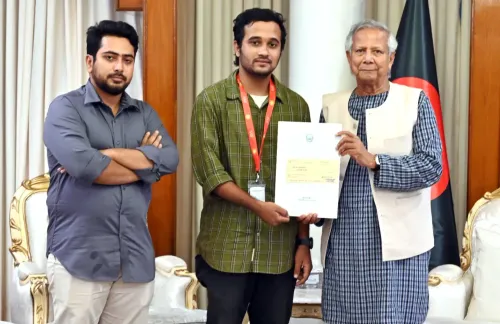
According to the report, the National Citizens Party (NCP) — formed by youth leaders described as close to former Bangladesh interim government chief advisor Muhammad Yunus — is set to spearhead the agitation. The reported objective is to remove current President Mirza Fakhrul Islam Alamgir and position Yunus as his replacement.
The strategic planning is allegedly being directed by retired Bangladeshi army officers, with former Brigadier Abdullahil Aman Azmi identified as a central figure. Azmi and his associates reportedly operate from a Defence Officers Housing Society in Dhaka's Banani district, where Pakistani and Turkish intelligence officials serving under diplomatic cover are said to be regular visitors, according to the report.
Two-Phase Strategy: Operation Domon and Militia Formation
Journalist Subir Bhaumik, writing in The Federal, described a two-phase plan attributed to the Azmi-led group. The first phase, dubbed 'Operation Domon' (suppression), allegedly targets the Awami League, which is reportedly preparing a political comeback centred around the potential return of ousted Prime Minister Sheikh Hasina. According to Bhaumik, the Azmi team is said to have secured the BNP government's tacit cooperation in this effort.
The second phase reportedly involves the formation of an armed militia. Former Bangladesh Directorate General of Forces Intelligence (DGFI) chief Rezzakul Haider Chowdhury allegedly spent an extended period in Turkey to procure weapons for a force described as an 'Armed Reserve.' The report claims 8,800 radicalised Muslim youths have been handpicked and are currently undergoing month-long combat training that includes modules on law and order operations — raising concerns among analysts that the force is intended for internal deployment rather than external defence.
Foreign Backing Alleged
The plan is allegedly backed by Pakistan, Turkey, and what the report describes as 'some elements within the US Deep State,' though these claims remain unverified and are attributed solely to the source report. Separately, Pakistan's envoy in Dhaka, Imran Haider, has reportedly made frequent visits to Islamic orphanages in recent months. A top Bangladesh National Security and Intelligence (NSI) official, cited in the report, claimed the agency flagged this activity as a potential effort to recruit and groom 'suicide bomber squads' for deployment in Bangladesh and adjoining Indian states.
Why the BNP Coalition Is Reportedly Frustrated
The Islamist coalition is reportedly frustrated by the BNP government's refusal to implement the July Charter or initiate the drafting of a new Islamist constitution. This political deadlock is said to have accelerated the shift toward a covert strategy. Notably, this comes amid broader tensions in Bangladesh following the political transition that brought the BNP to power, with multiple factions vying to shape the country's constitutional direction.
Implications for Regional Security
The report carries a stark warning for India, stating that failure to prevent the alleged Islamist power grab could result in the emergence of a 'Bengali Pakistan' on India's eastern flank, potentially aligned with what it terms the 'US-backed Mecca Alliance.' Such a scenario, analysts note, would fundamentally alter the security calculus across the Bay of Bengal region. How both governments respond to the intelligence inputs in the coming weeks will be closely watched.
Point of View
If verified, signals something more alarming than a routine political conspiracy — it describes a structured, externally backed attempt to redraw Bangladesh's constitutional identity through organised violence. The involvement of retired military officers, the alleged weapons procurement through Turkey, and the reported recruitment of thousands of trained cadres suggest an operation with institutional depth, not street-level opportunism. What is missing, however, is corroboration beyond a single sourced report; extraordinary claims of Pakistani, Turkish, and US Deep State backing require extraordinary evidence. India's strategic community will be watching the BNP government's response closely — if Dhaka downplays or dismisses the intelligence, it raises uncomfortable questions about whose interests the current administration is balancing.
NationPress
30 Sept 2026
Frequently Asked Questions
What is the alleged Jamaat-e-Islami plot in Bangladesh?
According to a report in The Federal, intelligence agencies in India and Bangladesh have uncovered a plan by a Jamaat-e-Islami-led coalition to overthrow the BNP government through a violent movement planned for November 2026. The alleged aim is to establish a 'revolutionary government' based on the July Charter, which envisions a Shariat-driven Islamic state.
Who is Muhammad Yunus and what is his alleged role?
Muhammad Yunus served as the chief advisor of Bangladesh's former interim government. The report alleges that the National Citizens Party, formed by youth leaders close to Yunus, is set to lead the agitation with the goal of installing Yunus in place of current President Mirza Fakhrul Islam Alamgir.
What is 'Operation Domon' mentioned in the report?
'Operation Domon' is the name given to the first phase of the alleged plan, attributed to retired Brigadier Abdullahil Aman Azmi. It reportedly targets the Awami League, which is said to be preparing a political comeback centred on ousted Prime Minister Sheikh Hasina's potential return.
Which foreign countries are alleged to be backing the plot?
The report alleges backing from Pakistan, Turkey, and what it describes as elements within the US Deep State, though these claims are unverified and attributed solely to the source report. Pakistani and Turkish intelligence officials are said to have been regular visitors to the planning hub in Dhaka's Banani area.
Why does this matter for India?
The report warns that a successful Islamist takeover in Bangladesh could result in the emergence of what it calls a 'Bengali Pakistan' on India's eastern border. This would significantly alter regional security dynamics, particularly concerning cross-border militant activity and India's strategic interests in the Bay of Bengal region.