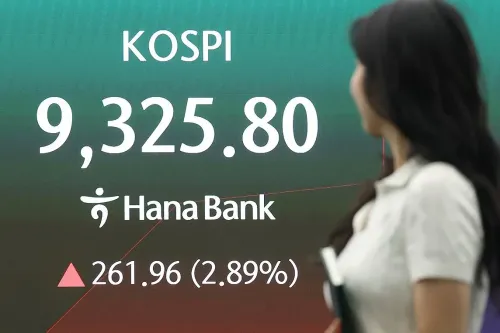
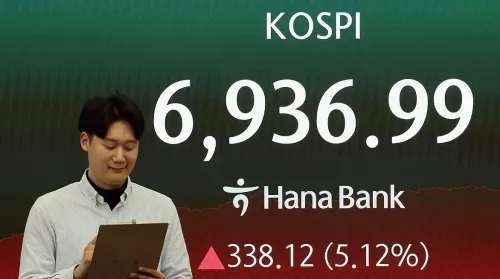
KOSPI rally masks breadth collapse as chip stocks dominate gains
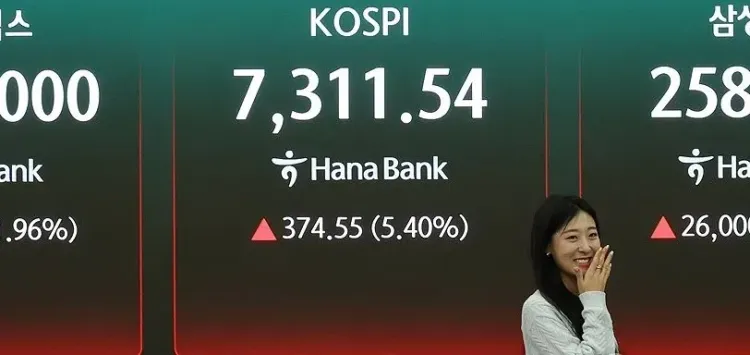
Synopsis
South Korea's KOSPI is posting headline gains, but the rally is essentially a two-stock event. On the day the index jumped 2.55%, only 72 stocks advanced. Samsung Electronics and SK hynix — up 13–14% in two weeks — are carrying the entire index while the majority of listed companies quietly decline.
Key Takeaways
Over the two weeks from 26 May to 6 June , an average of 210 KOSPI stocks advanced daily versus 586 that declined.
Samsung Electronics rose 13.72% and SK hynix rose 14.32% over the same period, driving headline index gains.
On 27 May , the KOSPI surged 2.55% but only 72 stocks advanced — versus 713 advancing on a day the index rose just 0.41% .
South Korean retail investors sold a net $793.67 million in overseas stocks in the first week of June, per KSD data.
If net foreign selling continues, June would be the third straight month of outflows — the first such streak since April–July 2023 .
South Korea's benchmark Korea Composite Stock Price Index (KOSPI) has staged a headline rally in recent weeks, but data from the Korea Exchange (KRX) reveals a stark divergence beneath the surface: more stocks are falling than rising, pointing to an increasingly narrow market driven by a handful of heavyweight semiconductor names.
The Breadth Problem
According to KRX data covering the two-week period from 26 May through 6 June, an average of just 210 KOSPI-listed stocks advanced on any given session, while 586 declined and the remainder were unchanged. The contrast is sharpest on big rally days: on 27 May, the KOSPI jumped 2.55%, yet only 72 stocks advanced. By comparison, 713 stocks rose on 22 May, when the index posted a far more modest 0.41% gain.
Chip Giants Driving the Index
The rally is effectively a two-stock story. Shares of Samsung Electronics Co. surged 13.72% over the cited period, while chipmaking rival SK hynix Inc. climbed 14.32%. Their outsized index weightings mean that gains in these two names can lift the headline number even as the majority of listed companies lose ground.
Noh Dong-gil, an analyst at Shinhan Securities, argued that the concentration goes beyond sentiment. 'Samsung Electronics and SK hynix have evolved beyond market leaders to become common underlying assets across a wide range of financial products,' he said, suggesting the dynamic is structural rather than cyclical.
Retail Investors Rotating Back Home
A parallel shift is under way among South Korean retail investors. Data released on Sunday, 7 June showed that local retail investors sold over 1 trillion won (approximately $641 million) worth of overseas stocks in the first week of June alone, according to the Korea Securities Depository (KSD). Net foreign stock selling for the week reached $793.67 million, continuing a streak that began in April.
That figure already surpasses the $469 million net sold in April and is approaching the $939.77 million recorded in May. If the trend holds through the end of June, it would mark the first three consecutive months of net foreign equity selling by Korean retail investors since the April–July 2023 period — a signal that domestic chip-sector gains may be pulling capital back onshore.
What the Divergence Signals
Notably, the inverse relationship between index performance and breadth also held on down days. When the KOSPI closed 1.84% lower on Thursday, 400 stocks actually advanced, outnumbering 389 decliners — the reverse of the pattern seen on strong up days. This underscores how thoroughly the index's direction has decoupled from the experience of most listed companies.
Analysts expect the concentration to persist as long as global demand for advanced semiconductors remains robust, though any reversal in chip valuations could expose the fragility of the broader market's apparent strength.
Point of View
There is no broad market underneath to cushion the fall. The retail repatriation trend adds a second-order risk — if domestic investors are rotating home to chase chip momentum, any reversal in semiconductor valuations could trigger simultaneous selling pressure from both foreign and domestic channels. South Korean regulators and fund managers should be watching the advance-decline line as closely as the headline number.
NationPress
21 Oct 2026
Frequently Asked Questions
Why is the KOSPI rising even as most stocks fall?
The KOSPI's gains are concentrated in a handful of heavyweight semiconductor stocks, chiefly Samsung Electronics and SK hynix, whose large index weightings can lift the headline number even when the majority of listed stocks decline. According to KRX data, only 210 stocks advanced on average daily over the two weeks to 6 June, while 586 fell.
How much have Samsung Electronics and SK hynix gained recently?
Samsung Electronics rose 13.72% and SK hynix climbed 14.32% over the two-week period from 26 May to 6 June 2025, according to Korea Exchange data. Their gains have been the primary engine of the KOSPI's headline rally.
What does the advance-decline divergence on 27 May indicate?
On 27 May, the KOSPI jumped 2.55% but only 72 stocks advanced — a stark illustration of how narrow the rally is. In contrast, 713 stocks rose on 22 May when the index gained just 0.41%, showing the index's direction is now almost entirely driven by a few large-cap chip names.
Why are Korean retail investors selling overseas stocks?
South Korean retail investors sold a net $793.67 million in foreign stocks in the first week of June, per Korea Securities Depository data, continuing a selling streak that began in April. Analysts suggest the record-breaking domestic chip-sector gains are drawing capital back to the local market.
What happens if the chip-stock concentration continues?
Analysts expect the concentration to persist as long as global semiconductor demand stays strong. However, any sharp reversal in chip valuations could expose the fragility of the broader market, since most KOSPI-listed companies have not participated in the rally and offer limited buffer against a sector-led correction.