Taiwan's Lai Ching-te calls on world to oppose China's ethnic unity law
Synopsis
Taiwan's President Lai Ching-te used the 10th Ketagalan Forum to issue a direct challenge to Beijing, calling on the world to oppose China's Ethnic Unity Law — enacted on 1 July — which over 50 Uyghur civil society groups have condemned as a legislative instrument of forced assimilation with extraterritorial reach that could penalise critics outside mainland China.
Key Takeaways
President Lai Ching-te called on the international community to oppose China's Ethnic Unity Law at the 10th Ketagalan Forum on 4 August 2026 in Taipei .
The law came into effect in China on 1 July 2026 and has been condemned as an instrument of forced assimilation of Uyghur , Tibetan , and Mongolian minorities.
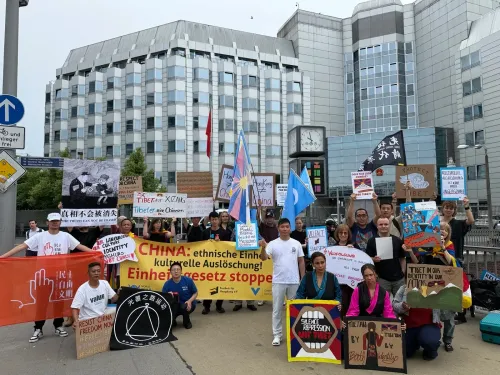
More than 50 Uyghur civil society organisations issued a joint statement urging the international community to press Beijing to repeal the legislation.
The law's provisions extend beyond China's borders, potentially holding overseas individuals and organisations legally liable for 'undermining ethnic unity.' Civil society groups have called on UN Special Rapporteurs and the Committee on the Elimination of Racial Discrimination (CERD) to monitor the law's implementation.
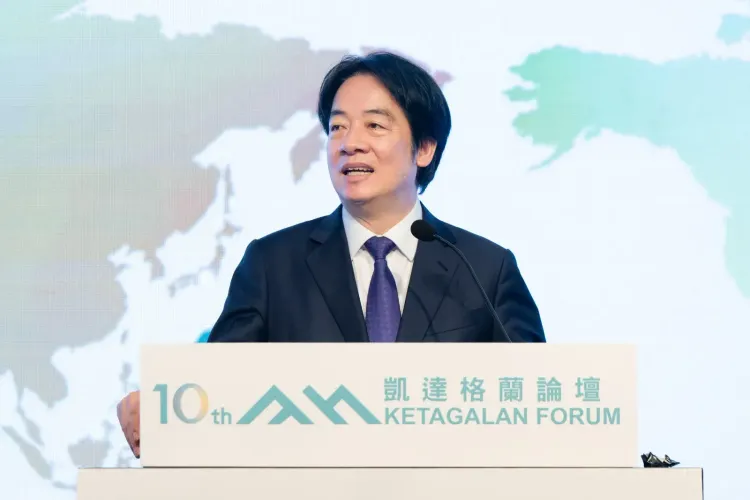
Taiwan's President Lai Ching-te on Tuesday, 4 August called on the international community to oppose China's Ethnic Unity Law, warning that the legislation threatens Taiwan's sovereignty, enables transnational repression, and endangers ethnic and religious minorities worldwide. His remarks came at the opening of the 10th Ketagalan Forum in Taipei, an annual Indo-Pacific security dialogue co-hosted by Taiwan's Ministry of Foreign Affairs and the Taiwan Institute of Economic Research.
What Lai Said at the Forum
Addressing delegates at the Ketagalan Forum, President Lai outlined four specific threats posed by the law, which came into effect in China on 1 July 2026: it undermines Taiwan's sovereignty, persecutes ethnic and religious minorities, institutionalises transnational repression, and enables political censorship with global reach.
In a post on X, Lai wrote: 'At the Ketagalan Forum, I emphasized Taiwan's firm stance against authoritarian expansion and transnational repression. The international community must oppose China's red terror and its malicious law on ethnic unity. We will strengthen countermeasures through global cooperation.'
He also reaffirmed Taiwan's commitment to democratic principles and to maintaining peace and security across the Indo-Pacific region.
What the Law Does — and Why Critics Condemn It
China's Law on the Promotion of Ethnic Unity and Progress has drawn sharp condemnation from civil society groups since its enactment. In July 2026, more than 50 Uyghur civil society organisations issued a joint statement describing the law not as a 'technical administrative measure' but as a 'legislative instrument of forced assimilation.'
According to the statement, the law explicitly conflates the Chinese nation with the Chinese Communist Party (CCP) and demands that ethnic minorities abandon distinct cultural identities in favour of loyalty to the Party, the Han-defined 'motherland,' and 'Socialism with Chinese Characteristics.'
The organisations stated that under this framework, Uyghur, Tibetan, Mongolian, and other non-Han identities are permitted to exist only insofar as they are absorbed into a single, CCP-defined Chinese nation.
Scope of the Law's Provisions
The joint statement described the law's reach as sweeping. It entrenches Mandarin as the sole language of education, displacing Uyghur, Tibetan, and Southern Mongolian languages from classrooms and public life. It mandates the 'sinicisation' of religion, subordinating faith to Party ideology, and instructs parents and teachers to raise children in loyalty to the CCP rather than their own culture, religion, or language.
'These are not incidental effects; they are the law's stated purpose, and they build directly on policies that have already devastated our communities — mass internment, cultural and religious destruction, and the forced separation of children from their families,' the statement read.
Extraterritorial Reach Raises Global Alarm
The civil society groups also flagged provisions that could hold individuals and organisations outside mainland China legally responsible under Chinese law if they are deemed to 'undermine ethnic unity and progress.' Critics argue this represents a direct extension of transnational repression beyond China's borders.
The organisations called on UN human rights experts — including Special Rapporteurs on freedom of religion or belief, minority issues, and the situation of human rights defenders — as well as the Committee on the Elimination of Racial Discrimination (CERD) and other treaty bodies to formally monitor the law's implementation and extraterritorial application, and to press Beijing to repeal it.
What Comes Next
Taiwan's call for coordinated international pushback reflects a broader effort by Taipei to internationalise concerns about Chinese policy toward ethnic minorities and to frame the issue as a global security threat rather than a bilateral dispute. Whether major democracies translate that call into formal diplomatic or multilateral action remains to be seen.
Point of View
Brussels, or New Delhi respond with more than statements will determine whether Taipei's internationalisation strategy gains traction or stalls at rhetoric. The pattern so far — condemnation without consequence — has done little to alter Beijing's calculus.
NationPress
19 Sept 2026
Frequently Asked Questions
What is China's Ethnic Unity Law?
China's Law on the Promotion of Ethnic Unity and Progress came into effect on 1 July 2026. Critics, including over 50 Uyghur civil society organisations, describe it as a legislative instrument of forced assimilation that demands ethnic minorities abandon distinct identities in favour of loyalty to the Chinese Communist Party.
Why did Taiwan's President Lai Ching-te speak out against the law?
President Lai addressed the 10th Ketagalan Forum on 4 August 2026, warning that the law threatens Taiwan's sovereignty, persecutes minorities, enables transnational repression, and poses a global threat through political censorship. He called for coordinated international opposition and stronger countermeasures through global cooperation.
What is the Ketagalan Forum?
The Ketagalan Forum is an annual Indo-Pacific Security Dialogue co-hosted by Taiwan's Ministry of Foreign Affairs and the Taiwan Institute of Economic Research in Taipei. The 2026 edition was its 10th iteration.
What extraterritorial concerns does the law raise?
The law contains provisions that could hold individuals and organisations outside mainland China legally responsible under Chinese law if they are deemed to undermine ethnic unity. Civil society groups and Taiwan's government argue this constitutes a direct form of transnational repression targeting overseas communities and diaspora activists.
What action have civil society groups demanded internationally?
More than 50 Uyghur organisations have called on UN Special Rapporteurs — covering freedom of religion, minority issues, and human rights defenders — as well as the Committee on the Elimination of Racial Discrimination (CERD) to monitor the law's implementation and press Beijing to repeal it.