Loktak Protocluster: PM Modi lauds Manipur scientist Dr Ronaldo Laishram
Synopsis
An astronomer from Manipur working in Japan helped discover a massive cluster of young galaxies — and named it after Loktak Lake, his home state's most iconic natural landmark. PM Modi spotlighted the achievement on Mann Ki Baat, calling it proof that global success and rootedness can coexist. It is a rare moment of scientific pride for Northeast India on a world stage.
Key Takeaways
PM Narendra Modi highlighted the work of Dr Ronaldo Laishram from Manipur on Mann Ki Baat's 136th episode on 26 July 2025 .
Dr Laishram , currently working in Japan , was part of a team that discovered a massive cluster of young galaxies.
The cluster was named the 'Loktak Protocluster' after Loktak Lake , the largest freshwater lake in Northeast India.
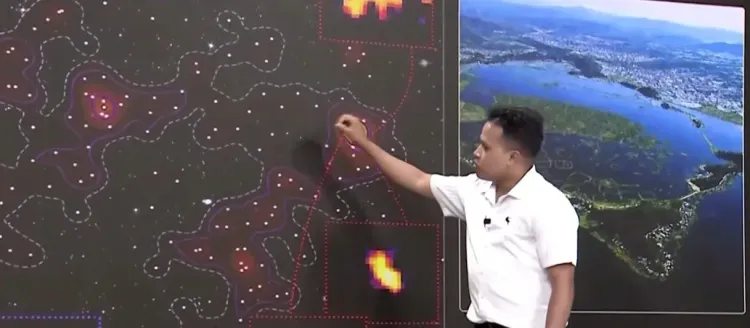
Modi drew a parallel between the lake's floating phumdis and the young galaxies forming a vast structure in space.
The Prime Minister called the achievement an inspiration for young Indians to pursue global excellence while staying rooted in their heritage.
Prime Minister Narendra Modi on Sunday, 26 July 2025, used the 136th edition of his monthly radio programme 'Mann Ki Baat' to celebrate the work of Dr Ronaldo Laishram, an astronomer from Manipur currently based in Japan, whose team discovered a massive cluster of young galaxies — named the 'Loktak Protocluster' after Manipur's Loktak Lake. Modi said the achievement has carried the name of the iconic freshwater lake beyond India's borders and into the universe itself.
The Discovery and Its Name
Dr Laishram was part of a research team that identified a vast cluster of young galaxies in deep space. In a tribute to his home state, he chose to name the structure after Loktak Lake — the largest freshwater lake in Northeast India, celebrated for its distinctive floating phumdis, or masses of vegetation and biomass that drift across the water's surface.
Drawing a vivid parallel, Prime Minister Modi said: 'The floating phumdis resemble small islands drifting over a vast expanse of water, much like the young galaxies that together form an enormous structure in space.'
What PM Modi Said
Modi introduced Dr Laishram to his radio audience with evident admiration. 'I will tell you about a person who will make you feel very proud. He is someone actively working in the fields of science and innovation and gaining global recognition; yet, he remains deeply connected to his roots and never forgets to honour his homeland whenever the opportunity arises. This person is Dr Ronaldo Laishram from Manipur,' he said.
The Prime Minister noted that despite sharing his name with the globally famous footballer Ronaldo, Dr Laishram's arena is astronomy — and his discoveries now carry a piece of Manipur into the cosmos. 'Today, Manipur's Loktak is shining bright not only on the country's map but also across the vast universe,' Modi added.
Significance for Manipur and Indian Science
The naming of the Loktak Protocluster has drawn international attention to a region and a natural landmark that, while celebrated within India, rarely features in global scientific discourse. Loktak Lake is also home to the Keibul Lamjao National Park, the world's only floating national park, making the lake itself a site of ecological uniqueness.
This comes amid a broader push by the Indian scientific community to raise the country's profile in astrophysics and space research, with institutions like the Inter-University Centre for Astronomy and Astrophysics (IUCAA) and ISRO expanding their international collaborations.
A Message for Young Indians
Prime Minister Modi framed Dr Laishram's journey as a lesson in rooted ambition — the idea that global achievement and local pride need not be in conflict. 'It teaches our young people that they can scale new heights while remaining connected to their traditions. These are roots capable of illuminating even the world of stars,' he said.
The spotlight on Dr Laishram during Mann Ki Baat is likely to amplify interest in astronomy careers among students in Northeast India, a region that has historically been underrepresented in India's scientific establishment. Whether institutional support follows the Prime Minister's words will determine how lasting that impact proves to be.
Point of View
But it also underscores a structural gap: Northeast India remains significantly underrepresented in India's scientific institutions, and individual brilliance celebrated on radio does not substitute for sustained investment in research infrastructure in the region. The Loktak Protocluster is a genuine scientific achievement, but the question worth asking is how many potential Dr Laishrams never made it to a Japanese research facility because the pipeline from Manipur to a top astronomy programme was never built. Pride is a start; policy is the follow-through.
NationPress
25 Oct 2026
Frequently Asked Questions
What is the Loktak Protocluster?
The Loktak Protocluster is a massive cluster of young galaxies discovered by a research team that includes Dr Ronaldo Laishram from Manipur. It was named after Manipur's Loktak Lake, the largest freshwater lake in Northeast India, as a tribute to the scientist's home state.
Who is Dr Ronaldo Laishram?
Dr Ronaldo Laishram is an astronomer from Manipur currently working in Japan. He was part of the research team that discovered and named the Loktak Protocluster, a large structure of young galaxies in deep space. PM Modi praised him during the 136th edition of Mann Ki Baat on 26 July 2025.
Why did PM Modi mention Dr Laishram on Mann Ki Baat?
Prime Minister Modi highlighted Dr Laishram as an example of how Indians can achieve global scientific recognition while remaining deeply connected to their cultural and regional roots. Modi called his journey an inspiration for young Indians, particularly those from smaller towns and states.
What is Loktak Lake and why is it significant?
Loktak Lake is the largest freshwater lake in Northeast India, located in Manipur. It is known for its unique floating phumdis — masses of vegetation and biomass that form natural floating islands. It is also home to Keibul Lamjao National Park, the world's only floating national park.
What was the comparison PM Modi drew between Loktak Lake and the galaxy cluster?
Modi compared the lake's floating phumdis — which resemble small islands drifting over a vast expanse of water — to the young galaxies that together form the enormous Loktak Protocluster in space. He quoted Dr Laishram's own inspiration for the name.