Is Women's Representation in Bangladesh's Upcoming Elections Minimal?
Synopsis
As Bangladesh gears up for its elections, a startling report reveals the shocking underrepresentation of women in politics, with only a small fraction of candidates being female. This raises critical questions about gender equality in the nation’s political landscape.
Key Takeaways
The representation of women in the upcoming elections is alarmingly low.
Many political parties in Bangladesh do not support female candidates.
Despite women's significant population, their political involvement remains minimal.
Societal norms and traditional practices hinder women's candidacy.
Failure to meet commitments for female representation reflects ongoing gender inequality.
Dhaka, Jan 20 (NationPress) The political environment in Bangladesh continues to be largely male-centric, embodying a patriarchal system that hinders female involvement in the country's political framework. This has led to a significant underrepresentation of women across various political parties, as highlighted in a recent report.
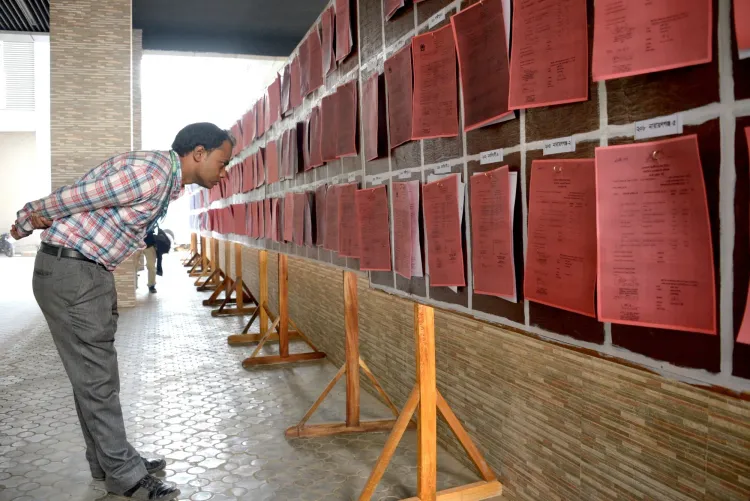
In an article for the prominent Bangladeshi newspaper Prothom Alo, Selim Jahan, the former Director of the Human Development Report Office (HDRO) within the United Nations Development Programme (UNDP), referenced media findings indicating that a total of 2,568 nomination papers were submitted for the elections scheduled on February 12. Of these, only 109 candidates are women, which constitutes a mere 4.2% of the overall candidates.
He specified that out of the female candidates, 72 are affiliated with political parties while 37 are running independently, suggesting that one in three women lacks party backing.
“Fifty political parties in Bangladesh are set to participate in the forthcoming elections. Alarmingly, thirty of these parties have not nominated any women, meaning that three-fifths of the political organizations in the country have failed to present even a single female candidate. Considering that more than half of the population in Bangladesh is female, it is regrettable that these thirty parties could not identify even one qualified woman to support as a nominee,” the report elaborated.
“Among the parties that have nominated women, the Bangladesh Nationalist Party (BNP) and the Marxist Bangladesh Socialist Party (BSP) lead, each presenting only 10 female candidates. It is disheartening that a major grassroots political entity like BNP could not or chose not to nominate more than 10 women, amounting to a mere 3% of its total 328 candidates,” it noted.
As per the report, the radical Islamist party Jamaat-e-Islami, one of the key political players in the nation, has not included a single woman among its 279 nominees for the upcoming elections.
Despite an agreement among political entities to ensure a minimum of 5% women candidates, it appears that many parties have not honored this commitment.
Overall, the report emphasizes that women's involvement in the political sphere of Bangladesh is exceedingly low, with few actively participating in politics.
“As a result, fewer women are emerging as candidates, attending rallies, or campaigning during elections. The societal mindset is not accustomed to seeing women in such roles. Additionally, the traditional reliance on force in Bangladeshi elections does not promote female candidacy,” it concluded.
Point of View
It is essential to highlight the evident disparities in political representation in Bangladesh. The findings of this report underscore a troubling trend that must be addressed to foster a more inclusive political environment where women's voices are heard and valued.
NationPress
19 Sept 2026
Frequently Asked Questions
What percentage of candidates in the upcoming elections are women?
Only 4.2% of the total candidates are women, amounting to 109 out of 2,568 nominees.
How many political parties have not nominated any female candidates?
Thirty out of fifty participating political parties have not nominated any women.
What is the significance of women's representation in politics?
Women's representation is crucial for ensuring diverse perspectives in decision-making and promoting gender equality.
What challenges do women face in politics in Bangladesh?
Women encounter societal resistance, lack of political support, and traditional practices that discourage their participation.
What was the commitment made by political parties regarding women's candidacy?
Political parties had agreed to nominate at least 5% women candidates, a commitment many have failed to meet.