Should the UGC Bill 2026 Be Repealed Immediately?

Synopsis
In a heated debate surrounding the UGC Bill 2026, Hindu spiritual leaders demand its immediate repeal, warning of severe repercussions for Hindu society. This article delves into their concerns, the proposed regulations, and the broader implications for education and politics in India.
Key Takeaways
Protests against UGC Bill 2026 are intensifying across India.
Hindu spiritual leaders demand its immediate repeal .
Concerns raised include potential caste-based conflicts .
The UGC aims to establish systems for equity and inclusivity .
Criticism centers on the ambiguity of the regulations.
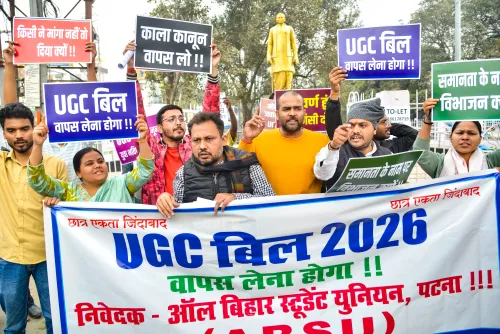
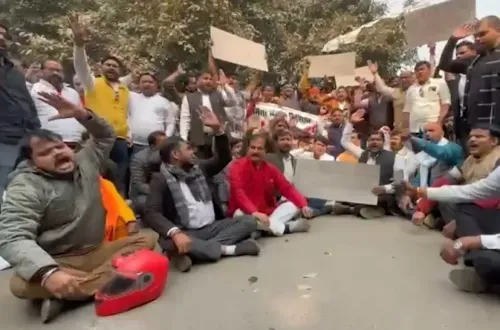
New Delhi, Jan 27 (NationPress) Amid ongoing protests against the University Grants Commission (UGC) Bill, 2026, numerous Hindu spiritual leaders have declared that the proposed legislation should be repealed without delay. They outlined various potential harms that may result from implementing this Bill.
In an interview with IANS, Swami Avimukteshwaranand Shankaracharya condemned the initiative, stating, “No caste is inherently unjust; it is the actions of individuals that lead to injustice. Each caste comprises both virtuous and faulty individuals. Labeling a whole caste as just or unjust is misguided and could inflict significant damage on Hinduism. Thus, this law must be revoked immediately.”
Jagadguru Paramhans Acharya also voiced strong dissent against the new legislation.
“We have sent a letter to Prime Minister Narendra Modi, urging the retraction of the new UGC regulations. We have requested either the withdrawal of these UGC rules or the approval for euthanasia for me,” he stated.
He further elaborated, “In our view, these regulations will lead approximately 35 percent of girls from the general category into exploitative situations. If false accusations are made, the careers of general category students will be irreparably harmed, while the accusers face no consequences. This could instigate caste-related conflicts. You have consistently stated that division leads to devastation, while unity provides safety. However, the new UGC regulations will divide and harm Hindus.”
Paramhans Acharya also suggested that the regulations could have political ramifications.
“If this situation persists, the BJP could face total annihilation in this country. As supporters of the BJP, I have reached out to the Prime Minister, advocating for the withdrawal of these regulations, as I cannot stand by and witness the party's decline,” he remarked.
Simultaneously, the University Grants Commission has rolled out the Promotion of Equity in Higher Education Institutions Regulations, 2026, aimed at combating caste-based discrimination and enhancing inclusivity in higher education institutions across India.
As per the new guidelines, universities and colleges are mandated to establish Equal Opportunity Centres, Equity Committees, grievance redressal mechanisms, and 24/7 helplines to address complaints from students belonging to Scheduled Castes (SC), Scheduled Tribes (ST), and Other Backward Classes (OBC).
The UGC asserts that these initiatives are essential for fostering safer and more equitable learning environments and for upholding the constitutional principles of social justice and equality.
While the objectives behind these regulations have received broad acknowledgment, they have also faced backlash from students, educators, academics, and political figures. Critics have denounced the rules as vague and biased.
Detractors argue that the framework lacks clear procedural safeguards and does not provide adequate verification mechanisms for complaints, leading to potential misuse. They caution that such deficiencies could heighten campus tensions and compromise institutional autonomy.
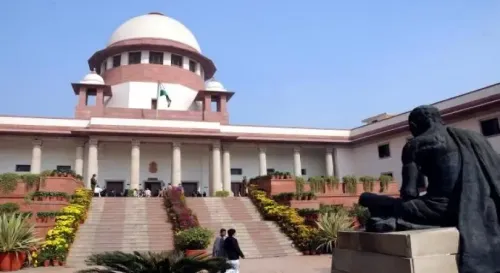
A Public Interest Litigation has also been initiated to contest the regulations, asserting that they may infringe upon constitutional principles of fairness and equality.
Point of View
It's crucial to present a balanced view on the UGC Bill 2026. While the intentions of promoting equity in education are commendable, the concerns raised by spiritual leaders cannot be dismissed lightly. A dialogue that considers both the need for inclusivity and the potential risks to societal harmony is essential for a constructive resolution.
NationPress
28 Sept 2026
Frequently Asked Questions
What is the UGC Bill 2026?
The UGC Bill 2026 aims to promote equity in higher education by establishing regulations to prevent caste-based discrimination and create inclusive environments in educational institutions.
Why are spiritual leaders opposing the UGC Bill 2026?
Spiritual leaders argue that the Bill could lead to caste division and social unrest, potentially harming Hindu society and the careers of students from general categories.
What measures are included in the new UGC regulations?
The regulations require universities to set up Equal Opportunity Centres, Equity Committees, and grievance redressal mechanisms to support students from marginalized communities.
What are the criticisms of the UGC Bill 2026?
Critics have labeled the regulations as vague and biased, highlighting concerns about procedural safeguards and the potential for misuse.
Is there a legal challenge to the UGC Bill 2026?
Yes, a Public Interest Litigation has been filed, claiming that the regulations violate constitutional principles of fairness and equality.