EAM Jaishankar Updates Rajya Sabha on PM Modi's Vigilance Over West Asia Crisis Affecting Indian Citizens
Synopsis
EAM Jaishankar revealed in the Rajya Sabha that PM Modi is vigilantly tracking the escalating conflict in West Asia, highlighting its grave implications for Indian citizens abroad. The government is taking proactive measures to ensure their safety amidst rising tensions in the region.
Key Takeaways
PM Modi is closely monitoring the crisis in West Asia.
The conflict poses serious risks to Indian citizens living abroad.
Government has issued multiple advisories and initiated evacuation processes.
West Asia is economically significant for India, accounting for $200 billion in trade.
Diplomacy and dialogue are being emphasized to de-escalate tensions.
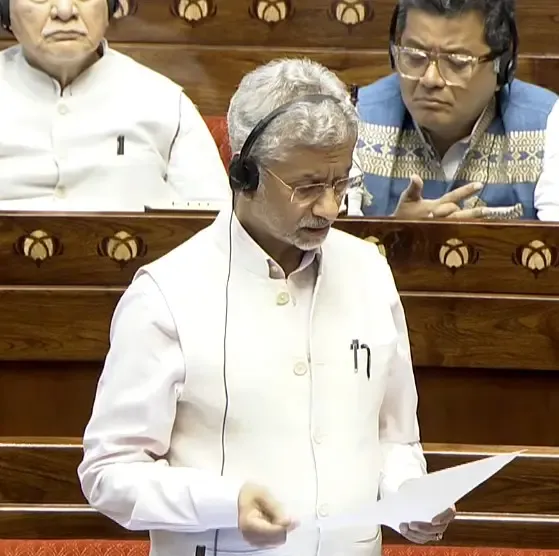
New Delhi, March 9 (NationPress) External Affairs Minister (EAM) S. Jaishankar informed the Rajya Sabha that Prime Minister Narendra Modi is actively observing the developing circumstances in West Asia. He emphasized that the ongoing conflict is particularly significant for India due to the substantial number of Indian nationals residing and working in the Gulf region.
At the outset of the session, Opposition Leader Mallikarjun Kharge sought to address the fatalities of Indian citizens amid the current turmoil in the area.
His comments sparked protests from the ruling party members, prompting Chairman C.P. Radhakrishnan to ask Kharge to wrap up his comments and allow the External Affairs Minister to present his statement.
While addressing the House amidst loud protests from Opposition members, EAM Jaishankar outlined the situation in West Asia, noting that the conflict escalated following US-Israeli strikes on Iran, resulting in widespread devastation and the deaths of several high-ranking leaders within the Iranian regime.
He acknowledged that conditions have deteriorated further, with tensions spreading across multiple nations in the area.
“Our government issued a statement on February 20 expressing profound concerns and urging all parties to exercise restraint, avoid escalation, and prioritize civilian safety. We maintain that dialogue and diplomacy should be the path forward to de-escalate tensions,” the External Affairs Minister remarked.
“It is crucial that the sovereignty and territorial integrity of all states in the region are respected,” he stressed.
EAM Jaishankar informed the House that the Cabinet Committee on Security, led by Prime Minister Modi, has acknowledged the conflict and the challenges faced by Indians living in the area as well as those traveling through it.
He stated that all ministers have been instructed to take necessary actions to assist Indian citizens. According to him, the Prime Minister has been consistently monitoring developments related to the crisis.
“PM Modi has contacted the heads of state from the UAE, Qatar, Saudi Arabia, Oman, Jordan, Israel, and Bahrain, urging all parties to reduce tensions,” he said.
The Minister underscored that the conflict has serious consequences for India due to its significant presence in Gulf countries.
“This conflict is especially alarming for India, where nearly 10 million Indian citizens reside and work in Gulf nations. Additionally, several thousand Indians are in Iran for studies and employment,” he stated.
EAM Jaishankar also highlighted the strategic and economic significance of the region for India, noting that West Asia is vital for the nation’s energy security and trade relations.
“The region is essential for energy security and includes key suppliers of oil and gas. The Gulf area is a crucial trading partner for India, accounting for approximately $200 billion annually. Furthermore, there has been notable investment from this region into the Indian economy over the last decade. As a result, any disruptions in supply chains and the prevailing instability are serious concerns,” he elaborated.
He added that the ongoing conflict has impacted maritime shipping activities in the region, where many Indian nationals are employed as crew members.
“Regrettably, we have already lost two Indian mariners, and one is still unaccounted for,” he stated.
The External Affairs Minister further updated the House that the government has been closely monitoring the West Asia situation since the 12-day conflict that occurred in June 2025.
“We have observed signs of escalating tensions and have cautioned the Indian community in Iran correspondingly,” he mentioned.
According to EAM Jaishankar, the government has released multiple advisories to Indian citizens in Iran as conditions worsened.
He highlighted that Indian authorities had warned citizens in January to refrain from non-essential travel to Iran. Those already there were encouraged to register with the Indian Embassy and stay alert by following updates on the embassy’s website and social media.
Later, the Indian Embassy in Tehran issued another advisory on February 14, urging Indian nationals to leave Iran using all available transport options, and the embassy provided assistance to facilitate these departures.
Another advisory on February 23 reiterated this warning, he added.
The Minister also reported that an evacuation process was initiated shortly after to ensure the safe return of Indian nationals, including students studying in Iran, as the regional situation continued to decline.
Even as EAM Jaishankar continued his statement in the House, Opposition members persisted with their protests during the proceedings.
Point of View
The ongoing conflict in West Asia presents serious implications for India, especially with a substantial diaspora in the region. The government's proactive measures to ensure the safety of its citizens reflect a commitment to safeguarding national interests while advocating for diplomatic resolutions.
NationPress
3 Oct 2026
Frequently Asked Questions
What is the current situation in West Asia?
The situation is tense due to ongoing conflicts, particularly following US-Israeli strikes on Iran, leading to widespread destruction and escalating tensions across multiple countries.
How many Indian citizens are in the Gulf region?
Approximately 10 million Indian citizens live and work in Gulf countries, making the region crucial for India's diaspora.
What actions is the Indian government taking?
The government is closely monitoring the situation, issuing advisories, and has initiated an evacuation process for Indian nationals in Iran.
What is the economic significance of West Asia for India?
West Asia is vital for India's energy security and trade, accounting for nearly $200 billion in annual trade and significant investment into the Indian economy.
What were the recent advisories issued to Indian citizens in Iran?
Indian authorities have advised against non-essential travel to Iran and encouraged citizens to register with the embassy and remain vigilant.