Rakhigarhi skeletons handed to AnSI for ancient DNA and Harappan study
Synopsis
Three complete human skeletons and bone fragments from Rakhigarhi's Mound No. 7 — the largest Harappan settlement ever found — have been handed to AnSI under a new MoU. Ancient DNA analysis and isotope studies on these remains could rewrite what we know about ancestry, migration, and disease in one of the world's first urban civilisations.
Key Takeaways
ASI formally transferred human skeletal remains from Rakhigarhi, Haryana to the Anthropological Survey of India (AnSI) on 22 June under a new MoU .
Eight burials were uncovered at Mound No.
7 during the 2025–26 excavation season; three complete skeletons have already been transferred to AnSI's Kolkata laboratory.
Researchers will apply ancient DNA analysis , stable isotope studies , osteological assessments , and palaeopathological investigations to the remains.
Rakhigarhi spans approximately 550 hectares and is the largest known settlement of the Indus-Saraswati Civilisation .
Remaining skeletal materials from the site are expected to be transferred to AnSI within days.
The Archaeological Survey of India (ASI) has formally transferred human skeletal remains excavated from Rakhigarhi, Haryana — the largest known settlement of the Indus-Saraswati Civilisation — to the Anthropological Survey of India (AnSI) for comprehensive scientific investigation, an official confirmed on Monday, 22 June. The handover, executed under a newly signed Memorandum of Understanding (MoU) between the two institutions, is expected to unlock multidisciplinary insights into one of humanity's earliest urban societies.
What Was Transferred and From Where
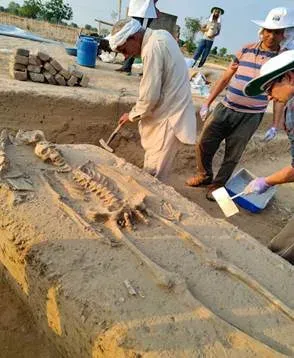
During the 2025–26 field season, archaeologists from ASI's Excavation Branch-II, Greater Noida, uncovered eight burials at Mound No. 7 of Rakhigarhi, an area previously identified as a cemetery. Three complete human skeletons, along with skeletal fragments recovered from the remaining burials, have been transported to AnSI's ancient human skeletal repository and laboratory in Kolkata. The remaining skeletal materials from the site are expected to follow within days, according to an official statement.
Scientific Methods to Be Applied
Researchers plan to deploy a suite of modern techniques on the remains, including ancient DNA analysis, stable isotope studies, osteological assessments, palaeopathological investigations, and environmental reconstruction. These methods are expected to yield evidence on ancestry, migration patterns, diet, disease prevalence, and human-environment interactions during the Harappan period.
Professor B.V. Sharma, Director of AnSI, said the transfer is expected to significantly advance multidisciplinary research into one of the most important urban centres of the Indus-Saraswati Civilisation. Anthropologist Professor Subhash Walimbe, formerly of Deccan College, Pune, emphasised the importance of intensive anthropological examination to understand how urbanisation influenced human biological and pathological responses.
Why Rakhigarhi Matters
Rakhigarhi, spread across approximately 550 hectares in Haryana, is widely recognised as the largest known settlement of the Indus-Saraswati Civilisation. Archaeological excavations have revealed evidence of continuous habitation from the Early Harappan to the Mature Harappan periods, encompassing planned settlements, drainage systems, craft production centres, trade networks, and burial grounds. The site's scale and stratigraphic depth make it a critical reference point for understanding South Asian prehistory.
Expert Perspectives
Professor Vijay Prakash, a former faculty member of Andhra University, described the transfer as an important step toward ensuring that biological heritage recovered through archaeological excavations is scientifically analysed and preserved by national institutions for future generations. Professor Udai Pratap Singh of Lucknow University called the handover a milestone in strengthening India's palaeoanthropological research tradition, noting that AnSI's expertise in human biology and osteology positions it well to reconstruct population history, health patterns, and cultural adaptation in the Indus-Saraswati Civilisation.
Broader Significance
Officials described the ASI–AnSI collaboration as a significant effort to integrate archaeology, anthropology, genetics, and environmental sciences in the study of India's ancient past. The findings are expected to contribute substantially to understanding the origins, health, mobility, and biological history of one of the world's earliest urban civilisations. With ancient DNA research having already reshaped understanding of Bronze Age populations globally, the Rakhigarhi remains could prove equally consequential for South Asian prehistory.
Point of View
But its scientific stakes are anything but. Ancient DNA from Rakhigarhi has already sparked fierce academic debate — a 2019 study on remains from the same site suggested the Harappan population showed little steppe ancestry, challenging dominant migration theories. The new batch of skeletons, analysed with updated sequencing technology, could either reinforce or further complicate that picture. What is notable is that the MoU formalises a collaboration that arguably should have existed decades ago; India's palaeoanthropological infrastructure has historically lagged behind the ambition of its archaeological excavations. Whether the findings are published transparently and swiftly — rather than held back for political or academic reasons — will determine whether this moment advances scholarship or merely generates headlines.
NationPress
21 Sept 2026
Frequently Asked Questions
What are the Rakhigarhi skeletal remains and why are they significant?
They are human bones excavated from Mound No. 7 at Rakhigarhi, Haryana — the largest known settlement of the Indus-Saraswati (Harappan) Civilisation, spanning roughly 550 hectares. The remains offer a rare window into ancestry, migration, diet, and disease patterns of one of the world's earliest urban populations, and ancient DNA extracted from them could reshape understanding of South Asian prehistory.
Which institution will study the Rakhigarhi remains and where?
The Anthropological Survey of India (AnSI) will conduct the scientific investigation at its ancient human skeletal repository and laboratory in Kolkata. The transfer was carried out under a newly signed MoU between ASI and AnSI.
What scientific techniques will be used on the Rakhigarhi skeletons?
Researchers plan to use ancient DNA analysis, stable isotope studies, osteological assessments, palaeopathological investigations, and environmental reconstruction. These methods are expected to provide evidence on ancestry, migration, diet, disease prevalence, and human-environment interactions during the Harappan period.
How many skeletons were found and transferred?
Eight burials were uncovered at Mound No. 7 during the 2025–26 field season. Three complete human skeletons, along with skeletal fragments from the other burials, have been transferred to AnSI's Kolkata lab. The remaining skeletal materials are expected to follow within days.
What is the MoU between ASI and AnSI?
It is a recently signed Memorandum of Understanding between the Archaeological Survey of India and the Anthropological Survey of India, formalising collaboration to ensure that biological heritage recovered through excavations is scientifically analysed and preserved. The Rakhigarhi transfer is the first major handover under this agreement.