South Korea, Tajikistan forge comprehensive partnership at Seoul summit
Synopsis
South Korea and Tajikistan upgraded ties to a comprehensive partnership on 16 September, sealing the deal with 17 agreements at Cheong Wa Dae — just hours before Seoul hosted the inaugural South Korea-Central Asia Summit. Critical minerals are at the heart of the deal, reflecting Seoul's accelerating push to diversify supply chains away from Chinese dominance.
Key Takeaways
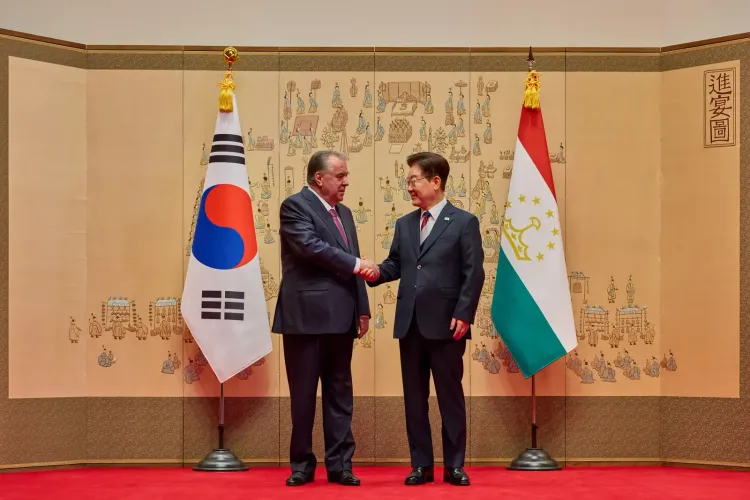
South Korean President Lee Jae Myung and Tajikistani President Emomali Rahmon agreed to a comprehensive partnership on 16 September 2026 in Seoul.
A total of 17 agreements were signed, mostly focused on economic cooperation including critical minerals , railways, and digital technology.
The bilateral summit at Cheong Wa Dae preceded the inaugural South Korea-Central Asia Summit attended by leaders of Kazakhstan, Uzbekistan, Turkmenistan, and Kyrgyzstan.
Rahmon also met South Korean Prime Minister Han Seong-sook to discuss broader bilateral cooperation.
South Korea and Tajikistan have maintained diplomatic relations since 1992 .
South Korean President Lee Jae Myung and Tajikistani President Emomali Rahmon agreed on Wednesday, 16 September 2026, to elevate bilateral ties to a comprehensive partnership, with Seoul placing particular emphasis on cooperation in critical minerals, railways, and digital technology. The agreement was sealed at a bilateral summit held at Cheong Wa Dae in Seoul, ahead of the inaugural South Korea-Central Asia Summit later the same day.
What the Partnership Covers
The two leaders agreed that the upgraded relationship — building on diplomatic ties established in 1992 — should be underpinned by concrete sectoral cooperation. President Lee specifically highlighted Tajikistan's rich mineral resources and its high economic growth potential, pledging that South Korea would serve as a 'trustworthy partner' in the country's economic development.
'I hope that the two countries will further expand mutually beneficial cooperation in sectors including railways, critical minerals and digital (technology),' Lee said at the opening of the bilateral meeting.
Agreements and Legal Framework
A total of 17 agreements were signed on the sidelines of the summit, the majority of them focused on enhancing economic cooperation. President Rahmon described the agreements as laying a legal framework for the development of bilateral relations, saying the new pacts 'will contribute to further strengthening the economic partnership that is beneficial to each other.'
Rahmon also stressed the need to build robust legal and institutional foundations to match the aspirations of the new partnership, calling the summit 'an important opportunity to ramp up diplomacy and political trust between the countries.'
High-Level Diplomatic Engagement
Beyond the presidential summit, Rahmon also held a separate meeting with South Korean Prime Minister Han Seong-sook, where both sides discussed ways to bolster all-round cooperation. 'The development of relations with the Republic of Korea is one of Tajikistan's important foreign policies,' Rahmon said through an interpreter at the start of that meeting.
This comes amid South Korea's broader strategic push into Central Asia, with the inaugural South Korea-Central Asia Summit — attended by the heads of state of Kazakhstan, Uzbekistan, Turkmenistan, and Kyrgyzstan alongside Tajikistan — signalling Seoul's intent to deepen its regional footprint at a time of intensifying global competition for critical mineral supply chains.
Strategic Context: The Critical Minerals Angle
Tajikistan holds significant reserves of minerals critical to semiconductor manufacturing, battery production, and clean energy — sectors where South Korea's top conglomerates have a major stake. Notably, Seoul has been accelerating resource diplomacy across Central Asia and Africa as it seeks to diversify away from dependence on Chinese-controlled supply chains. The comprehensive partnership with Dushanbe fits squarely into that strategic calculus.
With 17 agreements now in place and both leaders expressing satisfaction with the trajectory of ties, implementation timelines and specific project commitments will be the key metrics to watch in the months ahead.
Point of View
Cobalt, rare earths — is reshaping alliance architectures. Hosting five Central Asian heads of state in a single day is a significant diplomatic play, one that signals Seoul is no longer content to be a passive consumer of the region's resources. The real test will be whether the 17 agreements translate into operational projects, or whether, like many such diplomatic packages, they remain aspirational documents awaiting implementation funding and political follow-through.
NationPress
16 Sept 2026
Frequently Asked Questions
What is the South Korea-Tajikistan comprehensive partnership announced in September 2026?
It is an upgraded bilateral framework agreed between South Korean President Lee Jae Myung and Tajikistani President Emomali Rahmon on 16 September 2026 in Seoul, covering cooperation in critical minerals, railways, and digital technology. The partnership is backed by 17 agreements signed on the sidelines of the summit.
Why did South Korea prioritise critical minerals in the Tajikistan deal?
Tajikistan holds significant reserves of minerals essential to semiconductor manufacturing, battery production, and clean energy — all sectors where South Korean companies have a major stake. Seoul is actively diversifying its critical mineral supply chains away from over-reliance on Chinese-controlled sources.
What is the South Korea-Central Asia Summit held on 16 September 2026?
It is the inaugural multilateral summit hosted by South Korea in Seoul, attended by the heads of state of Tajikistan, Kazakhstan, Uzbekistan, Turkmenistan, and Kyrgyzstan. The summit reflects Seoul's broader strategic push to deepen economic and diplomatic ties across Central Asia.
How many agreements were signed between South Korea and Tajikistan?
A total of 17 agreements were signed on the sidelines of the bilateral summit, the majority focused on enhancing economic cooperation across priority sectors.
How long have South Korea and Tajikistan maintained diplomatic relations?
The two countries established diplomatic relations in 1992. President Lee described it as 'very meaningful' that the relationship has now been elevated to a comprehensive partnership more than three decades after those ties were first forged.