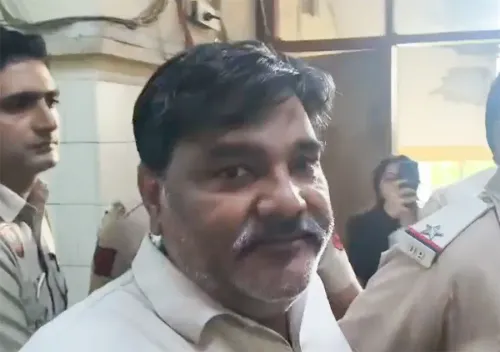
Delhi court defers Tahir Hussain sentencing to July 27 in IB officer murder case

Synopsis
Five years after IB officer Ankit Sharma was allegedly abducted and killed during the 2020 North-East Delhi riots, the sentencing phase for former AAP councillor Tahir Hussain and four co-convicts has been pushed to July 27. With murder charges carrying a potential death sentence, the Karkardooma Court's next hearing will be a defining moment in one of the most politically charged riot cases in recent memory.
Key Takeaways
Delhi's Karkardooma Court deferred the sentencing hearing for Tahir Hussain and four others to 27 July .
All five were convicted earlier this month for the murder of IB officer Ankit Sharma during the 2020 North-East Delhi riots .
Charges include murder ( Section 302 IPC ), kidnapping, rioting, and promoting enmity between groups.
All five were acquitted of criminal conspiracy under Section 120B IPC ; six other accused were also acquitted.
Sharma's body was recovered from a drain in Khajuri Khas on 26 February 2020 ; the riots claimed 53 lives in total.
A Delhi court on Thursday, 23 July deferred the hearing on the quantum of sentence to 27 July in the case of former Aam Aadmi Party (AAP) councillor Tahir Hussain and four others convicted for the murder of Intelligence Bureau (IB) officer Ankit Sharma during the 2020 North-East Delhi riots. The adjournment came after sentencing arguments could not be concluded in a single sitting at the Karkardooma Court.
Conviction and Charges
Earlier this month, the court found Hussain, Javed, Anas, Nazim, and Kasim guilty of multiple offences in the murder case. The charges included murder, kidnapping, rioting, and promoting enmity between different groups.
In its detailed judgment, the court held Hussain guilty under Sections 302, 365, 188, 153A, 147, 148, and 149 of the Indian Penal Code (IPC). The four co-convicts were held guilty of the same offences. Notably, all five were acquitted of the charge of criminal conspiracy under Section 120B of the IPC. Six other accused were also acquitted, as the prosecution failed to establish their guilt beyond reasonable doubt.
What Happened to Ankit Sharma
The case centres on the killing of IB officer Ankit Sharma, whose body was recovered from a drain in the Khajuri Khas area on 26 February 2020, during the communal violence that swept through North-East Delhi. According to the prosecution, Sharma was caught in the unrest near his residence on 25 February 2020, when clashes broke out between two groups near Chand Bagh Pulia.
It was alleged that he was abducted by a mob, assaulted, and stabbed multiple times before his body was dumped into a nearby drain. The FIR was registered at Dayalpur police station on the complaint of Sharma's father, Ravinder Kumar, who stated that his son had gone out to purchase household items and never returned.
The 2020 North-East Delhi Riots: Background
The violence that engulfed North-East Delhi in February 2020 claimed 53 lives, left several others injured, and caused damage to property worth crores of rupees. It remains one of the deadliest episodes of communal unrest in the capital in recent decades. The riots broke out amid widespread protests over the Citizenship Amendment Act (CAA), with clashes between two groups rapidly escalating into large-scale violence across multiple localities.
What Happens Next
The Karkardooma Court will hear arguments on the quantum of sentence on 27 July. The sentencing phase will determine the punishment for Hussain and the four co-convicts, with the murder charge under Section 302 carrying a maximum penalty of life imprisonment or the death sentence. The outcome is being closely watched given the high-profile nature of the case and the political background of the primary accused.
Point of View
But the stakes are anything but. A Section 302 conviction opens the door to life imprisonment or even capital punishment — and the court's eventual sentence will be read against the backdrop of a riot that killed 53 people and left deep political fault lines. Hussain's case is also a test of how the legal system handles elected representatives implicated in communal violence: the acquittal on conspiracy charges narrows the net, but the murder conviction itself is unambiguous. What the sentencing phase will reveal is whether the judiciary treats the killing of a state officer during mob violence as an aggravating factor — a question with implications well beyond this courtroom.
NationPress
22 Oct 2026
Frequently Asked Questions
Why was the Tahir Hussain sentencing hearing deferred?
The Karkardooma Court deferred the hearing on the quantum of sentence to 27 July because sentencing arguments could not be concluded in the session held on 23 July. Both sides are expected to present arguments on the appropriate punishment at the next date.
What was Tahir Hussain convicted of?
Tahir Hussain was convicted of murder (Section 302 IPC), kidnapping (Section 365), rioting (Sections 147 and 148), promoting enmity between groups (Section 153A), and related offences under the IPC. He and four co-convicts were, however, acquitted of criminal conspiracy under Section 120B.
Who was Ankit Sharma and how was he killed?
Ankit Sharma was an Intelligence Bureau officer whose body was found in a drain in the Khajuri Khas area of North-East Delhi on 26 February 2020. According to the prosecution, he was abducted by a mob near his residence, assaulted, and stabbed multiple times before being dumped in the drain during the communal riots.
What was the scale of the 2020 North-East Delhi riots?
The February 2020 riots in North-East Delhi claimed 53 lives, left several people injured, and caused damage to property worth crores of rupees. The violence broke out amid clashes between two groups and is considered one of the deadliest episodes of communal unrest in the capital in recent decades.
What punishment could Tahir Hussain face?
A conviction under Section 302 of the IPC for murder carries a maximum penalty of life imprisonment or the death sentence. The Karkardooma Court will hear arguments from both sides on the quantum of sentence on 27 July before pronouncing the punishment.