Tejashwi Yadav Critiques India's Foreign Policy, Calls for Strong Energy Security Measures
Synopsis
Tejashwi Yadav, RJD's National Working President, critiques India's foreign policy, urging the government to assert its energy independence and national sovereignty amid external pressures. His statements spark a crucial debate on the country's stance in global politics.
Key Takeaways
Tejashwi Yadav criticizes India's need for external approval for energy decisions.
Emphasizes India's sovereignty and independence in foreign policy matters.
Stresses the importance of energy security amid shifting global dynamics.
Calls for long-term vision in energy procurement strategies.
Highlights the critical geopolitical significance of the Strait of Hormuz.
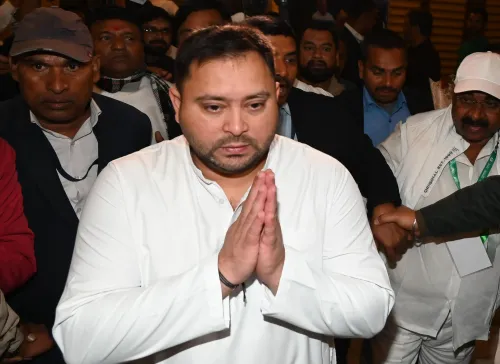
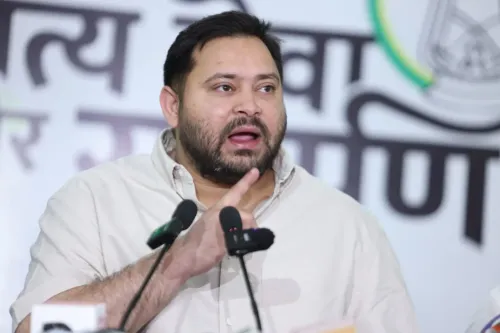
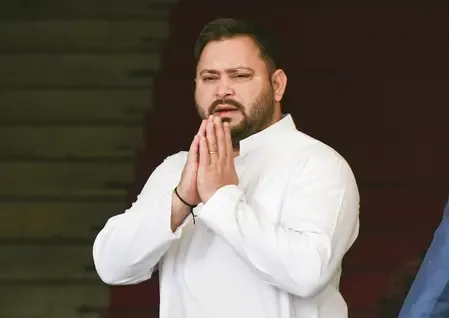
Patna, March 9 (NationPress) Tejashwi Yadav, the National Working President of the Rashtriya Janata Dal (RJD), expressed his discontent on Monday with the Union government's approach to foreign policy, asserting that India, as a prominent nation, should not need to seek approval from others to define its energy requirements or trade strategies.
In a statement on X, he remarked, "The United States has indicated that India is 'permitted' to purchase oil from Russia for a duration of 30 days. Prime Minister Narendra Modi, representing 1.5 billion proud Indians, must unequivocally declare that India's choices are not swayed by foreign influence."
Yadav emphasized that India, as a sovereign state, should maintain independence from foreign conditions or endorsements when making significant energy decisions.
Highlighting the shifting global political dynamics, the RJD leader stressed the importance of prioritizing energy security and the nation's interests.
Tejashwi Yadav articulated that decisions concerning vital matters like oil acquisition should be made autonomously and with a forward-thinking perspective.
According to him, India's policies should be shaped by the needs of its populace and not dictated by external agendas.
Addressing Prime Minister Modi directly, Yadav insisted that as a leader of a significant global power, Modi should assert India's dignity and sovereignty in international discussions.
He emphasized that this issue transcends political rivalries and is fundamentally about national pride and sovereignty, where no compromises should be entertained.
These comments by Tejashwi Yadav have sparked discussions in political arenas.
Opposition leaders are framing the situation as a test of India's commitment to an independent foreign policy, while responses from the Union government are anticipated.
India's choice to procure oil from Russia during the ongoing conflict involving Israel and the US with Iran has become a focal point of global discourse since the onset of turmoil in the Middle East.
In the context of escalating tensions with the US and Israel, Iran has reportedly gained control over the Strait of Hormuz, a vital chokepoint responsible for nearly 20% of the world's daily oil transport.
There are reports of Iran threatening to disrupt this strategically significant, oil-rich waterway.
Point of View
Tejashwi Yadav's comments underscore a broader conversation about India's foreign policy and its implications for national sovereignty. His stance invites reflection on how India navigates its relationships with powerful nations while prioritizing its citizens' interests.
NationPress
14 Sept 2026
Frequently Asked Questions
What did Tejashwi Yadav criticize regarding India's foreign policy?
Tejashwi Yadav criticized the Union government's foreign policy for requiring permission from other nations for energy needs, urging India to assert its independence.
How did Yadav suggest India should handle energy procurement?
Yadav suggested that India should make independent decisions about energy procurement without external influence, focusing on national interests.
What is the significance of the Strait of Hormuz in this context?
The Strait of Hormuz is a critical chokepoint for global oil transportation, and Iran's control over it poses potential disruptions to oil supply amid regional tensions.
What was the response from political circles regarding Yadav's remarks?
Yadav's remarks have sparked debate in political circles, with opposition leaders viewing it as a question of maintaining India's independent foreign policy.
What is the current geopolitical climate affecting India's oil purchases?
India's decision to purchase oil from Russia during the ongoing conflict involving Israel and the US with Iran has become a major topic of international discussion.