Will AI Agents Transform SaaS Business Models or Make Them Obsolete?
Synopsis
Industry leaders at the AI Impact Summit 2026 debate the impact of AI agents on SaaS models, emphasizing the importance of customer value and the evolution of software engineering roles. Discover how agility and orchestration are key to navigating this transformative landscape.
Key Takeaways
AI agents will transform but not eliminate traditional SaaS models.
Delivering real customer value is essential for long-term sustainability.
The role of software engineers is evolving towards high-level architecture .
AI is unlocking new market opportunities worth billions.
Success hinges on agility and the capacity to solve complex challenges.
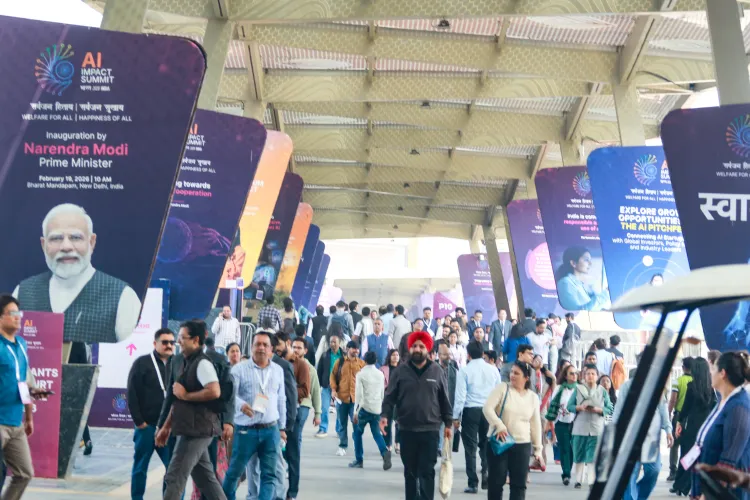
New Delhi, Feb 21 (NationPress) Prominent industry figures gathered at the ‘AI Impact Summit 2026’ to discuss whether AI agents are significantly disrupting traditional software-as-a-service (SaaS) models, while advising against overgeneralization.
In response to the future of SaaS, Arundhati Bhattacharya, Chairperson and CEO of Salesforce India, remarked that market predictions can often be misleading.
“The essence of the SaaS model transcends mere coding or application development; it involves comprehending workflows, identifying customer challenges, and effectively addressing them. It encompasses aspects like observability, governance, auditability, and adoption,” she stated during a session.
Bhattacharya asserted that while methods of operation will evolve, long-term viability will rely on delivering genuine customer value.
K. Krithivasan, CEO of Tata Consultancy Services, emphasized that “We are entering an age where the function of the software engineer is transitioning towards high-level architecture and stringent validation.”
He highlighted that despite the potential for substantial productivity increases through AI, enterprise adaptation necessitates considerable foundational work, ranging from data rationalization to application modernization.
“We don’t foresee a contraction in the sector; instead, we anticipate a remarkable surge in the volume of what can be created and the intricacy of the challenges we can tackle,” he continued.
Salil Parekh, Chief Executive Officer of Infosys, noted that AI is unlocking a $300 billion services market by rendering the ‘impossible’ financially feasible.
Through Infosys’ orchestration platforms, he emphasized that businesses can integrate foundational models with specialized agents to derive measurable business value.
C Vijayakumar, CEO and Managing Director of HCL Technologies, pointed out that “Large language models and foundational models are not yet optimally applicable to enterprise scenarios,” highlighting an ongoing disparity between foundational capabilities and enterprise-level performance.
The executives conveyed a clear message: while AI agents will transform business and operational frameworks, they will not render them obsolete in the immediate future.
Success in the AI-driven landscape will depend on agility, enterprise preparedness, orchestration, and primarily the capacity to continuously address real customer challenges in increasingly intricate digital ecosystems, they concluded.
Point of View
I recognize the critical transition underway in the SaaS landscape driven by AI. While the potential for transformation is immense, it is essential to remain grounded in the realities of customer needs and sustainable practices. The insights from industry leaders highlight a balanced approach towards embracing innovation without succumbing to the hype.
NationPress
1 Oct 2026
Frequently Asked Questions
Are AI agents going to replace traditional SaaS models?
No, AI agents are expected to reshape SaaS models rather than render them obsolete overnight.
What is the future role of software engineers in the age of AI?
Software engineers will transition towards high-level architecture and validation, focusing on complex problem-solving.
How significant is the impact of AI on business value?
AI is creating substantial opportunities, potentially unlocking a $300 billion services market.
What are the key components for success in AI implementation?
Agility, enterprise readiness, and the ability to solve real customer problems in complex ecosystems are crucial.
Will the SaaS sector shrink due to AI?
No, the sector is expected to experience growth in production volume and problem complexity.