Anand Mahindra hails Bhutan PM's EV pick in diplomatic nod
Synopsis
Mahindra Group chairman Anand Mahindra publicly thanked Bhutan PM Tshering Tobgay after Mahindra electric vehicles were selected for official Bhutanese use, tagging EAM Jaishankar and framing the moment as a boost to India-Bhutan ties.
Key Takeaways
Anand Mahindra posted on 14 October 2026 thanking Bhutan PM Tshering Tobgay for selecting Mahindra EVs for official use.
External Affairs Minister S.
Jaishankar was tagged in the post, signalling a deliberate diplomatic framing.
The development aligns with India's neighbourhood-first policy that increasingly promotes green technology exports to close partners.
Bhutan is one of India's most carbon-conscious neighbours, making it a natural market for Indian-made electric vehicles.
India's FAME scheme (2015) has underpinned Mahindra's competitiveness in EV manufacturing and export readiness.
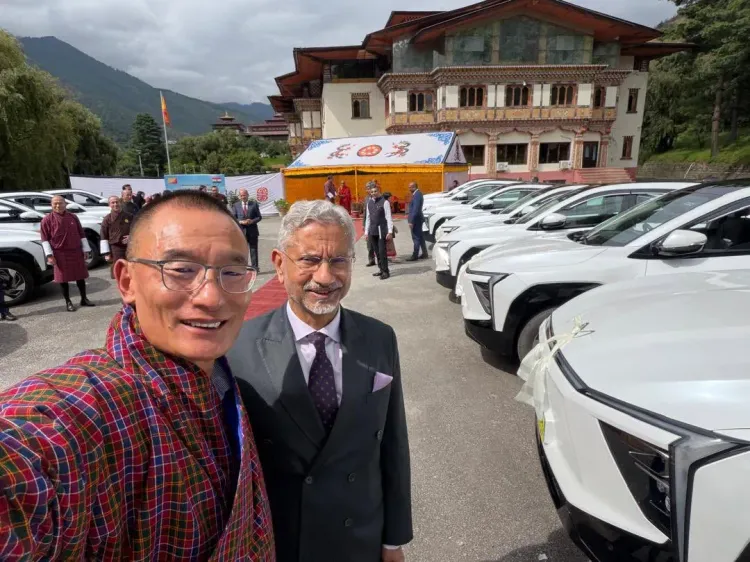
When a head of government chooses your vehicles to represent his country, the endorsement does not get much more official than that. Mahindra Group chairman Anand Mahindra took to X on Wednesday, 14 October 2026, to publicly thank Bhutan Prime Minister Tshering Tobgay after spotting Mahindra electric vehicles — apparently selected for official use — in images shared on the platform.
Posting two images of the vehicles, Mahindra wrote with characteristic wit: 'Thank you, Prime Minister @tsheringtobgay for, dare I say, your excellent judgment in selecting our automobiles!' He added that he was 'honoured to see our electric vehicles giving an extra charge to the bonds between Bhutan and India,' looping in External Affairs Minister S. Jaishankar in the post.
Mahindra EVs as soft-power on the Bhutan road
The choice of an Indian-made electric vehicle for official Bhutanese use is more than a procurement decision — it lands squarely inside India's neighbourhood-first policy, which has increasingly used green technology exports as a bridge to closer partners. Bhutan, a country that has long championed low-emission development and carbon negativity, fits the profile of an ideal early adopter of Indian EVs.
Mahindra's automotive arm has positioned itself at the front of India's electric transition, backed in part by the FAME (Faster Adoption and Manufacturing of Hybrid and Electric Vehicles) scheme, launched in 2015, which was designed to stimulate both domestic uptake and export competitiveness. Seeing those vehicles now deployed at a diplomatic level in a neighbouring capital is precisely the kind of outcome the scheme's architects envisioned.
Jaishankar tagged — the diplomatic signal is intentional
Mahindra's decision to tag External Affairs Minister S. Jaishankar was not accidental. The mention threads the commercial moment into the larger fabric of India-Bhutan bilateral relations, which are anchored by the Treaty of Friendship — last renewed in 2007 — covering cooperation in technology, energy, and the environment. Bhutan remains one of India's most strategically important neighbours, sharing deep economic and security ties.
By framing his EVs as giving an 'extra charge' to bilateral bonds, Mahindra neatly compressed commerce, diplomacy, and sustainability into a single social-media post — a reminder that in India's neighbourhood, industrial exports and foreign policy often travel in the same vehicle.
If Bhutan's official adoption of Mahindra EVs is confirmed at scale, watch for it to surface as a headline data point in the next India-Bhutan bilateral summit — a corporate win that doubles as a foreign-policy talking point.
Point of View
A government-level endorsement from Bhutan, however symbolic in volume, carries significant brand equity in emerging South and Southeast Asian markets increasingly focused on low-emission transport. The tagging of the External Affairs Minister also signals that Indian corporates are increasingly co-authoring the country's soft-power narrative, not just benefiting from it. Investors and trade-watchers should note that EV exports to SAARC nations could become a measurable segment as India's domestic EV manufacturing scales under the FAME framework.
NationPress
14 Oct 2026
Frequently Asked Questions
Which Mahindra electric vehicles were selected by Bhutan?
The exact models have not been officially confirmed; Anand Mahindra's post on 14 October 2026 referenced the selection without specifying the variant, and the scale of the procurement is yet to be publicly announced.
Why did Anand Mahindra tag S. Jaishankar in the Bhutan EV post?
Mahindra tagged External Affairs Minister S. Jaishankar to highlight the diplomatic dimension of the development, framing the EV selection as a contribution to India-Bhutan bilateral relations beyond a simple commercial transaction.
What is India's neighbourhood-first policy and how do EVs fit in?
India's neighbourhood-first policy prioritises economic, diplomatic, and strategic engagement with South Asian neighbours; green technology exports like electric vehicles have become a growing pillar of this approach, especially with countries like Bhutan that have strong sustainability mandates.
How does the FAME scheme support Mahindra EV exports?
The FAME (Faster Adoption and Manufacturing of Hybrid and Electric Vehicles) scheme, launched in 2015, incentivised domestic EV manufacturing in India, improving cost competitiveness and enabling companies like Mahindra to explore export markets in the region.
What is the current state of India-Bhutan relations?
India and Bhutan share deep ties anchored by a Treaty of Friendship last renewed in 2007, covering cooperation in technology, energy, and the environment; Bhutan remains one of India's closest strategic partners in South Asia.