BRICS 2026: India chairs release of 4 sustainability compendiums on wildfires, circular economy
Synopsis
Under India's BRICS 2026 Chairship, four landmark knowledge compendiums on wildfires, sustainable lifestyles, landscape greening, and circular economy were released at the 12th Environment Ministers' Meeting — the most comprehensive ecological knowledge-sharing exercise of any single BRICS chairship, pooling indigenous and tech-driven solutions from nine nations including newer members Egypt, Ethiopia, and the UAE.
Key Takeaways
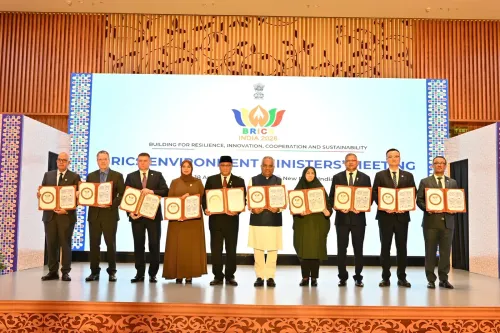
BRICS nations released four collaborative knowledge compendiums at the 12th Environment Ministers' Meeting on 18 August 2026 in New Delhi .
The compendiums cover sustainable lifestyles, wildfire management, landscape-based greening , and circular economy practices .
India's contributions to the sustainable lifestyles compendium include Mission LiFE , the Environment Education Programme , and the SAMBHAV Campaign .
The wildfire compendium addresses rising fire risks driven by prolonged droughts and rising temperatures , covering prevention through to recovery.
Union Minister Bhupender Yadav chaired the meeting under India's BRICS 2026 Chairship .
Case studies span Brazil, China, Egypt, Ethiopia, India, Indonesia, South Africa , and the UAE .
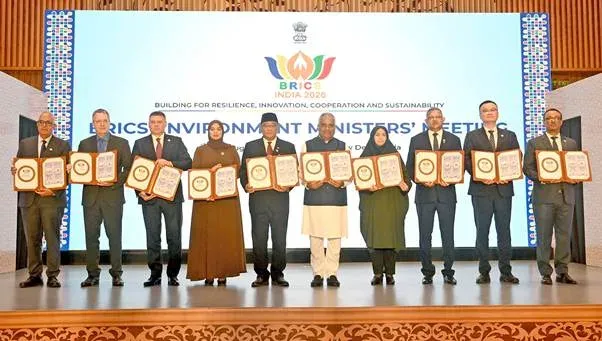
BRICS member nations on Tuesday, 18 August 2026 unveiled four collaborative knowledge compendiums spanning sustainable lifestyles, integrated wildfire management, landscape-based greening, and circular economy practices, the Ministry of Environment, Forest and Climate Change (MoEFCC) announced. The release came at the 12th BRICS Environment Ministers' Meeting held under India's BRICS 2026 Chairship in New Delhi.
What the Four Compendiums Cover
The knowledge products are the result of sustained deliberations under the BRICS Environment Working Group, pooling national experiences, leading practices, innovative solutions, and local knowledge systems from across the bloc. Together, they represent the most comprehensive environmental knowledge-sharing exercise undertaken under a single BRICS chairship.
The first compendium, on Promoting Sustainable Lifestyles, draws case studies from Brazil, China, Egypt, Ethiopia, India, Indonesia, South Africa, and the UAE. It documents how policy innovation, behavioural change, environmental education, community participation, and clean-energy transitions can collectively drive environmental transformation. India's contributions include Mission LiFE, the Environment Education Programme, and the SAMBHAV Campaign — all reflecting a citizen-centric approach to sustainability.
The second compendium addresses Integrated Wildfire Management, an increasingly urgent concern as changing climate conditions, prolonged droughts, and rising temperatures drive up the frequency and intensity of wildfires globally. It consolidates approaches ranging from community-led prevention and indigenous knowledge to early warning systems, technology-enabled preparedness, and coordinated cross-border response — covering the full wildfire-management cycle from prevention to recovery.
Greening Landscapes and Closing the Resource Loop
The third compendium focuses on Integrated Landscape-Based Greening Approaches, presenting policy frameworks to tackle land degradation, desertification, biodiversity loss, and climate change simultaneously. It identifies concrete areas for deeper BRICS cooperation, including capacity building, technical cooperation, collaborative research, and common monitoring frameworks.
While the source material provided details on the first three compendiums, the fourth addresses Circular Economy Practices — an area where BRICS nations, collectively accounting for a significant share of global resource consumption, have both the scale and the incentive to shift industrial and consumption patterns.
India's Role and Ministerial Participation
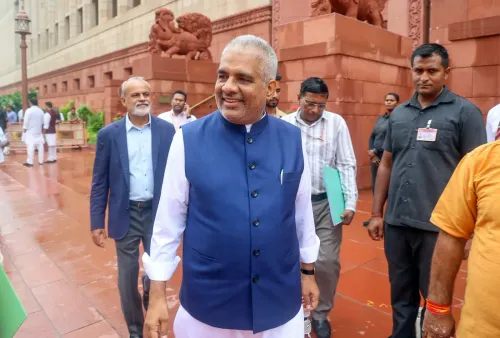
Union Minister for Environment, Forest and Climate Change Bhupender Yadav chaired the meeting alongside Heads of Delegations from all BRICS member countries. Under India's 2026 chairship, the environment track has prioritised actionable knowledge exchange over declaratory commitments — a deliberate shift in emphasis that officials say is designed to make BRICS environmental cooperation more tangible and implementable.
This is the 12th such ministerial-level environment meeting since the BRICS environment track was formalised, underscoring the bloc's long-running but often under-reported commitment to multilateral ecological cooperation.
Why This Matters Beyond the Bloc
BRICS nations collectively represent a substantial portion of the world's forests, arable land, and biodiversity hotspots, as well as some of its most wildfire-prone and drought-affected territories. The compendiums, by surfacing indigenous knowledge alongside technology-driven solutions, signal a recognition that no single model fits the ecological diversity of the bloc. Notably, the inclusion of countries such as Egypt, Ethiopia, and the UAE — newer BRICS members — in the sustainable lifestyles compendium reflects the expanded bloc's broader geographic and climatic range.
How member nations translate these knowledge products into domestic policy action will determine whether the exercise moves beyond documentation into measurable environmental outcomes.
Point of View
But the BRICS environment track has a credibility gap: previous ministerial meetings have produced declarations that rarely translate into verifiable domestic action. India's decision as chair to anchor this round in knowledge products rather than joint communiqués is tactically smart — it is harder to ignore a compendium with named case studies than a broadly worded pledge. The real test, however, is uptake. With wildfire seasons intensifying across South Africa, Brazil, and parts of India simultaneously, the integrated wildfire compendium in particular carries genuine operational value — if governments actually use it. The inclusion of newer members Egypt, Ethiopia, and the UAE also signals that the expanded BRICS is beginning to shape, not just sign, the bloc's environmental agenda.
NationPress
2 Oct 2026
Frequently Asked Questions
What are the four BRICS knowledge compendiums released in August 2026?
The four compendiums cover sustainable lifestyles, integrated wildfire management, landscape-based greening approaches, and circular economy practices. They were released at the 12th BRICS Environment Ministers' Meeting in New Delhi on 18 August 2026 under India's BRICS 2026 Chairship.
Which countries contributed to the BRICS sustainable lifestyles compendium?
The sustainable lifestyles compendium draws case studies from Brazil, China, Egypt, Ethiopia, India, Indonesia, South Africa, and the UAE. India's contributions include Mission LiFE, the Environment Education Programme, and the SAMBHAV Campaign.
Why is the BRICS wildfire management compendium significant?
Changing climate conditions, prolonged droughts, and rising temperatures are increasing the frequency and intensity of wildfires across BRICS nations, threatening ecosystems, biodiversity, and communities. The compendium consolidates approaches from community-led prevention and indigenous knowledge to early warning systems and coordinated cross-border response.
Who chaired the 12th BRICS Environment Ministers' Meeting?
Union Minister for Environment, Forest and Climate Change Bhupender Yadav chaired the meeting, alongside Heads of Delegations from all BRICS member countries, under India's BRICS 2026 Chairship.
What is the significance of India holding the BRICS 2026 Chairship for environmental cooperation?
India's chairship has prioritised actionable knowledge exchange over declaratory commitments, resulting in four concrete compendiums rather than broad joint declarations. Officials say the approach is designed to make BRICS environmental cooperation more tangible and implementable across member nations.