India-UK talks: Space, civil nuclear energy and emerging tech on agenda
Synopsis
India and the UK are moving beyond trade headlines into the harder business of science and technology cooperation — with small modular reactors, 800-plus space-tech startups, the SHANTI Act's nuclear reforms, and a shared AI-and-quantum agenda all on the table in a single bilateral sitting. If the institutional linkages take hold, this could be one of the most substantive India-UK tech engagements since the 2030 Roadmap.
Key Takeaways
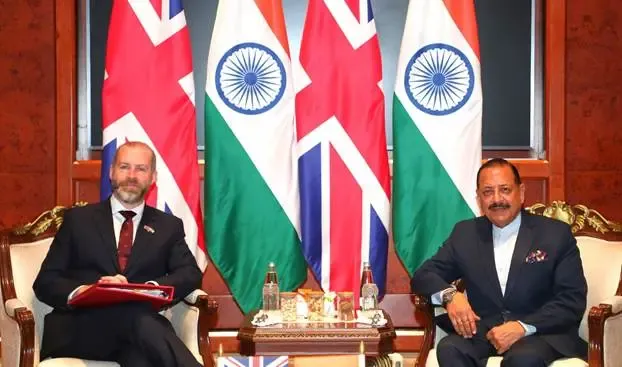
Dr Jitendra Singh and UK Secretary of State Jonathan Reynolds held bilateral talks in New Delhi on 12 October 2026 .
Cooperation discussed across space , civil nuclear energy , AI , quantum technologies , and cybersecurity .
India proposed connecting its 800-plus space-tech startups with British counterparts for commercial and innovation opportunities.
Nuclear discussions centred on small modular reactors (SMRs) and the SHANTI Act, 2025 , India's framework for widening private-sector participation in nuclear energy.
Nuclear medicine and healthcare identified as an additional area for India-UK life-sciences engagement.
Reynolds welcomed regular institutional interaction and commercial cooperation between the two sides.
Union Minister of State Dr Jitendra Singh on Monday, 12 October 2026, held bilateral talks with UK Secretary of State for Business, Innovation, Science and Trade Jonathan Reynolds in New Delhi, exploring avenues to deepen cooperation across space, civil nuclear energy, scientific research, and emerging technologies. The discussions signal a fresh push to translate the India-UK strategic partnership into concrete industrial and research outcomes.
Who Was at the Table
The Indian delegation, led by Dr Jitendra Singh, included Prof. Umesh Waghmare, Secretary of the Department of Science and Technology (DST), and Dr Praveenkumar Somasundaram, Adviser and Head of International Bilateral Cooperation at DST. The UK side comprised Jonathan Reynolds, British High Commissioner to India Lindy Cameron, and Interim Permanent Secretary of the Department for Business, Innovation, Science and Trade Amanda Brooks, according to the Ministry of Science and Technology.
Space Sector: Startups and Research Partnerships
Dr Singh highlighted that India's space-sector reforms have opened new opportunities for private industry and startups, freeing research institutions to concentrate on advanced work. He proposed stronger connectivity between Indian and British startups to drive innovation and commercial growth, noting that India now hosts around 800 space-tech startups. Both sides discussed collaboration in space science, satellite development, and greater engagement between scientific institutions and technology enterprises.
Civil Nuclear Energy and the SHANTI Act
On civil nuclear energy, Singh outlined India's nuclear-sector reforms, specifically referencing the SHANTI Act, 2025, which is designed to widen participation in the sector — drawing on the template of earlier space-sector liberalisation. The two delegations explored cooperation in small modular reactors (SMRs), advanced nuclear technologies, and associated industrial capabilities, amid growing demand from the energy and data-centre sectors. Singh also highlighted the broader applications of India's nuclear programme — particularly in nuclear medicine and healthcare — as a potential avenue for engagement with British expertise in life sciences.
Emerging Technologies: AI, Quantum and Cybersecurity
Discussions also covered artificial intelligence (AI), quantum technologies, cyber-physical systems, and cybersecurity. Reynolds welcomed closer engagement and emphasised the scope for regular institutional interaction and commercial cooperation between the two countries.
Why This Meeting Matters
This comes amid a broader recalibration of India-UK ties following the conclusion of long-running free trade agreement negotiations. Technology and clean energy have emerged as the two pillars most likely to yield near-term deliverables. Notably, SMR cooperation aligns with both nations' net-zero commitments, while the AI and quantum agenda reflects the global race to secure supply chains and talent in critical technologies. Reynolds' receptiveness to regular institutional engagement suggests the dialogue is intended to be structural, not ceremonial — a meaningful step beyond the headline announcements that have previously characterised bilateral science meetings.
Point of View
Not just a domestic reform. But the Act is less than a year old, and the regulatory architecture is still being built; British firms considering SMR partnerships will need more than a ministerial handshake before committing capital. The real test of this engagement will be whether the 'regular institutional interaction' that Reynolds endorsed translates into funded joint research programmes and startup exchange mechanisms — or whether it follows the familiar pattern of bilateral science meetings that generate communiqués without consequence.
NationPress
12 Oct 2026
Frequently Asked Questions
What did India and the UK discuss in their bilateral talks on 12 October 2026?
The two sides discussed cooperation in space science, civil nuclear energy, artificial intelligence, quantum technologies, cyber-physical systems, and cybersecurity. Key topics included small modular reactors, India's SHANTI Act nuclear reforms, space-tech startup linkages, and nuclear medicine applications.
What is the SHANTI Act, 2025, and why was it raised in the talks?
The SHANTI Act, 2025 is India's legislative framework to widen private-sector participation in the nuclear energy sector, modelled on earlier space-sector liberalisation. Dr Singh cited it to signal to the UK that India is creating avenues for broader industrial engagement in nuclear energy, including potential collaboration on small modular reactors.
How many space-tech startups does India have, and what was proposed for them?
India currently has around 800 space-tech startups, according to Dr Jitendra Singh. He proposed creating stronger connectivity between Indian and British startups to facilitate innovation and expand commercial opportunities in the space sector.
What role did British High Commissioner Lindy Cameron play in the talks?
British High Commissioner to India Lindy Cameron was part of the UK delegation, alongside Secretary of State Jonathan Reynolds and Interim Permanent Secretary Amanda Brooks. Her presence underlines the diplomatic weight the UK attaches to deepening the bilateral science and technology relationship.
What are small modular reactors (SMRs), and why do they matter to India-UK cooperation?
Small modular reactors are compact, factory-built nuclear reactors seen as a faster and more flexible alternative to large conventional nuclear plants. Both India and the UK are investing in SMR development, and growing demand from energy and data-centre sectors makes them a natural area for joint industrial and research cooperation.