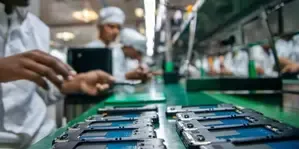
India's electronics output up sixfold in a decade, exports hit ₹3.3 lakh crore

Synopsis
India's electronics sector has pulled off a remarkable decade-long run — output up sixfold, exports up eightfold, and smartphones now flowing into the US faster than China's. But the Infomerics report lands a sharp caveat: most of what India assembles, it still imports in parts. The real test of the $500 billion target is whether India can move from screwdriver manufacturing to genuine deep-tech production.
Key Takeaways
India's electronics output grew from ₹1.9 lakh crore in FY15 to ₹11.3 lakh crore in FY25 — a nearly sixfold rise.
Electronics exports climbed eightfold to approximately ₹3.3 lakh crore over the same period.
Mobile phone manufacturing expanded 28 times ; mobile exports surged 127 times , with over 99% of domestic demand met locally.
India overtook China as the largest smartphone supplier to the US in Q2 FY26 .
The India Semiconductor Mission has secured over ₹1.60 lakh crore in approved investments; new units approved in Odisha , Punjab , and Andhra Pradesh .
India targets $500 billion in electronics production and $180–200 billion in exports by 2030–31 , contingent on deeper localisation and R&D.
India's electronics manufacturing output surged nearly sixfold — from ₹1.9 lakh crore in FY15 to ₹11.3 lakh crore in FY25 — while exports climbed eightfold to approximately ₹3.3 lakh crore, according to a report released on Wednesday, 15 July by Infomerics Valuation and Ratings Limited. The decade-long expansion has been powered by policy frameworks including the Production-Linked Incentive (PLI) Scheme and the Make in India programme.
The Value-Addition Gap
Despite the headline growth, the report cautions that value capture remains limited. Components and sub-assemblies continue to be largely imported, constraining domestic value addition and leaving India's electronics ecosystem more assembly-dependent than manufacturing-deep. The next phase of growth, the report argues, hinges on deeper localisation — one that can reduce import dependence and sharpen export competitiveness simultaneously.
Mobile Phones: The Standout Success
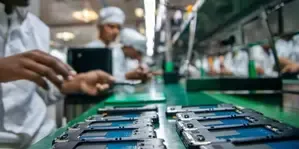
Mobile phone manufacturing has been the sector's most dramatic performer, expanding 28 times since FY15. Mobile exports have grown an extraordinary 127 times over the same period, with more than 99 per cent of domestic demand now met through local production. Reflecting this shift, India became the largest supplier of smartphones to the United States in Q2 FY26, overtaking China — a milestone that underscores India's accelerating role in global supply chain diversification, often framed as the China+1 strategy.
Semiconductor Push and New Approvals
The report highlighted recent policy momentum on semiconductors, including the approval of fabrication units in Odisha, Punjab, and Andhra Pradesh, drawing ₹4,600 crore in investment and generating 2,000 jobs. The India Semiconductor Mission has secured over ₹1.60 lakh crore in approved investments spanning fabrication, packaging, testing, and chip design. India already accounts for nearly 20 per cent of the world's semiconductor design workforce, according to Dr. Manoranjan Sharma, Chief Economist at Infomerics Valuation and Ratings Ltd., who described the country as 'a global semiconductor design hub.'
Government initiatives also aim to develop 50 fabless semiconductor companies while expanding the talent pipeline through specialised training programmes and industry partnerships, Sharma noted.
The 2030 Ambition and What It Will Take
India has set an ambitious target of $500 billion in electronics production by 2030–31 and $180–200 billion in electronics exports by 2031. The Infomerics report warns that reaching these milestones will require 'deeper component manufacturing, stronger R&D, improved logistics, skilled talent and sustained policy support.' This comes amid a broader global realignment in electronics supply chains, where India is well-positioned — but not yet structurally ready — to capture a larger share of high-value manufacturing.
Point of View
But the Infomerics report's value-addition caveat is the more important number. India has become a world-class assembler; it has not yet become a world-class manufacturer. The smartphone export story — overtaking China for US supply in Q2 FY26 — is genuinely historic, but it rests on imported components. Until India builds a credible domestic component ecosystem, the $500 billion target is a ceiling defined by someone else's supply chain. The semiconductor approvals in Odisha, Punjab, and Andhra Pradesh are a start, but ₹4,600 crore across three states is a fraction of what Taiwan or South Korea spent at comparable stages. Sustained policy continuity, not just headline targets, will determine whether this decade's assembly boom translates into the next decade's deep manufacturing story.
NationPress
14 Oct 2026
Frequently Asked Questions
By how much has India's electronics manufacturing output grown in the last decade?
India's electronics manufacturing output grew nearly sixfold, rising from ₹1.9 lakh crore in FY15 to ₹11.3 lakh crore in FY25, according to the Infomerics Valuation and Ratings Limited report released on 15 July. Exports over the same period climbed eightfold to approximately ₹3.3 lakh crore.
Which government schemes drove India's electronics growth?
The Production-Linked Incentive (PLI) Scheme and the Make in India programme are cited as the primary policy drivers of the expansion. The India Semiconductor Mission has also secured over ₹1.60 lakh crore in approved investments across fabrication, packaging, testing, and chip design.
Why did India overtake China in smartphone exports to the US?
India became the largest supplier of smartphones to the United States in Q2 FY26, overtaking China, driven by the global China+1 supply chain diversification trend and the rapid scaling of domestic mobile manufacturing — which has expanded 28 times since FY15. Over 99 per cent of India's domestic smartphone demand is now met by local production.
What is India's electronics production target for 2030?
India aims to achieve $500 billion in electronics production by 2030–31 and $180–200 billion in electronics exports by 2031. The Infomerics report warns these goals will require deeper component manufacturing, stronger R&D, improved logistics, skilled talent, and sustained policy support.
What is the main challenge holding back India's electronics sector?
Despite the surge in output, domestic value addition remains limited because components and sub-assemblies are largely imported. The Infomerics report identifies deeper localisation — building a robust domestic component ecosystem — as the critical next step to reduce import dependence and improve export competitiveness.