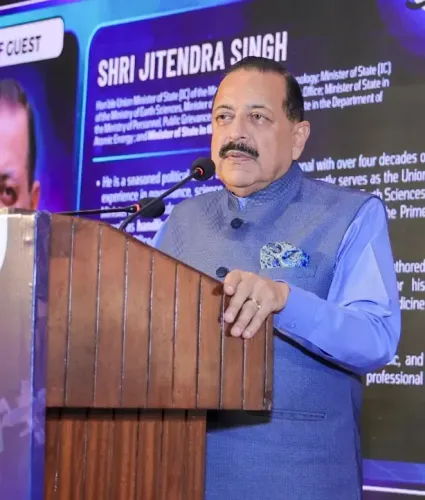
India's space economy to hit $40-45 billion in 7-8 years: Jitendra Singh
Synopsis
India's space economy is on course for a five-fold expansion — from $9 billion today to $40–45 billion within a decade — but only if regulatory speed, investment flows and demand creation keep pace with the technical ambition. Minister Jitendra Singh's Bloomberg Forum remarks signal that the government knows the next battle is commercial, not just scientific.
Key Takeaways
Dr Jitendra Singh projected India's space economy growing from $9 billion to $40–45 billion in the next 7–8 years .
The sector was opened to private participation in 2019–20 under PM Narendra Modi , yielding results within five to six years .
Faster regulatory approvals, GST reforms for space products, and lower business costs are among the key demands flagged.
The minister stressed the need for anchor government customers to help private firms move from proof-of-concept to commercial deployment.
International investment and partnerships are being encouraged, with a stated emphasis on protecting strategic autonomy .
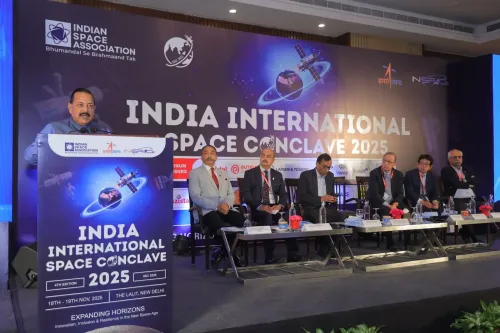
India's space economy, currently valued at around $9 billion, is projected to expand to $40–45 billion within the next seven to eight years, Union Minister of State Dr Jitendra Singh said on Saturday, 17 October 2026. Speaking at a media roundtable organised by the Bloomberg New Economy Forum in New Delhi, the minister said the country must move beyond demonstrating technological capabilities to building globally competitive commercial space enterprises.
From Capability to Commerce
Singh stressed that the sector's next phase demands a decisive shift from proving technical prowess to building sustainable, internationally viable businesses. He said anchor government customers and support for proof-of-concept projects could help private space firms demonstrate their technologies and move toward commercial deployment at scale.
The minister traced the sector's momentum to the opening of the space industry to private participation in 2019–20 under Prime Minister Narendra Modi, noting that significant results had followed within five to six years. The priority now, he said, was to translate those capabilities into commercially competitive ventures.
Investment, Regulation and Demand
Singh identified four pillars critical to scaling Indian space enterprises: greater domestic and international investment, predictable demand, faster regulatory approvals, and sustainable business models. He called on authorities to ensure that companies seeking installation or export licences receive approvals within defined timeframes.
Reforms including GST-related measures for space products, he said, must translate into tangible benefits for industry — not remain on paper. He also highlighted the need for lower business costs and stronger supply-chain integration to make Indian players competitive in global markets.
Opening Up Without Compromising Strategic Autonomy
On international cooperation and capital flows, Singh said India was actively opening up opportunities for foreign investment and partnerships while continuing to build indigenous capabilities. He described the balance as essential — greater investment could support technology development, manufacturing, and access to global markets, while domestic capabilities remained important for national security and strategic autonomy.
The minister called for deeper collaboration between government institutions and private enterprises in India, complemented by international partnerships that could help Indian companies integrate into global supply chains and expand their customer base without compromising national interests.
What This Means for India's Space Sector
India currently holds roughly 2–3% of the global space economy, according to industry estimates. The five-fold growth target would represent a significant reordering of that share over the coming decade. With over 150 private space startups now operating in the country following sector liberalisation, the policy environment — and the speed of regulatory response — will be a key variable. The next step, as Singh indicated, lies in turning ambition into commercial momentum.
Point of View
But the regulatory bottlenecks and GST anomalies the minister himself flagged suggest the system has yet to catch up with the ambition. Global space commerce is accelerating fast, with SpaceX and a clutch of US and European players already entrenched in launch and satellite services. If India's approval timelines and supply-chain depth do not improve materially, the five-fold growth target risks becoming another impressive headline that outruns structural reality.
NationPress
17 Oct 2026
Frequently Asked Questions
What is India's space economy target for the next 7–8 years?
India aims to grow its space economy from its current value of around $9 billion to $40–45 billion over the next seven to eight years, according to Union Minister of State Dr Jitendra Singh. He made these remarks at a Bloomberg New Economy Forum roundtable in New Delhi on 17 October 2026.
When was India's space sector opened to private participation?
India opened its space sector to private participation in 2019–20 under Prime Minister Narendra Modi. According to Dr Jitendra Singh, the move has already yielded significant results within five to six years.
What reforms does the government say are needed to grow India's space industry?
Dr Jitendra Singh identified faster regulatory approvals, lower business costs, GST-related reforms for space products, stronger supply-chain integration, and greater domestic and international investment as critical requirements. He also stressed the need for predictable demand through anchor government customers.
How does India balance foreign investment with strategic autonomy in space?
The minister said India is actively opening up to foreign capital and international partnerships while simultaneously building indigenous capabilities. He argued the two goals are complementary — global investment supports technology and market access, while domestic capability safeguards national security and strategic autonomy.
Why does generating demand matter for India's private space sector?
Without reliable customers, private space companies struggle to move from demonstration to commercial viability. Singh said anchor government procurement and support for proof-of-concept projects are essential to bridge that gap and help firms compete in international markets.